


Radio-Controlled Alarm Clocks for the Bedroom: What to Look for When Buying

An alarm clock intended for use in the bedroom must do more than just ring on time: it should remain silent when not needed, be readable in the dark, and display the time accurately at all times. Anyone looking to find their bearings in this category will quickly come across terms like DCF77, ticking noise, or brightness control, without these always being explained.
This article answers the most important questions about buying a radio-controlled alarm clock for the bedroom: how the time signal works, what makes a quiet movement, which display types are actually practical at night, and which additional functions make everyday life easier. The following sections compare technical features based on product data, not test experiences.
How a radio-controlled alarm clock receives the time: DCF77 signal and range in Germany
The term "radio" in a radio-controlled alarm clock does not refer to Bluetooth or Wi-Fi, but to the reception of a longwave time signal. In Germany and large parts of Europe, this signal is known as DCF77. It is broadcast by the Physikalisch-Technische Bundesanstalt in Braunschweig from a transmitter near Mainflingen near Frankfurt and carries the exact legal time.
The transmitter operates at 77.5 kHz and reaches a radius of approximately 1,500 kilometers under good reception conditions. This means that within Germany, Austria, Switzerland, and large parts of Western Europe, radio-controlled alarm clocks generally receive the signal reliably. The alarm clock automatically synchronizes its internal quartz clock daily, usually in the early morning hours. As a result, it is permanently accurate to the second and adjusts itself automatically during daylight saving time changes.
How good the reception is in a specific room depends on several factors, which are covered in the next section. For the purchasing decision, the following applies first: a radio-controlled alarm clock does not need a battery to set the time, but it is also not a device that works in every room without any shielding.
Volume and noise level: ticking, alarm, and display illumination in the bedroom
The ticking noise is the decisive dealbreaker for many bedroom users. Classic analog alarm clocks with a mechanical escapement produce an audible tick-tock because the second wheel jumps in individual steps. Digital radio-controlled alarm clocks and modern analog alarm clocks with a so-called sweep movement—meaning a continuously running second hand without detents—are, on the other hand, virtually silent.
Quiet movements
Digital radio-controlled alarm clocks generally do not have a mechanical movement that generates audible noise. The quartz movement controls the display directly, without hands that need to click into place. This makes them the first choice for bedrooms where even very quiet noises are disruptive. Analog alarm clocks with a sweep mechanism are an alternative if a dial with hands is desired, but they are less common in the product range than digital models.
Alarm tone and snooze function
The alarm tone itself is usually electronic in radio-controlled alarm clocks and can therefore be controlled much louder than in alarm clocks with a bell. Many models offer step-by-step or continuous volume control. Also relevant for the bedroom is the snooze function: a snooze interval that is too short (less than five minutes) or too long (more than ten minutes) can disrupt the sleep cycle.Quiet alarm clocks without ticking noise are now available in almost every price range.
Display illumination as a sleep disruptor
An aspect that is often overlooked when buying: a permanently lit display can impair sleep if it is set too bright. Alarm clocks with automatic brightness control or manually switchable backlighting therefore have a clear advantage for the bedroom.

Identifying and resolving reception problems: wall thickness, electrosmog, and placement
A radio-controlled alarm clock that does not display the correct time or permanently remains on its internal quartz time has a reception problem. The DCF77 signal is a longwave signal and is dampened or disrupted by various factors.
| Source of interference | Effect on the DCF77 signal | Countermeasure |
|---|---|---|
| Reinforced concrete walls | Significant attenuation, reception often limited | Place the alarm clock near a window or close to an outer wall |
| Electrical devices (PC, TV) | Electromagnetic interference, especially at night | Keep a distance of at least 1-2 meters from devices |
| Metal frames or cabinets | Shielding of the antenna | Do not place the alarm clock inside closed furniture |
| Basements or interior rooms without an outer wall | Strong signal attenuation | Prefer placement in a room with an outer wall |
The synchronization process takes place at night on most devices because the DCF77 signal is less disrupted during the night hours. Anyone who notices a discrepancy in the time display in the morning should first check the location of the alarm clock before assuming a defect. The orientation of the alarm clock also plays a role: the internal ferrite antenna receives best when it is aligned perpendicular to the direction of the transmitter (Frankfurt), i.e., in a North-South orientation in large parts of Germany.
Anyone living in an area with notoriously poor DCF77 reception will find in the article Always on time: radio-controlled alarm clocks for daylight saving time changes further information on signal testing and how to handle reception problems.
Display types and readability: LED, LCD, and analog dials in the dark
The choice of display type is closely linked to usage habits. In the bedroom, one question arises above all: how easy is it to read the time in different lighting situations without disturbing other people?
| Display type | Readability in the dark | Power consumption | Special features |
|---|---|---|---|
| LED display (red/green/blue) | Very good, even from a distance | Medium to high | Can dazzle with permanent illumination; dimmer is important |
| LCD with backlighting | Good, when backlighting is activated | Low | Hardly readable in the dark without backlighting |
| Analog dials with luminous hands | Passable (luminous material fades after hours) | No self-illumination required | No pixel display; natural reading; no glare |
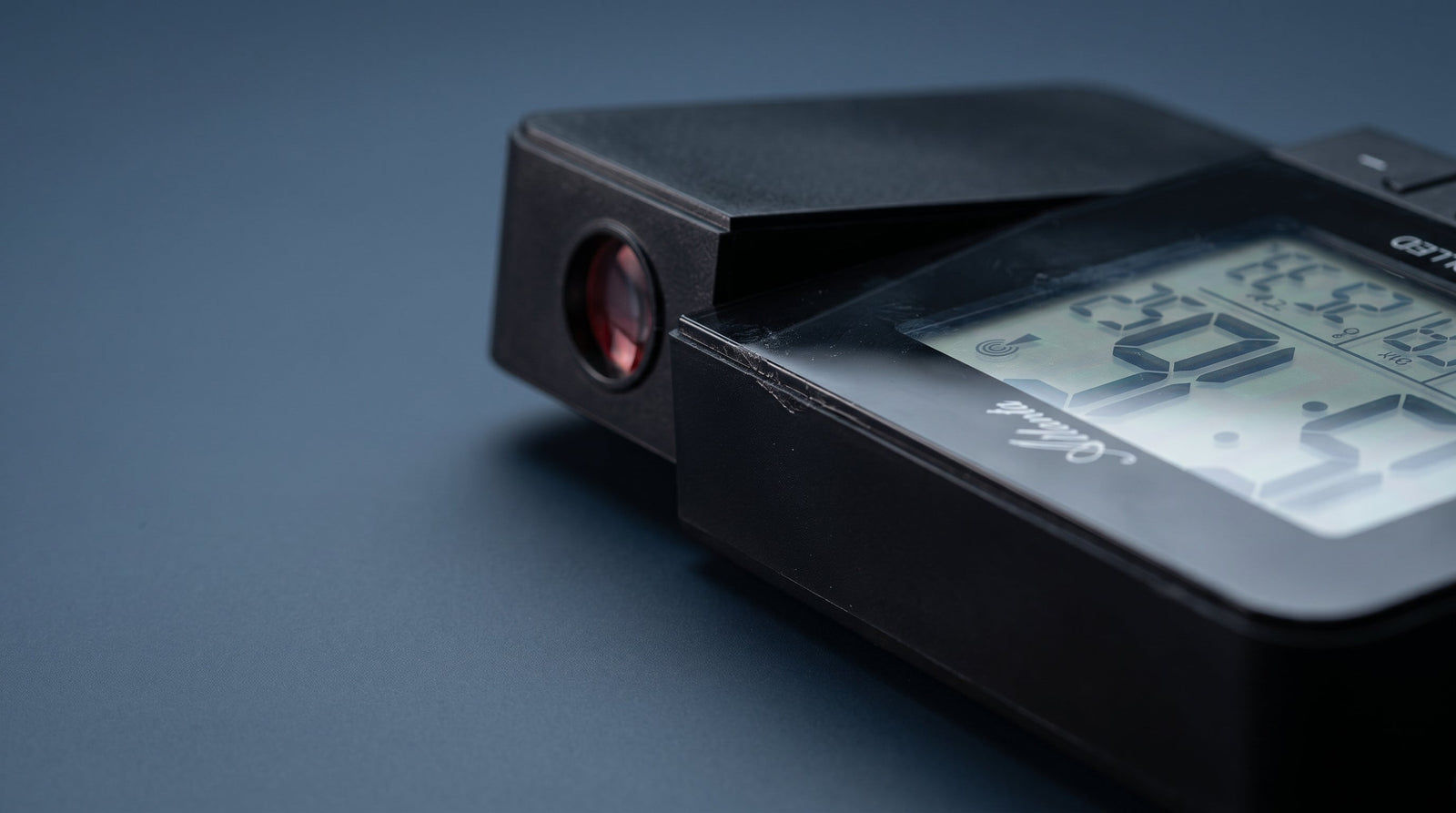
| Projection on ceiling/wall | Very good, readable without looking directly | Medium | Requires a dark room for clear projection |
Projection alarm clocks are a category of their own: they project the time onto the ceiling or wall, so the time can be read without lifting your head. However, this requires the room to be dark enough for the projection to remain visible.

Additional functions: temperature display, snooze, brightness control, and multiple alarms
Modern radio-controlled alarm clocks for the bedroom offer a range of functions that go beyond just waking you up. Which of these are actually useful depends on your own habits.
Temperature display
A built-in temperature sensor displays the room temperature. This is practical in the bedroom because sleep quality depends heavily on the temperature. Temperatures between 16 and 18 degrees Celsius are recommended for sleeping. An alarm clock with a temperature display makes this value visible directly on the bedside table without an additional device.
Snooze and alarm repeat
The snooze function delays the alarm by a fixed period of time. Five to ten minutes are common. Some devices allow multiple alarm times, which is helpful for people with different wake-up times in the same household. Anyone who frequently uses the snooze button benefits from alarm clocks where the snooze time is configurable.
Brightness control
Automatic brightness controls adjust the display brightness to the ambient light: brighter during the day, dimmed at night. Manually adjustable levels are a simpler alternative. Both variants are clearly preferable to a permanently bright display.
Multiple alarm times
Models with two or three independent alarm times are useful for households with different wake-up schedules. The product range includes devices that store up to three separate alarm times. Switching is usually done via a button on the back of the case.

Price ranges and what they deliver: entry-level to upper mid-range
Radio-controlled alarm clocks for the bedroom are available in a wide price range. The differences between the ranges relate less to the basic function than to the material quality, display size, and the scope of additional functions.
| Price range | Typical features | Limitations |
|---|---|---|
| Under 40 euros | DCF77 reception, digital display, snooze, simple illumination | Plastic case, few brightness levels, no or simple temperature display |
| 40 to 80 euros | Quiet movement, multiple alarm times, temperature display, automatic brightness control | Case quality varies; projection sometimes with less sharpness |
| Over 80 euros | Large displays, precise projection, USB charging ports, higher-quality materials | Rarely significantly more accurate than cheaper DCF77 models; added value lies in design and comfort |
In the entry-level range under 40 euros, models from the Atlanta brand already deliver the essentials: DCF77 reception, automatic time synchronization, and simple illumination. Anyone wanting more comfort, a temperature display, and automatic brightness control will find a wider selection in the mid-price range. An overview of different alarm clock types is also provided in the article Alarm clocks compared: analog, radio-controlled, and smart alarm clocks.
In the upper mid-range, you will find models with larger displays, sharper projections, and additional ports for charging smartphones. The time accuracy itself does not differ: all DCF77 devices synchronize to the same atomic clock reference. Alarm clocks in beautiful design also play a larger role visually in this price range.
Checklist before buying
- Is the movement quiet or tick-free? (Digital models: yes; check analog alarm clocks explicitly for a sweep mechanism)
- Does the display have a brightness control or a manual dimmer?
- How many alarm times can be saved?
- Is a temperature display available, if desired?
- Is the planned installation location close to an outer wall to favor DCF77 reception?
- Is a projection needed, and is the room dark enough for it at night?
- Should the alarm clock be operated by battery or power cord?


