


Classifying Seiko Watches: Model Series, Movements, and Price Ranges

Anyone starting to research Seiko will quickly encounter a broad field: model names like Prospex, Presage, and Seiko 5 Sports stand side-by-side, caliber designations like 4R34, 6R35, or NH35 appear, and the price range spans from the lower three-digit range to four-digit regions. Without a structured overview, it is difficult to decide which line fits your own requirements.
This article organizes the Seiko product range by model lines, explains the caliber designations, identifies the differences in glass, and provides guidance on which line makes sense for which needs. The basis is technical product data, not a wear test.
Why Seiko's product breadth requires orientation
Seiko is one of the few watch brands that covers almost all production stages in-house: movements, cases, glass, and dials are largely manufactured by the company itself. This has historical reasons, but it also creates a product range that is broader than that of most competitors in the same price segment.
The most important pillars for the European market are Seiko 5 Sports, Prospex, and Presage. In addition, there is the Conceptual line (quartz watches with special functions like chronographs), the Classic line, and, in the premium sector, Grand Seiko as a legally independent brand. Those who do not distinguish between these pillars are comparing watches built for completely different requirements.
Seiko 5 Sports: Automatic in the entry-level price band
For decades, the Seiko 5 Sports has been the brand's best-known entry-level offering in the automatic sector. The concept combines mechanical self-winding with a robust case and a price that lies in the lower to mid-three-digit range.
Currently, Seiko uses the NH35 caliber (simple automatic with date display) and the 4R36 caliber (automatic with date and second-hand stop function) in the 5 Sports line. Newly added is the 4R34 caliber in the Seiko 5 Sports Field GMT models: It displays a second time zone via an additional GMT hand function, with which Seiko expands the entry-level line with a complication that was previously reserved for higher price classes.
The 5 Sports models are delivered with a stainless steel case and mineral glass. A screw-down crown and water resistance of 10 bar are standard. This is sufficient for everyday life and occasional swimming; this class is not designed for diving.
What the NH35 and 4R36 can do
The NH35 caliber runs with an accuracy of about -20 to +40 seconds per day, which is normal for a mechanical movement in this price class. The 4R36 is similar. Those who need precise time display are better served with a quartz watch. Those who appreciate the mechanical aspect and can live with the inaccuracy get a reliable movement with long-term spare parts availability. More on the question of what automatic means in everyday life is explained in this article about automatic watches for beginners.
| Caliber | Type | Special feature | Accuracy |
|---|---|---|---|
| NH35 | Automatic | Date | approx. -20 / +40 s/day |
| 4R36 | Automatic | Date, second-hand stop | approx. -20 / +40 s/day |
| 4R34 | Automatic | GMT (second time zone) | approx. -20 / +40 s/day |
| 6R35 | Automatic | Date, 70-hour power reserve | approx. -10 / +15 s/day |
Prospex and Presage: Sport and Dress as separate worlds
Prospex and Presage serve two clearly separated requirements. Prospex stands for sport and outdoor, Presage for craft-oriented dress watches.
Prospex: Diving, flying, expeditions
Under the Prospex label, Seiko groups all watches built for demanding environments. The range extends from diving watches with 20 bar water resistance to chronographs with flyback function for the aviation sector. The entry-level models of the Prospex diving series (solar drive, mineral glass, Hardlex coating) are in the mid-three-digit range. The upscale variants with sapphire crystal and the 6R35 caliber or the high-precision 8L35 caliber move in the upper three-digit to lower four-digit range. The official Prospex model overview on seikowatches.com provides a complete look at the current line.
Presage: Enamel, Zaratsu, and craftsmanship
Presage is Seiko's answer to the question of how much Japanese craftsmanship is possible in a dress watch segment without moving into the Grand Seiko price field. Typical features: dials in enamel or mother-of-pearl, Zaratsu polishing of the case flanks (a polishing process that creates flat, mirror-smooth surfaces), and automatic movements of the 4R or 6R family. Presage models almost consistently come with sapphire crystal. The price starts in the upper three-digit range.
Seiko calibers at a glance: 4R, 6R, NH, and what's behind them
Seiko's caliber numbers follow an internal logic that can be deciphered. The first digit indicates the movement family, the second the specific construction.
| Caliber family | Manufacturer unit | Price segment | Typical line |
|---|---|---|---|
| NH35, NH36 | Seiko Instruments (SII) | Entry-level | Seiko 5 Sports, OEM |
| 4R34, 4R36, 4R57 | Seiko Instruments (SII) | Entry-level to mid-range | Seiko 5 Sports, Prospex |
| 6R15, 6R35 | Seiko Instruments (SII) | Mid-range | Presage, Prospex |
| 8L35, 8L55 | Seiko Epson | Upper mid-range | Prospex Diver |
| 8T63, 8T67 | Seiko Epson | Mid-range | Conceptual (quartz chrono) |
The NH35 is both the most widely used Seiko caliber in the entry-level sector and is also installed as an OEM movement in watches from other brands. The 6R family offers higher accuracy compared to the 4R/NH family (approx. -10 to +15 seconds per day instead of -20 to +40) and, in the 6R35 version, a power reserve of 70 hours. This means: A 6R35 watch lasts about three days with a full mainspring without being worn, an NH35 watch about 41 hours. Those who wear the movement regularly hardly notice the difference. Those who take the watch off often appreciate the longer power reserve.
The 8T63 caliber in the Conceptual line is a quartz movement with a stopwatch function (chronograph). Quartz here means: accuracy of typically ±15 seconds per month, no dependence on wearing habits, no manual winding required. A more detailed picture of the different movement types is provided by the movement lexicon with quartz, automatic, manual wind, and solar.

Price levels and glass types: Mineral glass versus sapphire in the range
The glass type is one of the clearest distinguishing features between Seiko lines. Seiko uses three glass types: mineral glass, Hardlex, and sapphire crystal.
| Glass type | Scratch resistance | Break resistance | Typical Seiko line |
|---|---|---|---|
| Mineral glass | medium | medium | Seiko 5 Sports (entry-level) |
| Hardlex | medium to good | better than mineral | Prospex entry-level, Seiko 5 Sports |
| Sapphire crystal | very high | more brittle than mineral | Presage, Prospex upscale models |
Hardlex is Seiko's own term for a hardened mineral glass. It is more scratch-resistant than normal mineral glass but significantly more susceptible to scratches than sapphire crystal. Sapphire crystal (corundum crystal, hardness grade 9 on the Mohs scale) is the more robust material against everyday scratches but breaks more easily than mineral glass upon point impact. Which glass makes more sense in everyday life depends on usage. A complete comparison with stress scenarios can be found in the article on sapphire crystal, mineral glass, and Hardlex.
As a rule of thumb: Those who work with their hands a lot and risk impacts are well served with Hardlex or hardened mineral glass. Those who fear scratches more than impacts should choose sapphire crystal.
Who is which Seiko line suitable for
The following overview organizes the lines by requirement and usage situation. It does not replace an individual decision but provides a direction.
- Seiko 5 Sports: First contact with mechanical watches, everyday watch with automatic, budget in the lower to mid-three-digit range. Mineral glass or Hardlex, 10 bar water resistance, solid movements without surprises.
- Seiko 5 Sports Field GMT (caliber 4R34): For those who need a second time zone but do not want to spend more than for a standard 5 Sports watch. Entry into the GMT complication without a surcharge compared to the base series.
- Prospex Solar / Diving watches: Active use, water sports, high water resistance (20 bar and more), low-maintenance drive via solar. Glass selection between Hardlex (entry-level) and sapphire crystal (upscale models).
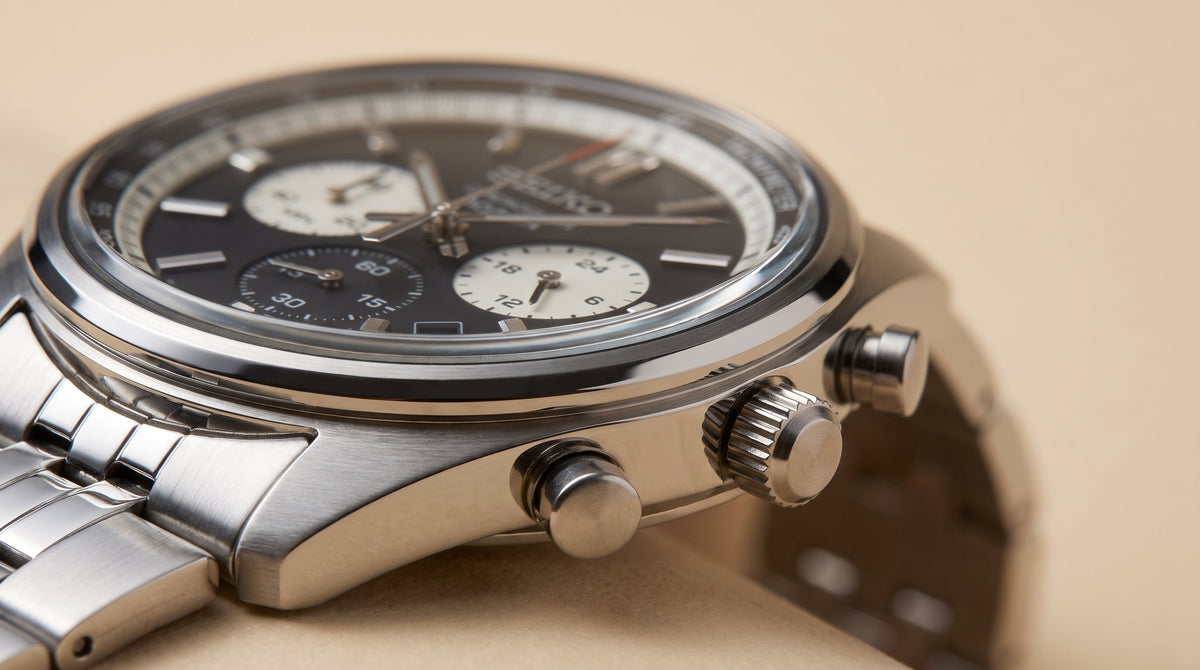
- Prospex Chronograph (Speedtimer line): Sporty-functional dress-sport hybrid watches with stopwatch function. Mostly automatic or quartz, sapphire crystal in the newer versions.
- Presage: Dress watch with artisanal dial, sapphire crystal, Zaratsu-polished case. Office, occasion, interest in Japanese craftsmanship. Less water resistance than Prospex, but more visual care.
- Seiko Conceptual (quartz chronograph): For those who want to combine stopwatch function with quartz precision. More affordable than automatic chronographs, easier to care for in everyday life.


