


Automatic Watches for Beginners: What Self-Winding Means in Everyday Life
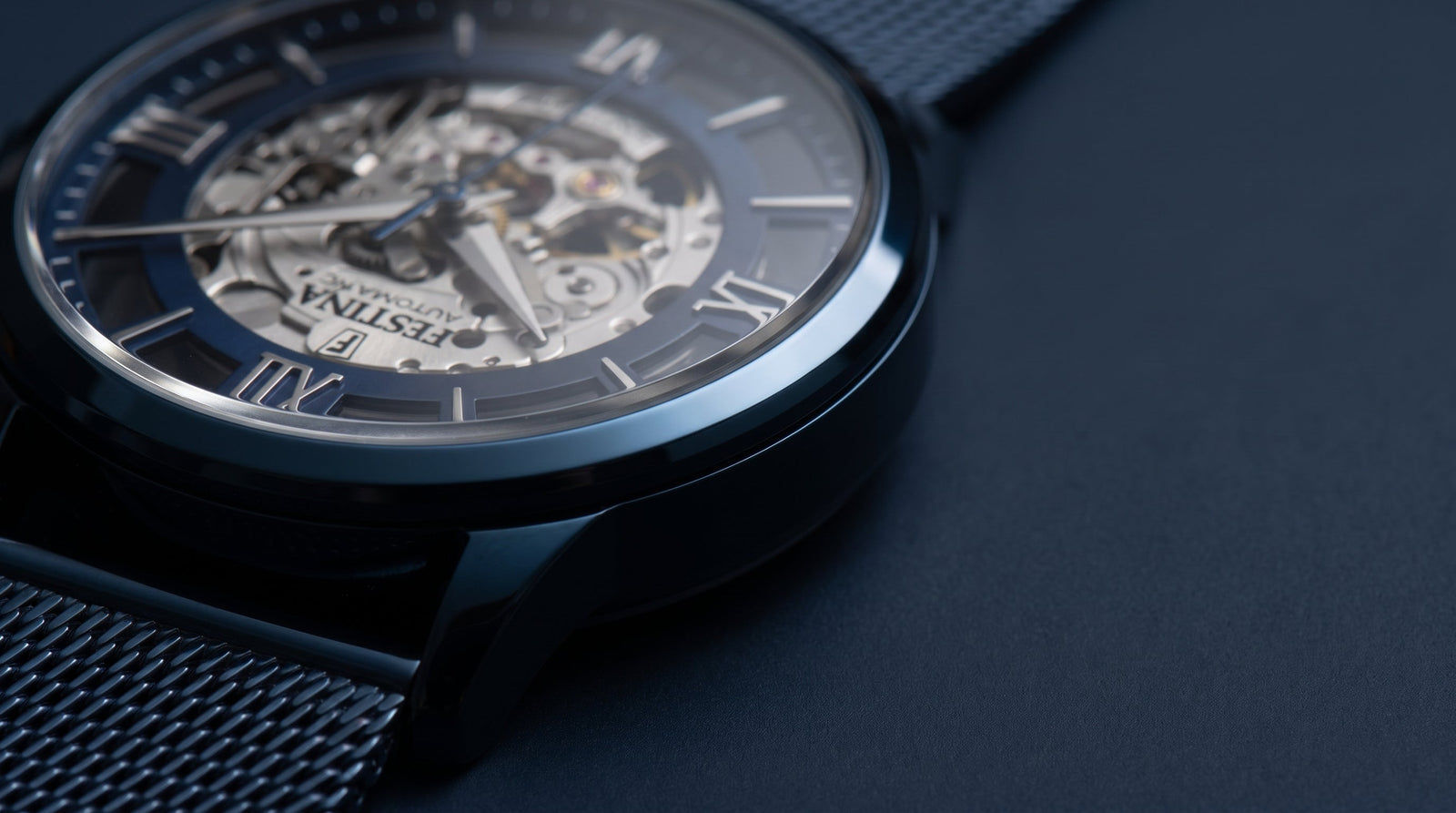

Anyone holding an automatic watch for the first time and hearing the rotor whir when tilting it slightly usually asks the same question: How long does it last if I don't wear it, and how accurate is it really? These questions are valid, as automatic watches behave differently in everyday life than the quartz watches most people grew up with. New models from Seiko and Citizen show that the market for entry-level automatic watches continues to grow in 2026 and the selection in the mid-price segment is better than ever.
This article compares technical specifications and explains what they mean in practice: how self-winding works, which calibers are used in the entry-level and mid-range segments, and when an automatic watch makes sense and when it doesn't. Those who would like to fundamentally think through the question of automatic vs. quartz afterwards will find a separate article on this: Automatic vs. Quartz vs. Smartwatch.
How an automatic movement stores energy: rotor, mainspring, power reserve
The principle of an automatic movement can be broken down into three components. The rotor is a semi-circular heavy metal weight that can rotate freely within the movement. It turns with every arm movement, and this rotational movement is transmitted via a gear train to the mainspring: a coiled steel spring that stores energy like a spring in a mechanical toy. The watch movement draws its drive from this stored energy, releases it in a controlled manner via the escapement wheel, and thus powers the hands.
The power reserve indicates how long a fully wound watch will continue to run without being worn further. Typical values in the entry-level segment are between 38 and 42 hours. This means: if you take the watch off in the evening and put it back on the morning after next, you risk it having stopped. This is not a defect, but a physical limit. Some models offer 70 or more hours of power reserve, which makes the issue much less of a concern, but often means a higher price. The Zeppelin Atlantic 8462-3, for example, even displays its power reserve on the dial, which is a real guide for beginners.

Accuracy in everyday life: What +/- 10 seconds per day means in practice
An automatic watch is not as accurate as a quartz watch. This is not a design flaw, but a characteristic of mechanical escapements. Most uncertified automatic movements in the entry-level segment run in the range of plus 10 to plus 30 seconds per day, some also slightly into the minus. Over a week, this adds up to several minutes of deviation.
What does this mean in practice? Anyone who coordinates appointments to the second will notice the deviation and will have to set the watch regularly. On the other hand, anyone who wears a watch to tell the time and as an everyday companion will get through a week without any problems without having to intervene. A chronometer, i.e., a watch with a COSC certificate, is only allowed to deviate by -4 to +6 seconds per day, but costs correspondingly more. The chronometer certificate rarely appears in the entry-level range.
Typical calibers in the entry-level and mid-range segments
The market for entry-level automatic watches is dominated by three movement families. A look at their core data helps with classification.
| Movement / Movement family | Manufacturer | Typical oscillation frequency | Power reserve | Special feature |
|---|---|---|---|---|
| Miyota 82xx (e.g., 8215, 8217) | Citizen Group (Japan) | 21,600 vph | approx. 42 hours | Widely used, robust, inexpensive to service |
| Miyota 9015 | Citizen Group (Japan) | 28,800 vph | approx. 42 hours | Higher precision, frequently found in the mid-range |
| Seiko NH35 / NH36 | Seiko (Japan) | 21,600 vph | approx. 41 hours | Hacking movement (NH36 with date and day), very common |
| ETA 2824-2 / Sellita SW200 | ETA (Switzerland) / Sellita (Switzerland) | 28,800 vph | approx. 38-42 hours | Swiss base, frequently found in mid-range models |
The Miyota 82xx series is the most frequently installed entry-level automatic movement worldwide. The Festina F20574/1 relies on the Miyota 82 series automatic movement, a solid and widely used caliber characterized by simple maintenance and a broad supply of spare parts. The Seiko NH35/NH36 can be found in the Seiko 5 line and, as the NH36 variant, also features a day display in addition to the date. Those who prefer a Swiss movement will find models with ETA derivatives or the structurally similar Sellita SW200, albeit at higher prices.

Sapphire crystal or mineral crystal: a side issue that counts
Regardless of the movement, it is worth looking at the crystal. Sapphire crystal is significantly more scratch-resistant than mineral crystal. In the entry-level segment, mineral crystal is the rule; sapphire crystal appears from about 200 euros upwards. The Boccia Titanium 3653-03 combines a lightweight titanium case with sapphire crystal, which is unusual for a watch in this price range.

Wearing, winding, or stopping: three scenarios for everyday life
How you handle an automatic watch depends on how often you wear it. Three typical everyday situations and what they mean:
| Scenario | Consequence | Recommendation |
|---|---|---|
| Worn daily, at least 8 hours | Mainspring remains almost fully wound | No action necessary, watch keeps running |
| Alternating wear (multiple watches) | Power reserve runs out, watch stops | Watch winder or manually wind before putting on |
| Longer break (vacation, storage) | Watch stops after 38-42 hours | Set date/time before putting back on, manually wind briefly if necessary |
A watch winder rotates the watch mechanically and thus keeps the mainspring tensioned. It is useful if you own several automatic watches and do not want to switch between them daily. For a single everyday watch, it is not a necessary accessory. Important: You can usually also wind the mainspring of an automatic watch manually via the crown. This does not damage the movement, but is a built-in function.
Automatic vs. Quartz vs. Solar: Who benefits from self-winding
The question is not which drive principle is better, but which one suits which user. Solar watches for men work on a fundamentally different principle and have their own strengths.
| Criterion | Automatic | Quartz | Solar |
|---|---|---|---|
| Accuracy | +/-10 to +/-30 sec./day | +/-15 sec./month | +/-15 sec./month |
| Energy source | Wearer's movement | Battery (approx. every 2-3 years) | Light (rechargeable battery, no battery change) |
| Service interval | approx. every 5-8 years | Battery + occasional service | Rechargeable battery life 10+ years |
| No wearing necessary | No (power reserve limited) | Yes | Yes (light storage lasts weeks) |
| Visible movement possible | Yes (exhibition case back) | Rarely | Rarely |
| Fascination with mechanics | High | None | None |
Those who prioritize precision and low maintenance are better served with quartz or solar. Those who appreciate the craftsmanship of a mechanical watch, see real value in an exhibition case back, and are willing to wear the watch daily will benefit from an automatic. Self-winding is not a technical advantage over quartz. It is a different concept with different pros and cons, and that is not a weakness, but an honest classification.
The Lorus Classic RL491BX9 with a transparent screw-down case back shows how, even in the lower price segment, a view of the movement can be part of the experience.

Care and service intervals for automatic movements
An automatic movement consists of hundreds of moving parts, all of which are oiled. Over time, the oil resinifies and the accuracy decreases. As a rule of thumb, a service is recommended every 5 to 8 years. For inexpensive entry-level movements like the Miyota 82xx, the service effort is manageable because the calibers are widely used and spare parts are available. For rare movements, a service can be significantly more expensive.
What you can do yourself: wind the watch regularly if it is not worn daily, avoid shocks, and take the water resistance rating seriously. A watch with 3 ATM (30 m) is designed for brief contact with water, not for swimming. With the Boccia Titanium 3653-03 or the Zeppelin Atlantic 8462-3 with 5 ATM, rinsing under water is no problem, but regular swimming is also not recommended. Seals age and should be checked at every service. External sources such as VIIS Watch on mechanical watches and Chrono24 on automatic vs. manual winding comparison explain the physics of the movement in more detail.
Checklist: What to look for when buying an entry-level automatic watch
- Check caliber designation: Is Miyota, Seiko NH, or ETA line specified? Unknown origin is a risk for maintenance.
- Note power reserve: Less than 40 hours becomes a problem with irregular wear.
- Exhibition case back available? If you want to see the movement, you have to look for it specifically.
- Clarify crystal type: Sapphire crystal is more scratch-resistant, mineral crystal is cheaper and easier to replace.
- Assess water resistance realistically: 3 ATM is enough for rain, 5 ATM for occasional splashing, 10 ATM for swimming.
- Match case diameter to wrist: 38-42 mm fits most wrists; anything larger becomes visually more dominant.


