


Chronograph or Three-Hand: Which Bulova Suits You?
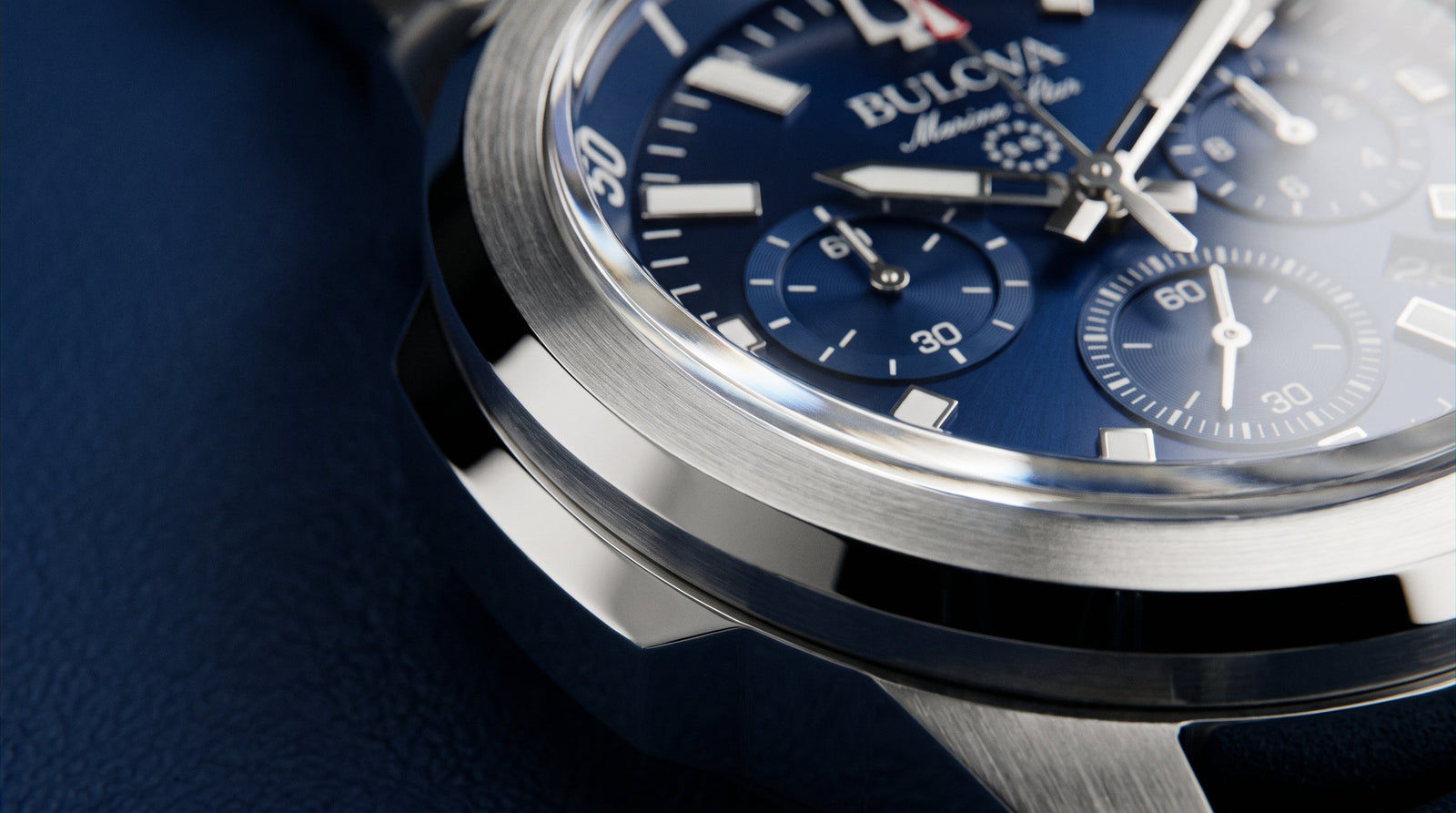

Anyone looking to buy a Bulova men's watch is quickly faced with a fundamental question: a chronograph with multiple counters and pushers, or a simple three-hand watch that displays hours, minutes, and seconds? The answer depends not only on personal taste, but also on wrist circumference, the situation in which it is worn, and how much of the dial you are willing to read on a daily basis. This article compares specific Bulova models from both categories based on technical data from the catalog, without reviews or recommendation rankings.
The assortment at uhren4you includes over 220 Bulova models, ranging from slim three-hand watches in the 200-euro price range to precision chronographs just under 400 euros. The following sections go through the decision criteria step by step: everyday function, dial structure, case format, readability, and price range.
What a chronograph really does in everyday life
A chronograph is a stopwatch function integrated into the watch movement. Two pushers on the crown start, stop, and reset the measurement. For this purpose, at least two sub-dials appear on the dial: one for stopped seconds, one for minutes. Some models add a third for hours. In several models, Bulova uses its own high-frequency movement with 262 kHz instead of the usual 32 kHz, which increases the resolution of the stop function to 1/1000 of a second. This difference is relevant in sports, but rarely decisive in everyday life.
Who is the stop function actually useful for? For runners, swimmers, and anyone who measures intervals. For people who frequently measure speaking time in meetings. For everyone else, the chronograph is a dial feature that increases visual complexity without being used daily. This is not a judgment, but a fact: a watch can have a chronograph for aesthetic reasons without you ever using it. However, you should choose this consciously because the functional elements necessarily make the case wider and thicker.


Three-hand: simple, flat, unobtrusive
A classic three-hand watch shows hours, minutes, and seconds on a single level. No auxiliary movement, no pushers, no sub-dials. This simplifies reading, allows for flatter cases, and looks much calmer under a shirt or jacket.
In the Classic line, Bulova offers several three-hand men's watches with a 40 mm case and Miyota quartz movement. The case depth there is around 7.3 mm, which is a good bit below the chronographs. The Miyota movement is a Japanese series movement known for accuracy and robustness. Not to be confused with the Bulova high-frequency movement, which is exclusively installed in the precision chronographs.
Which dial information you really need
Most people read a watch to know the time. The date is helpful. Everything else is a function that you either need or don't. A three-hand watch with a date display covers 90 percent of everyday reading cases. The advantage: every piece of information on the dial has sufficient space, and numerals and hands can be designed larger.


Case size and strap width on the wrist
Case size is the most common buying mistake with watches. In a product photo, a 44 mm case looks different than on the wrist of a person with a 16 cm circumference. As a rough guide: a wrist circumference of up to 16 cm handles cases up to 40 mm well, 16-18 cm handles 40-44 mm, and from 18 cm, 44 mm and larger also fit without dominating.
| Model | Diameter | Case depth | Type | Price range |
|---|---|---|---|---|
| Bulova Sutton 96B412 | 41 mm | 9.7 mm | Chronograph | approx. 160 EUR |
| Bulova Classic 96B408 | 44 mm | not specified | Precision chronograph | approx. 262 EUR |
| Bulova Racer 98B428 | not specified | not specified | Chronograph | approx. 319 EUR |
| Bulova Marine Star 96B466 | not specified | not specified | Chronograph | approx. 299 EUR |
| Bulova Classic 96B474 | 40 mm | 7.3 mm | Three-hand | approx. 206 EUR |
| Bulova Classic 96B475 | 40 mm | not specified | Three-hand | approx. 206 EUR |
| Bulova Wilton 96B389 | not specified | not specified | Three-hand | approx. 199 EUR |
Important: Chronographs are almost always thicker than comparable three-hand watches from the same brand. The Bulova Classic 96B474 with a 7.3 mm case depth slides under a shirt sleeve. The Sutton 96B412 with a 9.7 mm depth is still suitable for everyday use, but noticeably more present. Those who wear them in the office a lot should take this into account.
The strap width follows the case. A 44 mm case usually has a wider strap than a 40 mm case. This affects the overall impression because a wide steel strap visually emphasizes the wrist more strongly.

Readability day and night
A chronograph dial is structurally more complex than a three-hand dial. Several concentric rings for tachymeter or pulsometer scales, two to three sub-dials, and up to six hands share the available surface. This is not a flaw, but it means: the hands for the actual time are smaller, and the eye must distinguish between levels.
With the Bulova Classic 96B456, for example, the high-frequency movement brings a special feature: the second hand moves noticeably more smoothly than with a standard quartz movement, which subjectively supports the readability of the current time. The sapphire crystal of this model reduces reflections and improves readability in side light.
Mineral crystal vs. sapphire crystal
Mineral crystal is hardened but more prone to scratches than sapphire crystal. Sapphire crystal has a Mohs hardness of 9, mineral crystal is significantly lower. For watches under 200 euros, mineral crystal is predominantly found; from 300 euros, sapphire crystal becomes more common. Sapphire crystal shows significantly fewer fine scratches after years of everyday use. This is relevant if the watch encounters sharp edges, as happens more often during chronograph use in sports than in the office.
| Model | Crystal type | Water resistance | Field of application |
|---|---|---|---|
| Bulova Classic 96B474 | Mineral crystal | not specified | Everyday, office |
| Bulova Classic 96B456 | Sapphire crystal | not specified | Everyday, increased wearing comfort |
| Bulova Marine Star 96B466 | Sapphire crystal | not specified | Sport, water |
| Bulova Marine Star 96B396 | not specified | 100 m | Water sports, outdoor |
| Bulova Racer 98B428 | Sapphire crystal | not specified | Sport, motorsport look |
Regarding night readability: Luminescent coatings on hands and indices glow after light exposure. This is a real advantage for sports and outdoor applications. For office watches, it is a nice feature that is rarely used. Whether a specific Bulova model has luminescence is stated in the respective technical data on the product page.

Those looking for watches for sporting activities will find a detailed overview by area of application in our magazine article Sports watches for men: Which technology for which activity .
Price ranges from 150 to 400 euros
The Bulova assortment at uhren4you covers the range from just under 160 euros to over 320 euros. There is a recognizable correlation between price range and equipment, but not a linear one. A more expensive model does not necessarily have more functions, but often better materials or a more elaborate movement.
| Price range | What you get for it | Example models |
|---|---|---|
| 150-200 EUR | Quartz or simple chronograph, mineral crystal, stainless steel | Sutton 96B412, Wilton 96B389 |
| 200-260 EUR | Three-hand with Miyota movement or entry-level chronograph, partly sapphire crystal | Classic 96B474, Classic 96B475, Classic 96B408 |
| 260-400 EUR | High-frequency precision movement, sapphire crystal, Marine Star with 100 m | Marine Star 96B466, Marine Star 96B396, Racer 98B428, Classic 96B456 |
The high-frequency movement, which Bulova calls "Precisionist", is a unique selling point of the brand in this price range. A quartz movement with 262 kHz oscillates eight times as often as a standard quartz movement, which improves accuracy to about ±10 seconds per year and makes the second display significantly smoother. Those who appreciate this feature will find it at Bulova in the 260-350 euro zone, not in the entry-level segment.
An important note on automatic: Bulova also offers automatic movements, for example in the Surveyor line. These are priced similarly, but work with a mechanical self-winding movement without a battery. Automatic watches have a natural rate tolerance of about ±10-20 seconds per day, which is significantly wider than a precision quartz movement. Those who prioritize accuracy are better advised with a quartz chronograph. For those who enjoy the mechanical movement, the automatic is the right choice.
For a look at another pair of brands in a similar price environment, it is worth comparing in our article Sternglas vs. Zeppelin: Two German watch brands in data comparison.


Those interested in the Marine Star line will find further background information on the Bulova manufacturer page regarding the Racer collection and its origin in the brand's motorsport history.


