


Citizen Caliber in Detail: Eco-Drive, Automatic, and Quartz Compared
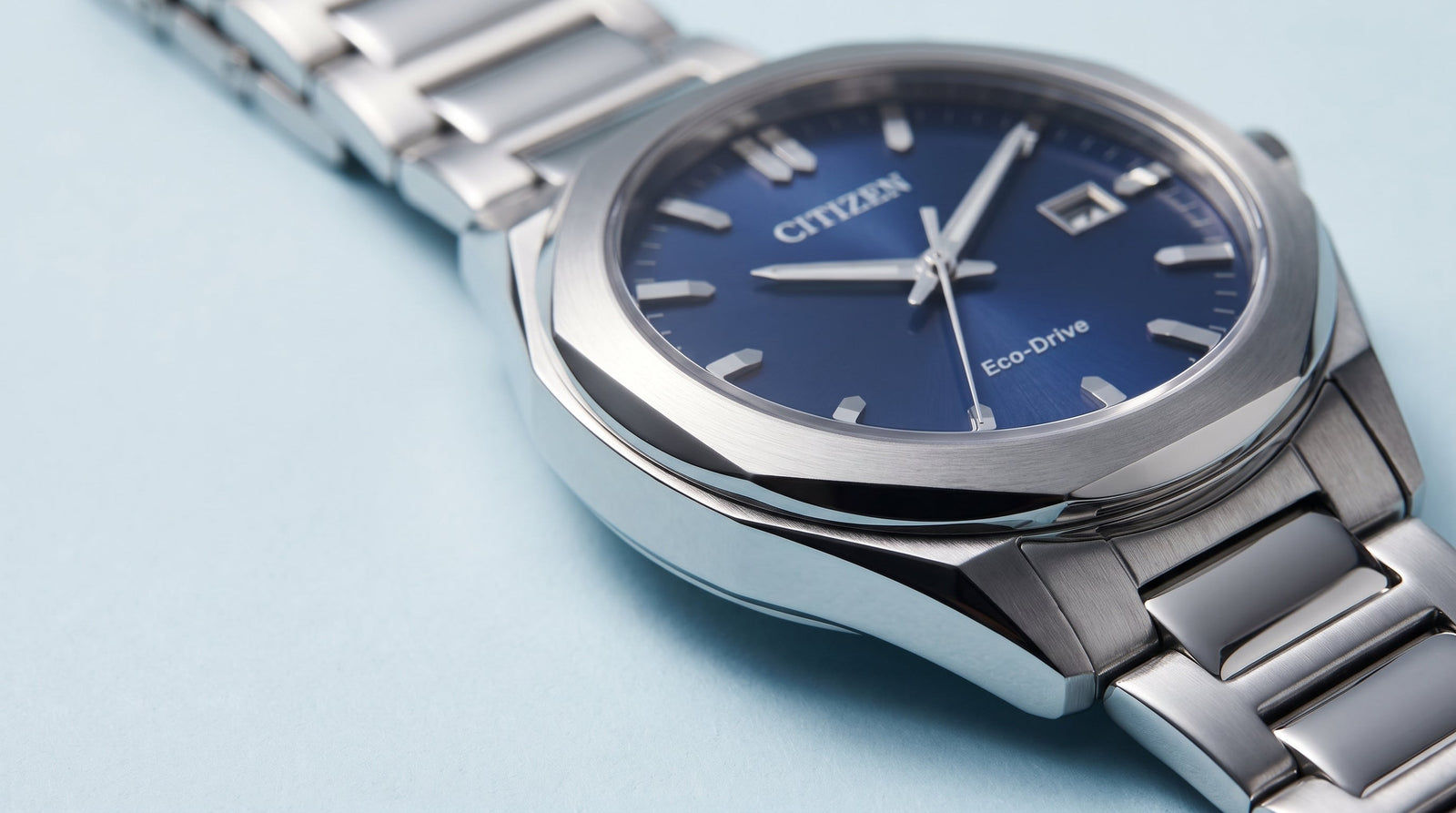

Anyone looking to buy a Citizen watch will quickly come across caliber designations like B620, H145, or 8310 and wonder what these numbers actually mean. This article compares the technical specifications of the most important Citizen calibers based on manufacturer information and data sheets, rather than independent measurements.
For the 50th anniversary of Eco-Drive technology, Citizen is launching new caliber variants, making a look at the entire caliber portfolio particularly worthwhile. The following overview categorizes quartz, solar, and automatic movements according to criteria that are truly relevant when making a purchase: accuracy, power reserve, range of functions, and robustness.
Citizen Caliber Overview: Quartz, Solar, and Automatic in the Assortment
Citizen develops and manufactures its own calibers, which is not a given in the mid-price segment. It is important to distinguish between the movement (the mechanical or electronic drive unit) and the caliber (the specific version of this movement with its own number): Caliber 8310 refers to a very specific version of Citizen's automatic movement, while "automatic movement" only describes the type of drive.
The Citizen range can be divided into three groups:
- Quartz Calibers: Battery-powered movements, typically with an accuracy of ±15 seconds per month. Most affordable entry points, no maintenance required.
- Eco-Drive Calibers: Solar-powered quartz movements in which a solar cell under the dial converts light into electrical energy and charges a rechargeable battery. No battery change required.
- Automatic Calibers: Mechanical self-winding movements in which a rotor winds the mainspring through kinetic energy from wearing the watch. No external energy source required, but lower accuracy than quartz.
| Drive Type | Example Caliber | Typical Accuracy | Battery/Rechargeable Battery |
|---|---|---|---|
| Quartz | BI5xxx series | ±15 sec./month | Battery, every 2-3 years |
| Eco-Drive Solar | B620, H145, E111 | ±15 sec./month | Rechargeable battery, no replacement needed |
| Automatic | 8210, 8310, 9051 | ±10-15 sec./day | none |
Eco-Drive Calibers in Detail: B620, H145, and Other Solar Movements
Eco-Drive is Citizen's patented solar drive technology: A photovoltaic cell under the dial converts light into electrical energy, which is stored in a lithium-ion battery. The technology was developed in 1976 and used in the first mass-market Eco-Drive watch in 1995. Further background on the history of Citizen calibers can be found at Uhren-Nerd.
Caliber B620
The B620 is one of the most common entry-level Eco-Drive movements in the mid-range segment. It powers simple three-hand models with a date display. According to the manufacturer, the power reserve in the dark is around 6 months. The caliber is designed for compact cases and is found in many everyday models of the BM7xxx series.
Caliber H145
The H145 belongs to the Citizen Promaster line and is designed for greater robustness. In various versions, it includes additional functions such as world time or a dive time display. The power reserve is also around 6 months. Due to the higher water resistance of the cases in which it is typically installed (up to 20 bar in certain Promaster models), it is suitable for sporty applications.
Caliber E111 and High-Precision Movement 0100
The E111 powers, among others, GPS solar models where time signal correction is performed via satellite signal. At the top end of the Eco-Drive line is the 0100 caliber: It operates with a thermo-compensated AT-cut quartz oscillator and, according to Hodinkee, achieves an accuracy of ±1 second per year, which is significantly higher than the chronometer standard. The technical details of the 0100 caliber have been documented in detail by Hodinkee. The power reserve is 6 months in normal operation, 8 months in power-saving mode.

Citizen Automatic Calibers: In-House Development vs. Purchased Movements
Citizen develops its automatic calibers entirely in-house. This has a practical advantage: the tolerances between the movement and the case are matched, service centers worldwide are familiar with the movements, and spare parts are available in the long term. For a comparison with automatic movements from other manufacturers, the article Automatic Calibers at a Glance: Miyota, Seiko NH, and Sellita provides further orientation.
Caliber 8210 and 8310
The 8210 is Citizen's entry-level automatic in the mid-range segment. It runs at 21,600 vibrations per hour (6 vibrations per second) and offers a power reserve of around 42 hours. The 8310 is the further developed version with a 40-hour power reserve and also 21,600 vph. Both calibers are designed for three-hand models without complications.
Caliber 9051
The 9051 is used in the higher-quality Series 8 line. It runs at 28,800 vibrations per hour (8 vibrations per second), which typically results in a smoother second hand movement and slightly better shock absorption. The power reserve is 50 hours. In some versions, the 9051 features a view of the rotor through the case back.


Comparison of Accuracy, Power Reserve, and Water Resistance
The three parameters most frequently asked about when comparing calibers are accuracy, power reserve, and water resistance. Important: Water resistance is a property of the case, not the movement. One and the same caliber can be installed in a 3-bar case or a 20-bar case. The table therefore lists typical values from the model series, not absolute limits of the caliber.
| Caliber | Type | Accuracy | Power Reserve | Typical Water Resistance |
|---|---|---|---|---|
| B620 | Eco-Drive | ±15 sec./month | 6 months (dark) | 3-10 bar |
| H145 | Eco-Drive | ±15 sec./month | 6 months (dark) | 10-20 bar |
| E111 | Eco-Drive GPS | Satellite-corrected | 6 months (dark) | 10 bar |
| 0100 | Eco-Drive | ±1 sec./year | 6-8 months | 5 bar |
| 8210/8310 | Automatic | ±10-15 sec./day | 40-42 hours | 10 bar |
| 9051 | Automatic | ±10 sec./day | 50 hours | 10 bar |
A note on water resistance specifications: According to ISO 22810, 10 bar means water resistance sufficient for swimming and snorkeling. For scuba diving with compressed air, at least 20 bar and additional standard criteria such as luminous hands and a rotating bezel are required according to ISO 6425. Those who only mean everyday moisture, rain, and occasional hand washing will be fine with 3 bar. For underwater sports, 10 bar is the sensible minimum value. The article explains more about this Solar and Radio-Controlled Watches in Detail: Technology, Performance, and Limits.
Which caliber fits which use case
The choice of caliber follows from the usage profile, not from a ranking. The following classification describes which drive type and which caliber family makes sense for which everyday life.
Eco-Drive B620: Office and Everyday Life
Anyone looking for a low-maintenance watch that is worn daily and does not need a battery change is well-served with a B620 model. The power reserve of 6 months is enough to get through even the darkest winter month. Accuracy and range of functions correspond to a standard quartz movement; the advantage lies solely in energy self-sufficiency.
Eco-Drive H145: Sport and Outdoor
The H145 with higher case water resistance and more robust dial functions is suitable for wearers who also use their watch for sports, swimming, or in damp environments. Those who value a dive bezel or world time display will find corresponding models in the Promaster line.
Automatic 8310 and 9051: Mechanics as an Experience
Wearers choose automatic watches who appreciate mechanics: the visible dial, the smooth or sweeping second hand, the feeling of keeping the watch running by wearing it. On the other hand, those who need time accurate to the second are better served with a quartz or Eco-Drive caliber. The timing error of up to 15 seconds per day with an automatic movement is not a defect, but a design feature of mechanical movements.
GPS Solar (E111 and subsequent movements): maximum time accuracy without a radio network
GPS solar calibers correct the time via satellite signal and are therefore not dependent on a terrestrial radio network (such as the DCF77 signal from Mainflingen). This makes them useful in regions where DCF77 reception is not reliable, i.e., outside Central Europe. The price for this is a more complex movement, which usually requires a larger case and a higher purchase price.


