


Buy a Cuckoo Clock: Black Forest Mechanical or Quartz Movement
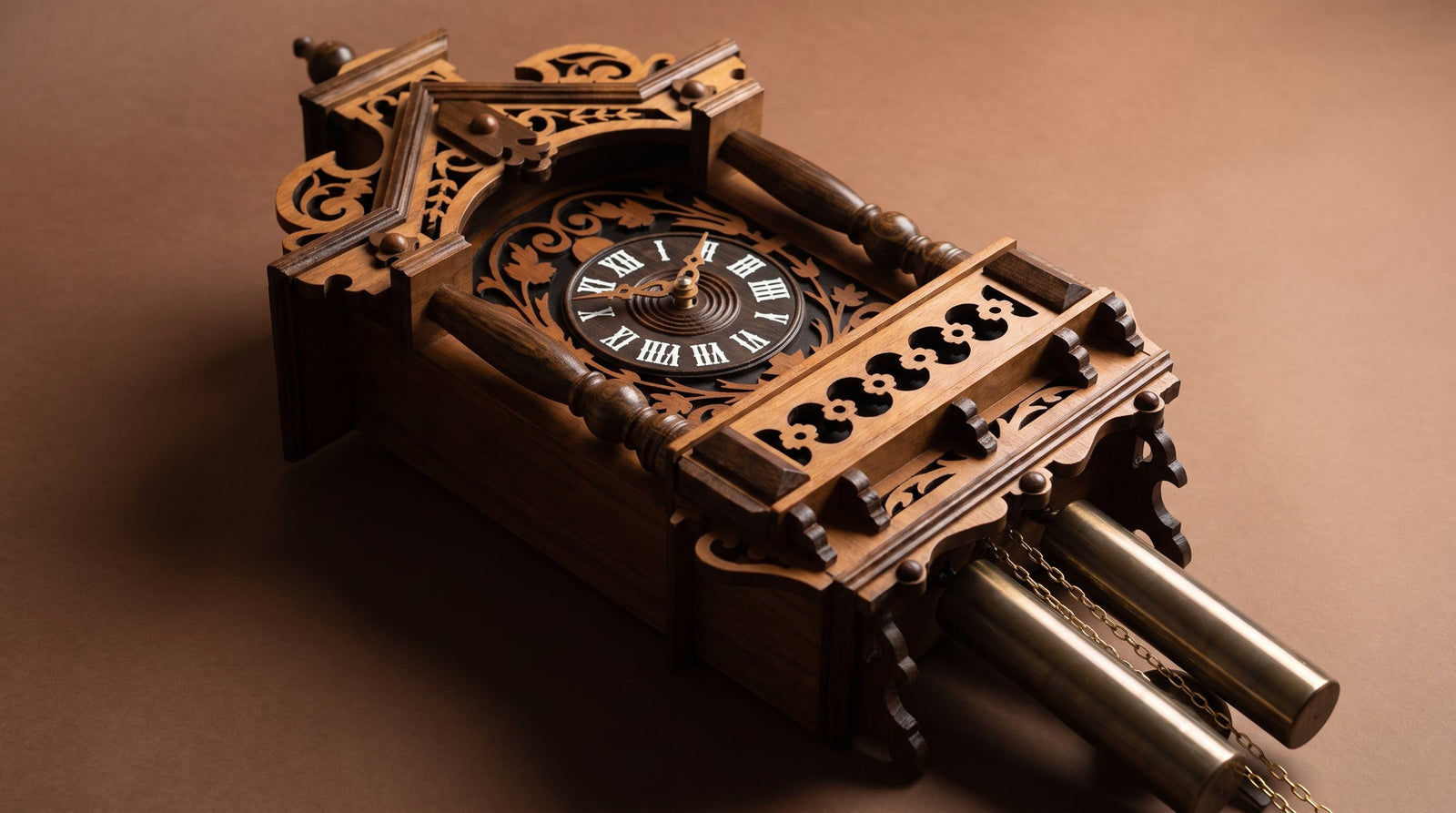

Anyone looking to buy a cuckoo clock is quickly faced with a decision that involves more than just choosing between carvings and a simple case: Should it be a mechanical movement that needs to be wound every eight days, or a quartz movement that simply runs? And what about the cuckoo call at night when the house is quiet? This article compares the essential differences based on the product data of the models in our range and helps you make the right choice for your space.
The decision depends on three factors: the desired level of authenticity, the willingness to perform regular maintenance, and the requirements for nighttime quiet. Once you have sorted these out, you will find the right model even in the mid-price range.
What makes a cuckoo clock: Call, pendulum, and case
The hallmark of a cuckoo clock is the small door behind which a bird appears on the hour and calls as many times as the hour requires. This interplay of mechanics and sound has existed in the Black Forest since the early 18th century, and the basic principles have hardly changed since then.
A pendulum provides the visual rhythm and simultaneously regulates the running rhythm of the movement in mechanical clocks. The case is traditionally made of wood, often linden wood for the carvings and softwood for the actual box. The designation "Original Black Forest Cuckoo Clock" is only awarded by the Black Forest Clock Association (VdS) if the movement and case were actually manufactured in the Black Forest. This label is not a marketing promise, but a verified guarantee of origin.
The cuckoo call itself is produced in mechanical models by two pipes with a bellows mechanism: a short and a long tone create the characteristic two-syllable sound. Quartz models use a stored sound chip that plays the call through a speaker. The difference is audible in a direct comparison: the mechanical call sounds softer and slightly variable, while the digital call is reproducibly identical.
Mechanical 8-day movement or quartz movement: Winding, sound, and daily effort
The most important practical distinguishing feature is the type of drive. Mechanical cuckoo clocks are powered by weights hanging on chains: gravity causes the weights to sink, thereby driving the movement. With a 1-day movement, the chains must be pulled up every evening; with an 8-day movement, once a week is sufficient.
Mechanical 8-day movement
An 8-day movement allows for more time between windings and is therefore more suitable for everyday use than a 1-day movement. The mainspring, which is tensioned by pulling up the weights, releases the stored energy evenly via the escapement wheel. The timekeeping error in well-regulated mechanical cuckoo clocks is typically in the range of one to two minutes per week, which is practical for a wall clock of this type. The mainspring itself is a precision metal part and not a wear part in the usual sense, as long as the clock is oiled regularly.
Quartz movement with battery drive
Quartz clocks do not need winding. The piezoelectric quartz crystal runs on a stable frequency and is significantly more accurate than a mechanical movement: a good quartz movement deviates by less than a minute per year. The practical effort is limited to changing the battery, which is required every one to three years depending on the model and battery type. In quartz models, weights and chains are often just for decoration.
| Feature | Mechanical 8-day movement | Quartz movement |
|---|---|---|
| Winding interval | Once a week | Battery every 1-3 years |
| Accuracy | approx. 1-2 min/week | less than 1 min/year |
| Cuckoo call | Mechanical (bellows and pipes) | Digital sound chip |
| Power failure | Not relevant | Time and sound stop |
| Maintenance | Oiling recommended every 5-8 years | Minimal |


Black Forest carving art or modern design: Which shape fits which room
Traditional cuckoo clocks from the Black Forest often feature elaborate carvings with hunting motifs, deer, oak leaves, or mill wheels. These versions fit into living spaces with a rustic or alpine interior style, in country-style kitchens, and in rooms where wood surfaces dominate anyway.
Modern cuckoo clock design works with clean lines, geometric cases, and reduced surfaces. The goal here is to maintain the cuckoo call as a function without making the case the focal point of the room. Black or white-black finishes allow for integration into contemporary living spaces where a carved Black Forest house would look out of place.
A third category consists of deliberately colorful models that function as a design statement: the cuckoo clock motif is combined with an unexpected color and is intended to be an eye-catcher, not a piece of period furniture. These models are generally smaller and cheaper.
| Style | Typical room | Movement type in range |
|---|---|---|
| Traditional, carved | Country house, rustic living room | Mechanical (8-day) |
| Modern, geometric | Contemporary living room, office | Quartz or mechanical with visible movement |
| Colorful, decorative | Teenager's room, kitchen, children's room | Quartz |

Nighttime quiet: Shut-off by hand, via timer, or light sensor
The cuckoo call is a pleasant acoustic signal during the day, but it can be disruptive at night. Almost all newer cuckoo clocks offer a way to turn off the call at night. The differences lie in the operation.
Manual night shut-off
A small lever or switch on the case interrupts the connection to the call system. The user turns the call off in the evening and back on in the morning. This is the simplest and most reliable solution, but it requires two manual steps daily and is easily forgotten in everyday life.
Timer shut-off
Some quartz models automatically turn off the call between set times, for example from 10:00 PM to 8:00 AM. This setting is fixed or selectable via a rotary switch. The advantage: no daily intervention. The disadvantage: In summer, it may still be light at 10:00 PM, and the clock is already silent.
Light sensor
A light sensor on the front of the case detects whether it is dark in the room and turns off the call accordingly. This solution reacts to the actual lighting situation, not a fixed schedule. It works well in rooms where no artificial light is on at night, but fails where nightlights or street lighting fall through curtains.
The Rombach & Haas TRADITION 3401 and the Rombach & Haas Einblick FV35-2, as mechanical models, have a manual shut-off lever. The AMS W7399 and the AMS Tuningen W7391, on the other hand, use a light sensor or a night shut-off via quartz control. The Karlsson KA5768BP offers manual shut-off via the pendulum.

Space on the wall: Case size, chain length, and pendulum swing
Cuckoo clocks need more wall space than a simple quartz wall clock. There are three dimensions to consider.
Case height: Traditional cuckoo clocks start at about 25-30 cm in height without chains and reach up to 60 cm or more for large versions with musical movements and three weights. Modern quartz models are often more compact.
Chain length: In mechanical movements, the weights hang on chains that are pulled up as high as possible when fully wound and then sink over eight days. The drop height of the chains determines how much free space is needed below the clock. For an 8-day movement, 60-90 cm of drop height should typically be planned. This means that the hook on the wall should be at least 120-150 cm above the floor, depending on the case size and chain length. If you hang the clock lower, you have to wind the weights more often or risk them touching the floor.
Pendulum swing: The pendulum swings out to the side. With large models, this can be several centimeters on each side. On a narrow wall between two doors, this can become a problem. Check the pendulum width in the product description before installation.
Useful tips for installation and the correct hanging height can be found in the article Hanging a wall clock correctly: Height, distance, and wall in view. If you want to adjust your mechanical movement after hanging it, you will find the corresponding steps under Setting a pendulum clock and radio-controlled clock: Step by step.
Purchase decision: Checklist before buying
- Which movement fits your everyday life: 8-day winding or low-maintenance quartz movement?
- Is the mechanical call (bellows and pipes) or a digital sound desired?
- Does the case design match the existing interior style of the room?
- How is the cuckoo call turned off at night: manually, via timer, or light sensor?
- Is the drop height for the chains sufficient below the planned hanging location (at least 60-90 cm for mechanical movements)?
- Does the pendulum have enough space on the sides without hitting walls, door frames, or furniture?
- Is the VdS label as an Original Black Forest Cuckoo Clock desired, or is a clock in the Black Forest tradition sufficient?


