


Festina in Profile: Sports Watches, Dress Models, and Movements

Anyone looking for a watch in the 50 to 500 euro range who doesn't want to spend an hour researching every model will quickly come across Festina. The brand is broadly positioned in this price bracket, offers both quartz and automatic movements, and caters to both sporty and formal occasions. What is less clear, however, is: which model series stands for what, which movements are actually inside, and where do the objective limits of an offering in this price class lie?
This article compares data sheets from the Festina range and classifies the brand technically. It answers which buyer Festina is suitable for and where other options make more sense. The basis is the technical fields from the catalog, not wearing experience.
Festina: Spanish brand with European manufacturing and global distribution
Festina was founded in Switzerland in 1902, has its administrative headquarters in Barcelona today, and belongs to the Festina Group, which also manages Candino, Calypso, and Jaguar in addition to the main brand. Depending on the line, the watches are manufactured partly in Switzerland and partly in Spain. Only selected collections bear the "Swiss Made" label, including the Rivé series, which occupies a different price level than the main assortment.
Worldwide, Festina is best known as the official watch partner of the Tour de France, a sponsorship that has been running since the 1990s and has directly shaped the Chrono Bike line. In the German market, the brand is well-established among specialist retailers and is one of the volume brands that shows a consistent range from the entry-level price to just under the 500-euro mark. Rising Swiss export figures in the mid-price segment confirm that exactly this positioning is in stable demand.
Model series at a glance: Chrono Bike, Mademoiselle, Timeless, and others
Festina divides its range into clearly named collections, each defining a target group and a style.
Chrono Bike
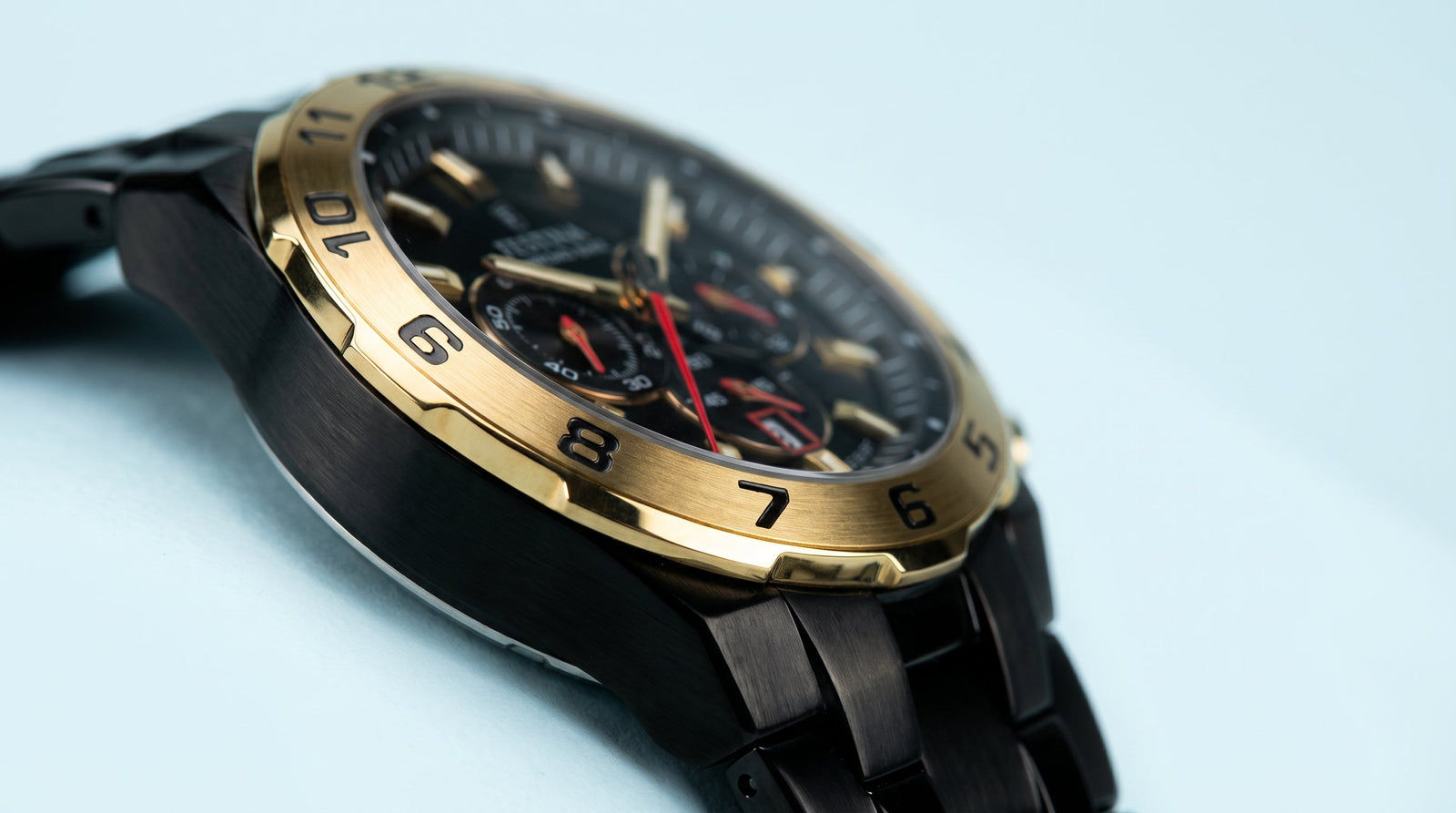
The best-known line. Sports chronographs with 43-45 mm cases, often stainless steel or rubber straps, 10 ATM water resistance (corresponds to 100 meters test pressure), and quartz or Miyota chronograph movements. The connection to cycling is visually apparent: many models feature tachymeter scales on the bezel.

Timeless Chronograph
Slightly more formal than Chrono Bike, with narrower bezel designs and often Milanese or classic stainless steel bracelets. Water resistance is also usually 10 ATM, mineral glass is standard, and it features a quartz movement with a stopwatch function.

Mademoiselle
The classic women's line from Festina. Case diameters are typically around 36 mm, quartz movement, 5 ATM water resistance. The models are designed for everyday use, not for sports or outdoor activities.

Automatic Skeleton and Rivé
The Automatic Skeleton series shows the movement through an open dial, Miyota automatic movement, and sapphire crystal. The Rivé line bears the Swiss Made label and an automatic movement, which puts it in a separate price category. Sapphire crystals with anti-reflective coating are also standard here.

Movements and calibers: which watch movements Festina uses and what they can do
A movement is the entire drive unit of a watch; a caliber is the type designation of a specific movement. Festina does not produce its own watch movements but sources them from established suppliers.
Quartz movements
The majority of the Festina range runs on quartz movements of Japanese or European origin. Miyota (a Citizen subsidiary) supplies reliable mass-produced movements that typically have an accuracy within plus/minus 10-15 seconds per month. For simple three-hand models, Ronda movements from Switzerland are also used. Festina quartz models run more precisely than any automatic in this price range.
Miyota chronograph movements
For chronographs, Festina often uses Miyota chronograph movements, for example, the JS25 or similar calibers in this family. These movements offer a stop function with 1/5-second resolution and are easy to maintain. The accuracy corresponds to that of other quartz movements.
Miyota automatic movements
In the Skeleton and some dress models, you will find the Miyota 82S5 or a related caliber: automatic movement with self-winding via a rotor, power reserve of around 40 hours, accuracy of plus/minus 10-20 seconds per day. This is typical for a Miyota automatic movement in the mid-price segment and is behind the precision of a quartz movement. Those who need an exact time display choose quartz; those who appreciate the mechanics accept the deviation.
Swiss Made movements (Rivé)
The Rivé series bears the Swiss Made label, which legally means that at least 60 percent of the movement's manufacturing costs are incurred in Switzerland and the final inspection takes place there. Which specific caliber is used differs depending on the model.

Price ranges from under 100 to over 500 euros: what changes in each class
| Price range | Typical movement | Glass | Water resistance | Special feature |
|---|---|---|---|---|
| Under 100 euros | Quartz (Ronda etc.) | Mineral glass | 3-5 ATM | Mademoiselle, simple three-hand |
| 100-200 euros | Quartz, Miyota chronograph | Mineral glass | 10 ATM | Timeless Chronograph, casual lines |
| 200-300 euros | Miyota automatic | Sapphire crystal | 10 ATM | Skeleton, Chrono Bike special edition |
| 300-500 euros | Swiss Made automatic | Anti-reflective sapphire crystal | 5-10 ATM | Rivé collection |
The most important jump takes place between mineral and sapphire crystal. Sapphire crystal (corundum, Mohs hardness 9) is significantly more scratch-resistant than mineral glass and is reflected in the price. Anyone who wears the watch daily and does not accept scratches should specifically look for this jump, even if it means a surcharge of 100-150 euros. The second jump is marked by the Swiss Made automatic movement in the Rivé line.
Festina Sport vs. Festina Dress: technical differences in data comparison
| Feature | Festina Sport (e.g., Chrono Bike) | Festina Dress (e.g., Rivé) |
|---|---|---|
| Case diameter | 43-45 mm | 40-42 mm |
| Case height | higher (chronograph movement) | flatter |
| Water resistance | 10 ATM (100 m test pressure) | 5-10 ATM |
| Glass | Mineral (entry-level) or sapphire | Sapphire with anti-reflective coating |
| Movement | Miyota quartz chronograph | Swiss Made automatic |
| Strap | Stainless steel, rubber | Stainless steel, leather |
| Suitable for | Casual wear, outdoor, sports | Business, evening, formal occasion |
10 ATM means: the watch has passed a test pressure of 100 meters water column. This allows swimming and snorkeling, but not diving with compressed air tanks. 5 ATM (50 m test pressure) allows splashes and brief immersion, but not swimming as a continuous operation. Anyone who wants to learn more about choosing the right watch size can find guidance in the article Case diameter and wrist circumference: Which watch size fits.
Dress models like the Rivé are not optimized for robustness, but for a flat feel and readable dials. The automatic rotor makes them slightly thicker than a pure quartz dress model, but it remains within the limits of a shirt sleeve.
For whom Festina is the right choice and where the limits lie
Festina fits well with buyers who are looking for a well-known European label, clear model series, and a consistent price-performance ratio in the mid-segment. The movement supply via Miyota and Swiss Made calibers is solid and maintainable. Specialist retailers have carried the brand for decades, and spare parts are available.
Limits are evident in two points. First: In the lower Festina price segment under 150 euros, the brand competes directly with Lorus, Casio, and Citizen, which offer better glass quality or more proven movements in a similar price range. Anyone who wants to make this comparison specifically will find a direct comparison in the article Festina vs. Citizen: Comparison in the price band up to 300 euros. Second: Festina does not build manufacture movements or proprietary calibers. Anyone looking for a watch with a manufacturer caliber and a long mechanical tradition is better off with Seiko or in a different price class.
For everyday life, for sports, and for formal occasions up to business level, Festina covers the need without compromising on workmanship quality.
- Looking for a sports chronograph with 10 ATM: check Chrono Bike or Timeless Chronograph.
- Everyday quartz for women under 100 euros: check out the Mademoiselle line.
- Automatic with sapphire crystal under 300 euros: compare the Skeleton series.
- Swiss Made automatic for a formal occasion: specifically look for the Rivé collection.
- Robustness more important than elegance: prefer 10 ATM models, accept mineral glass.
- Daily wear in water planned: demand 10 ATM, exclude 5 ATM models.


