


Silver, Gold Plating, and Titanium in Jewelry: Categorizing Materials

When buying jewelry, you quickly read terms like "925 silver," "18k gold-plated," or "titanium" on the label without immediately knowing what that means for everyday use. Tarnishing, discoloration, skin irritation: most questions arise not at the time of purchase, but afterwards. This article provides a technical classification of the most common jewelry materials, lists their strengths and limitations, and explains what to look out for if you have sensitive skin.
The following sections are based on material data and manufacturer information from our range. Where numbers are mentioned, they come from the product fields of the respective items. An overview at the end summarizes the care rules for each material.
Why the material in jewelry counts more than the design
The design determines whether you like a piece. The material determines whether it looks the same after a year as it did on the first day. Two necklaces can look identical and yet differ fundamentally: in their resistance to moisture, their weight on the wrist, and their compatibility with the skin.
Added to this is an economic aspect: a thin gold plating on brass wears out faster than rhodium plating on silver. If you cannot assess this when buying, you may end up buying twice what could have been sufficient if chosen well the first time. The material is therefore not a technical side issue, but the decisive factor for longevity and suitability for everyday use.
925 silver: what the alloy means and how it behaves
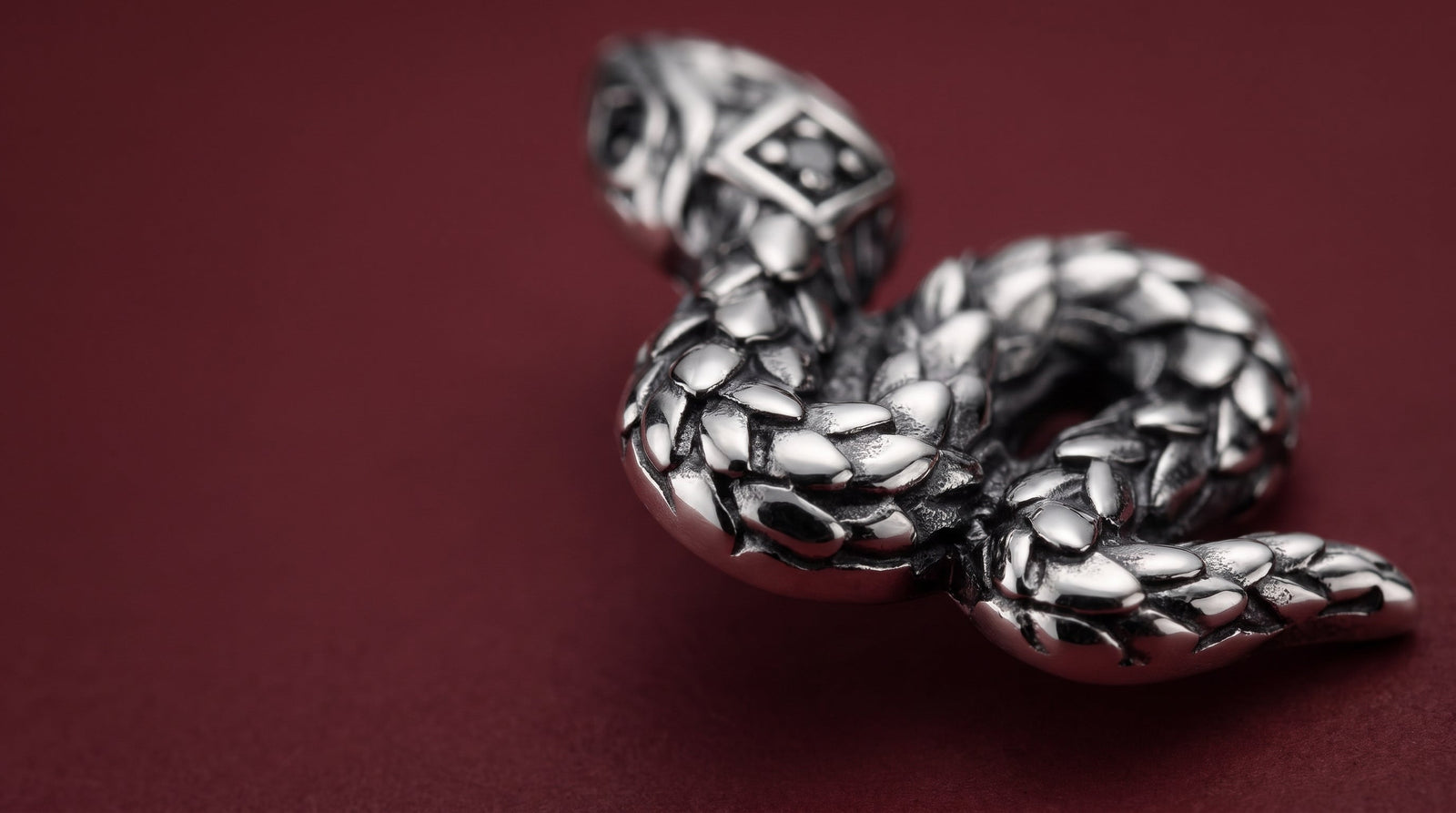
The term "925 silver" or "sterling silver" indicates the fineness: 92.5 percent pure silver, 7.5 percent additional metals, usually copper. Pure silver with a fineness of 999 would be too soft for jewelry worn daily. The copper content increases the hardness and makes the material dimensionally stable.
The copper is also the reason why silver jewelry tarnishes. In the air, copper reacts with sulfur compounds to form a dark layer, which is called a tarnish layer or patina. This is not damage, but a chemical reaction on the surface. It can be reversed with a soft silver polishing cloth or a mild silver cleaner.
What the hallmark says
European jewelry often bears the stamp "925" or "Ag 925". This information is standardized and confirms the fineness. Pieces without a stamp can still consist of sterling silver, for example in the case of very small jewelry parts for which a stamp is technically difficult to apply. In case of doubt, a look at the manufacturer's product data sheet helps.

More about care methods and the properties of sterling silver in everyday life can be found in the article Jewelry made of 925 silver: material knowledge and care tips.
Gold plating and rhodium plating: layers, thicknesses, and durability
Gold-plated jewelry does not have a solid gold layer, but a coating that is galvanically applied to a base metal. The base metal is often sterling silver or brass, and the coating consists of gold in a specific karat rating.
What "18k gold-plated" means
The specification "18k" describes the gold alloy in the coating layer, not the gold content of the entire piece. 18 karats correspond to a fineness of 750 thousandths of gold. The layer thickness for galvanic gold plating is between 0.5 and 3 micrometers, depending on the manufacturer and quality level. Higher-quality pieces reach 2.5 to 3 micrometers, which lasts significantly longer in everyday life.
Some Thomas Sabo items in the range are specified as "18k gold plating on recycled 925 silver." This means: the core consists of sterling silver with recycled content, the coating of an 18-karat gold alloy. The combination is a common quality standard in the mid-price segment.
Rhodium plating: white gold look and tarnish protection
Rhodium is a platinum group metal. As a wafer-thin coating on silver or white gold, it gives the piece a clear, high-gloss tone and prevents the silver surface from tarnishing. Rhodium-plated silver jewelry therefore stays bright longer without having to be polished.
The coating wears off, especially in places that frequently come into contact with skin or other surfaces. After a few years, refinishing at a jeweler may be useful. The base material underneath remains unchanged sterling silver, so it is not affected.

| Material | Composition | Tarnishing behavior | Surface durability |
|---|---|---|---|
| 925 silver, untreated | 92.5% silver, 7.5% copper | tarnishes (oxidation) | durable, polishable |
| 925 silver, rhodium-plated | Silver alloy + rhodium layer | hardly, rhodium protects | layer wears off |
| 925 silver, 18k gold-plated | Silver alloy + gold layer | hardly | layer wears off |
| Gold-plated on brass | Brass + gold layer | hardly, as long as layer is intact | lower, as base metal is softer |
Titanium and stainless steel: light, robust, nickel-free
Titanium and stainless steel are often referred to as "low-maintenance" materials in the jewelry sector. Both materials do not corrode under normal everyday conditions and do not require a protective coating.
Stainless steel in jewelry
The term "stainless steel" refers to a group of rust-resistant steel alloys. In jewelry, 316L stainless steel is mostly used, a variant with a low carbon content and molybdenum content, which is considered skin-friendly. Stainless steel is heavier than titanium, but more robust against scratches and dimensionally stable. Clasps and connecting pieces made of stainless steel are therefore also common on bracelets made of other materials.
Titanium
Titanium is significantly lighter than stainless steel with comparable strength. This plays a practical role in jewelry worn on the body: titanium ear studs are hardly noticeable, large titanium bangles appear less heavy. Titanium contains no nickel and is considered one of the most compatible metals in dermatology. More about the differences between titanium and stainless steel is summarized in this comparison of jewelry materials .

| Property | Stainless steel 316L | Titanium |
|---|---|---|
| Weight | medium to heavy | very light |
| Corrosion resistance | high | very high |
| Nickel content | traces possible | nickel-free |
| Skin compatibility | good | very good, hypoallergenic |
| Scratch resistance | high | medium to high |
Skin compatibility: what to consider with a nickel allergy
Nickel allergy is one of the most common contact allergies. It manifests itself as redness, itching, or small blisters on the areas of skin that come into contact with the jewelry. Once sensitized, the reaction to nickel remains permanently.
The EU Nickel Directive (EU standard 94/27/EC, now part of the REACH regulation) limits the nickel release of jewelry that has direct skin contact to 0.5 micrograms per square centimeter per week. Many manufacturers label their products as "nickel-free" or "nickel tested," which means that the limit values are met or undercut.
Which materials are safe
Titanium is the material with the lowest reaction rate. Surgical stainless steel (316L) and 925 sterling silver are also considered suitable for people with sensitive skin when of normal quality. More critical are cheap alloys without manufacturer information, brass with nickel content, and old galvanic coatings that expose the base metal when worn.
Gold-plated jewelry is unproblematic as long as the gold layer is intact. As soon as it wears off in places that have skin contact, the underlying base metal can react. This applies especially to rings and bangles, which are subjected to more stress than pendants or ear studs.
Blackened sterling silver, as found in some ear studs in the range, is darkened by an oxidation treatment or the application of a special tempering agent. The base material remains 925 silver; the compatibility does not change fundamentally as a result.

Care by material: tarnishing, cleaning, storage
Proper care significantly extends the life of jewelry. The requirements differ significantly depending on the material.
Cleaning 925 silver
For tarnishing silver, a soft silver polishing cloth with polish is sufficient. For heavier discoloration, a mild silver immersion bath that acts for a short time helps. Ultrasonic cleaners are suitable for solid silver without stones, not for jewelry with glued stones or enamel work, as vibration can loosen bonds.
Protecting gold-plated and rhodium-plated jewelry
Abrasive cleaners, ultrasound, and hard cloths attack coatings. Gold-plated and rhodium-plated jewelry is best wiped dry with a soft glasses or microfiber cloth. Contact with perfume, sunscreen, and chlorinated water accelerates layer degradation, so the rule is: put jewelry on last, take it off first.
Cleaning stainless steel and titanium
Both materials are easy to care for. Warm water with a small drop of dish soap and a soft brush are sufficient for cleaning. Then rinse thoroughly and pat dry. Stainless steel jewelry can look matte due to fingerprints; a microfiber cloth quickly restores the shine.
Storage
Silver jewelry tarnishes more slowly if it is stored in closed containers without air circulation. Special jewelry bags with an anti-tarnish inner lining help with this. Different materials should be stored separately, as harder metals can scratch softer surfaces.
| Material | Cleaning | Storage | To avoid |
|---|---|---|---|
| 925 silver | Silver polishing cloth, immersion bath | low air, dry | sulfur, chlorine, perfume directly |
| Gold-plated / Rhodium-plated | soft cloth, no abrasion | separately, dry | ultrasound, abrasives |
| Stainless steel 316L | water, dish soap, brush | any | hard scouring agents |
| Titanium | like stainless steel | any | strong acids |


