


Large clocks over 300 euros: What the premium price range offers
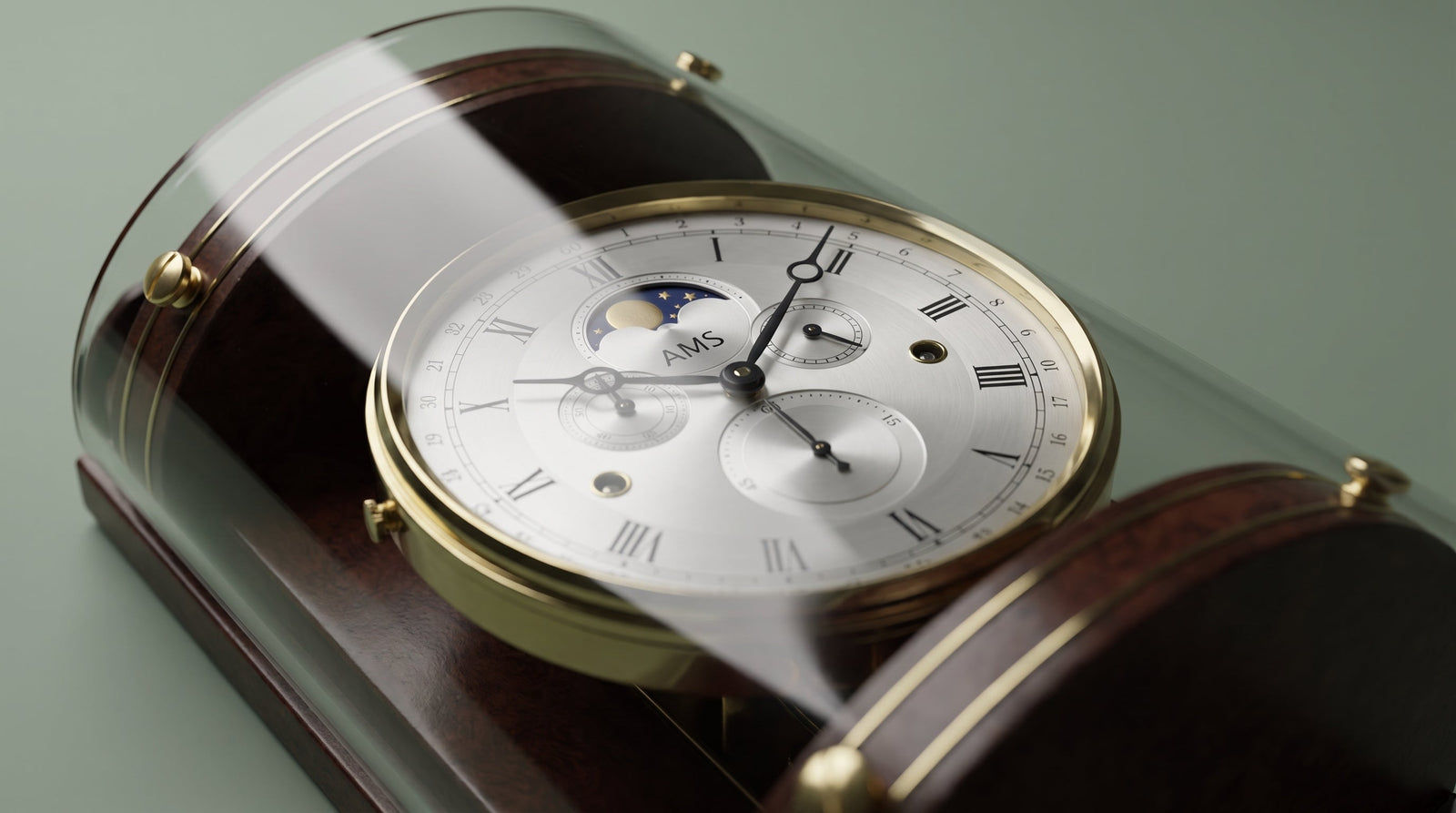

Anyone buying a wall or table clock for over 300 euros asks a valid question: What justifies this price compared to mid-range models? Current trends regarding decorative wall clocks as room centerpieces show that buyers in the higher price bracket are specifically looking for quality and style, not the cheapest offer. This article compares technical data and materials from our range to explain what the budget is actually being spent on.
The short answer: movement quality, case material, and special features make the difference. However, this does not apply across the board to every category and application. This guide explains step-by-step exactly what the upper price bracket for wall and large clocks offers and who it is suitable for.
What quality costs in large clocks: Overview of the price bracket from 300 euros
In the segment starting at 300 euros, wall and table clocks show a significant leap in quality compared to entry-level and mid-range models. This affects not only the appearance but, above all, the interior. Movements with longer running intervals, more solid cases, and more elaborate finishes drive the price up.
At the same time, the upper price bracket is not a homogeneous segment. Between 300 and 500 euros, you will find functional radio-controlled wall clocks with robust metal cases, classic pendulum clocks with chimes, and the first models with moon phase displays. From 500 euros up to the four-digit range, specialization increases: mechanical movements with a running duration of several weeks, hand-selected woods, large diameters, and elaborate dial constructions.
Those looking for a direct comparison with the mid-range price bracket will find it in the article Large clocks 100 to 300 euros: What the mid-range price bracket offers.
| Price range | Typical movement type | Case material | Special features |
|---|---|---|---|
| 300-499 euros | Radio-controlled, quartz | Metal, wood (veneered) | Westminster chime, pendulum |
| 500-999 euros | Radio-controlled, mechanical (quartz pendulum) | Solid wood, metal (thick-walled) | Moon phase, regulator dial |
| From 1,000 euros | Mechanical, 31-day movement | Solid walnut, brass inlays | Multi-week running duration, Westminster gong |
Movement types and drives: Radio-controlled, pendulum, and quartz in the upper segment
The movement type is the most important factor in understanding the price structure. In the upper price bracket, there are three types of drives that differ significantly in precision, maintenance requirements, and character.
Radio-controlled movement
A radio-controlled movement receives the DCF77 time signal from the Physikalisch-Technische Bundesanstalt in Braunschweig and automatically sets itself to the exact time, usually once a day in the early morning hours. This means no manual time correction, no deviation due to timing errors, and no resetting during daylight saving time changes. In the upper price bracket, radio control often appears in combination with a pendulum movement or a Westminster chime. The pendulum often serves as a decorative element that swings independently of the actual drive. Those who want to know how radio-controlled and pendulum clocks behave during time changes will find details in the article Time change 2026: Automatically switching radio-controlled and pendulum clocks.
Mechanical movement
Mechanical wall clocks in the upper price bracket use either a mainspring (for pendulum clocks with a winding mechanism) or, in some regulators, a weight as a drive. Movements with a 31-day running duration, as are common with Hermle in this price class, must be wound once a month. They are more sensitive to vibrations and temperature fluctuations than quartz movements, but offer the charm of mechanical precision work and are independent of batteries or mains power.
Quartz movement with pendulum look
Even in the upper price bracket, there are quartz drives that are combined with a decorated pendulum. The movement ensures accurate timekeeping, while the pendulum provides visual impact. This approach is lower-maintenance than a mechanical movement and just as reliable as a simple quartz drive.

Cases and materials: Comparing wood, metal, and glass
The case of wall clocks in the upper price bracket is more than just packaging. Solid wood, high-quality metals, and mineral glass differ so significantly in feel, durability, and visual effect that the choice of material often influences the purchase decision more than the drive.
Wood
Walnut and walnut-look are the most common types of wood in the upper price bracket. Solid walnut wood is denser and heavier than veneered versions, which apply a thin layer of real wood to a substrate. The difference is visible in a direct comparison: solid cases have deeper grain, heavier edges, and different acoustics for the chime. Veneered versions are lighter and more uniform in appearance, but more susceptible to moisture damage at the edges.
Metal
Metal cases made of steel or aluminum offer robust everyday suitability. In the upper price bracket, the wall thicknesses and surface finishes are more elaborate than in the entry-level range. Offices, reception areas, and large living spaces benefit from the resistance to temperature fluctuations that can stress wood in such environments.
Glass and dial
High-quality wall clocks from 300 euros often use mineral glass instead of plastic. Mineral glass is more scratch-resistant and appears clearer, but breaks under heavy impact. The dial itself can be silver-plated, painted, or made of brass. Silver-plated brass dials, as found on regulators with a classic look, have a depth and reflection that printed paper dials cannot achieve.
| Material | Advantage | Limitation | Typical use |
|---|---|---|---|
| Solid wood (walnut) | High-quality look, good chime acoustics | Sensitive to moisture fluctuations | Living room, office with wooden elements |
| Veneered wood | Lighter, cheaper, more uniform look | Edges more susceptible, less depth effect | Bedroom, hallway |
| Metal (steel/aluminum) | Robust, temperature-neutral, durable | Cool look, poorer chime acoustics | Office, reception, large rooms |
| Mineral glass (cover) | Scratch-resistant, clear view of the dial | Breaks under heavy impact | All segments from 300 euros |

Brands in the upper price bracket: AMS, Karlsson, and others
In the uhren4you range, several brands cover the upper price bracket for wall and table clocks. Their positioning differs significantly.
AMS
AMS is one of the strongest large clock brands in our range and stands for classic to traditional wall clocks, often with chimes, pendulums, and wooden cases. In the upper price bracket, AMS offers both radio-controlled pendulum clocks and mechanical regulators with moon phases. The workmanship is aimed at a living room audience that values classic looks and special technical features.
Hermle
Hermle stands for mechanical wall clocks with their own movements and long running durations. The 31-day movement is a feature that is rare in this category: wind it once a month, no battery changes, no external time source. Hermle clocks with walnut cases are among the most elaborately crafted pieces in our range.
Karlsson
Karlsson serves a different audience: design-oriented wall clocks with a modern or minimalist appearance, often without chimes, but with unusual shapes, materials, and color schemes. In the upper price bracket, Karlsson offers models where design ambition and build quality are the focus.
GER-Technik and Peweta
These brands are aimed more at commercial or semi-professional users: large diameters, radio-controlled operation, robust metal cases, and very good readability in large rooms. Less for the living room, more for meeting rooms or receptions.

Volume, chimes, and special features from 300 euros
Chimes are a central selling point in the upper price bracket and at the same time one of the most frequent points of disappointment if they do not fit the context of use.
Westminster chime
The Westminster chime plays a melodic sequence every quarter hour and the number of hours on the hour. It dates back to the chimes of the Westminster Church in London. In the upper price bracket, the Westminster melody sounds fuller in wooden cases than in metal cases because wood acts as a resonance body. Anyone hanging a wall clock in the bedroom or home office should check whether the chime can be switched off. With high-quality models from 300 euros, this is usually possible, but not always.
Moon phase display
A moon phase display shows the current state of the lunar cycle on a rotating disc or a segment in the dial. It is not an astronomically exact display, but a classic decorative element with a long watchmaking tradition. In the upper price bracket, it often appears on regulators with a classic design.
Size and diameter
Wall clocks from 300 euros often have diameters or case dimensions that are significantly larger than the mid-range. An 80x80 cm metal case or an 88x27 cm wooden body requires different room dimensions than a standard 35 cm wall clock. This is not a quality feature in itself, but a requirement that should be checked before purchase.
| Function | Advantage | What to look for |
|---|---|---|
| Westminster chime | Sound experience, classic character | Switchable? Volume in the room? |
| Moon phase display | Classic decorative element, high visual value | Not exact astronomy, adjustment wheel required |
| Radio synchronization | No manual correction, automatic time change | DCF77 reception limited depending on the building |
| 31-day movement (mechanical) | Independent of power and battery | Wind once a month, more sensitive to vibrations |
| Large case (from 50 cm) | Room centerpiece, easy to read from a distance | Check wall area and weight load |
Who is the upper price bracket for large clocks worth it for?
The upper price bracket is not an end in itself. It is worth it for buyers who meet at least one of the following criteria.
- The room is large enough that a standard wall clock would look lost. Living and dining rooms with high ceilings or long wall areas need a clock with appropriate dimensions.
- A chime is part of the desired room atmosphere. Anyone who finds the hourly striking pleasant and has a suitable room for it will get the most sonorous versions in the upper price bracket.
- The clock should work without battery changes or power cords. Mechanical movements with long running durations fulfill this wish, but require regular winding.
- Automatic time accuracy without any settings is desired. Radio-controlled movements fulfill this, provided the DCF77 reception at the installation site is reliable.
- The case should be perceived as furniture and a furnishing item, not just as a clock. Solid wood, brass inlays, and silver-plated dials differ visibly from entry-level models.
Conversely, anyone looking primarily for a reliable, discreet clock for the hallway or bedroom will usually find better value for money in the mid-range price bracket. An overview of all price levels can be found in the article Wall clocks and table clocks by price: What every price level offers.


