


Maintaining Pendulum and Radio-Controlled Clocks: Accuracy and Cleaning
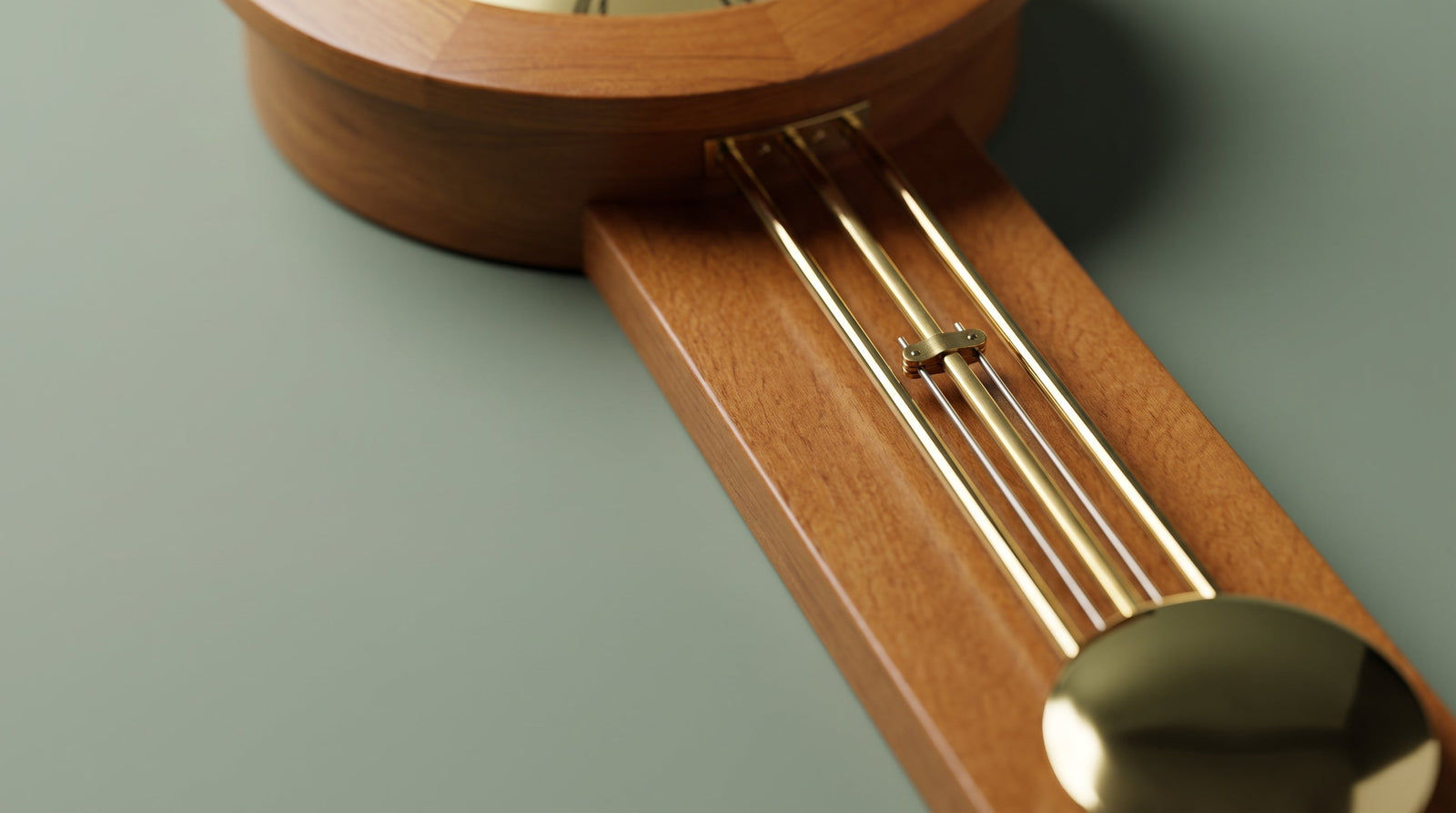

A pendulum clock that loses two minutes every day is no longer a timepiece, but rather a decoration with a tick. The problem is almost never in the movement itself, but rather in an incorrectly adjusted pendulum length, an uneven location, or dirt that has accumulated over the years. Anyone who knows the cause can fix it without a trip to the clockmaker.
This article explains how the maintenance of pendulum clocks and radio-controlled wall clocks differs, how to precisely adjust the pendulum beat, how to clean the case, and what happens automatically—and what does not—during the daylight saving time change on October 26, 2025. The information refers to typical quartz and radio-controlled pendulum movements, such as those installed in the models from the AMS clock factory in Furtwangen, as well as mechanical movements for hobbyists.
What distinguishes the maintenance of pendulum clocks and radio-controlled wall clocks
Pendulum clocks and radio-controlled wall clocks share the same case and appearance, but they work in fundamentally different ways. A classic pendulum clock with a quartz or mechanical movement drives the pendulum electrically or via a mainspring. The time is stored within the movement itself, and time deviations accumulate daily. A radio-controlled pendulum clock, on the other hand, receives the DCF77 signal from the time signal transmitter in Mainflingen near Frankfurt, automatically corrects its internal time daily, and therefore permanently displays the official time.
| Feature | Quartz pendulum movement | Radio-controlled pendulum movement (DCF77) |
|---|---|---|
| Accuracy | ±15 seconds/month typical | Second synchronized to official time |
| Daylight saving time change | Manual adjustment required | Automatic via DCF77 reception |
| Reception dependency | None | Requires clear line of sight towards Mainflingen |
| Maintenance effort | Pendulum length, battery, cleaning | Antenna position, battery, cleaning |
| Operation without signal | Always independent | Continues running as quartz, corrects at next reception |
Conclusion: A quartz pendulum clock requires regular manual time checks and pendulum adjustment. A radio-controlled pendulum clock requires a good reception location and clear antenna orientation. Both need clean contacts and a dust-free case.

Adjusting the pendulum beat: Pendulum length, weight, and adjustment screw
The pendulum of a quartz movement is, in most modern wall clocks, a purely visual addition. The movement runs independently of the pendulum. In mechanical pendulum clocks, the pendulum is the actual timekeeper, whose oscillation period determines the speed of the clock.
Oscillation period and pendulum length
A pendulum swings more slowly the longer it is. The physical relationship is clear: A pendulum of about 99.4 cm swings back and forth exactly once per second. If you shorten the pendulum, the clock runs fast. If you lengthen it, it runs slow. This length is adjusted using the adjustment screw under the pendulum lens (the flat brass or wooden disc at the lower end of the pendulum rod).
- Clock is slow: Turn the adjustment screw to the right, the lens moves up, the pendulum effectively becomes shorter, and the clock runs faster.
- Clock is fast: Turn the adjustment screw to the left, the lens moves lower, the pendulum effectively becomes longer, and the clock runs slower.
- Depending on the model, a quarter turn corresponds to a change of about 30 seconds per day. Small steps are advisable.
How much time deviation is normal?
For mechanical pendulum movements in the hobby sector, a deviation of 1 to 5 seconds per day is common. Precision pendulum clocks from the 19th and early 20th centuries achieved fractions of a second per day, but this requires a temperature-compensated pendulum rod and a vibration-free location. For home use, a daily deviation of less than 30 seconds is generally acceptable, provided the clock does not receive a radio correction signal.
Hanging the clock level
Before turning the adjustment screw, it is worth checking the location. A pendulum clock must hang vertically on the wall. Even a few degrees of tilt to the side will alter the uniform pendulum swing and lead to an uneven ticking rhythm, known as a "bad beat." If the clock hangs crookedly, adjusting the pendulum length will not help.

Cleaning without damage: Case, dial, and pendulum
Large clocks often stand in the same place for years. Dust settles on the wooden case, the glass pane, and the dial. If you clean rarely, you risk dust entering the ventilation slots and combining with moisture to form a tough paste that slows down the movement or corrodes contacts.
Wooden case
Wooden cases, whether cherry, alder, or wood decor, should be wiped with a slightly damp, soft cotton cloth. No spray cleaners, no polishes with solvents. Lacquered surfaces are sensitive to alcohol and can become dull. For stubborn stains, lukewarm water is sufficient. Wipe dry immediately afterwards so that no moisture seeps into the joints.
Mineral glass and dial
The glass pane can be cleaned with a grease-free microfiber cloth. Fingerprints on mineral glass disappear without pressure; never scratch with sharp objects. The dial itself should not be touched; gently dust it off with a soft brush (photographic lens cleaning brush). Moisture on the dial can leave irreversible discoloration.
Pendulum and suspension
Wipe the pendulum itself, i.e., the rod and lens, with a dry cloth. Do not bend the suspension spring, the thin metal leaf at the upper end of the pendulum rod, and do not touch it with cleaning agents. It is the most sensitive part of the pendulum suspension. If you notice a broken suspension spring (the clock does not start even though the battery and movement are fine), you should take the movement to a clockmaker.
Movement and contacts
The actual quartz or radio-controlled movement is usually accessible behind the dial. Clean the battery compartment contacts with a dry cotton swab. Carefully treat corroded contacts (recognizable by white or greenish deposits) with contact spray. Do not introduce oils or lubricants into the quartz or radio-controlled movement; these movements are maintenance-free and do not tolerate re-lubrication. For mechanical pendulum movements with chain or spring drive, the following applies: a basic cleaning and re-lubrication should be done by a professional every 5 to 10 years.
Radio-controlled wall clock: Check DCF77 reception and align antenna
The DCF77 signal transmits from the long-wave transmitter in Mainflingen (Hesse) at a frequency of 77.5 kHz. It carries Germany's official time and can be received in large parts of Central Europe. The range is over 2,000 km under good conditions. Within Germany, reception problems are almost always due to shielding, not excessive distance.
Common reception obstacles
| Obstacle | Effect | Remedy |
|---|---|---|
| Concrete walls, reinforced concrete | Damping of the long-wave signal | Place the clock closer to an outer wall or window |
| Electrical devices nearby | Interference signals overlap DCF77 | Minimum distance of 1.5 m from PC, TV, microwave |
| Metal case or aluminum frame | Shielding of the ferrite antenna | Align the antenna axis perpendicular to the transmitter direction |
| Basement or interior room without outer wall | Signal too weak | Change location, ideally near an outer wall |
Antenna alignment
The ferrite antenna in a radio-controlled wall clock is directional. It receives best when its longitudinal axis is perpendicular to the line connecting Mainflingen and the clock. If you live in Germany, turn the clock so that the antenna (usually invisible behind the dial) is oriented east-west. Many manufacturers print an arrow or note on the case. Reception is checked via the synchronization cycle: Most radio-controlled wall clocks synchronize between midnight and 3 a.m. A quick battery reset (remove battery, wait 10 seconds, reinsert) starts an immediate search.
If you are unsure whether a radio-controlled wall clock is actually receiving, you can find further information in the article Solar and radio-controlled clocks in detail: Technology, performance, and limits.

Daylight saving time change in autumn: What happens automatically and what remains manual
On the last Sunday in October, clocks in Germany and Austria are set back from 3:00 a.m. to 2:00 a.m. In 2025, this is October 26. For clock owners, this means: one hour gained, but also one hour of effort if the clock does not do it itself.
Radio-controlled pendulum clocks and radio-controlled wall clocks
Radio-controlled clocks with DCF77 reception handle the time change fully automatically. The signal contains an advance notice sent one day before the change, and the clock sets itself to the correct time during the night. Prerequisite: The clock must receive a valid signal on the night of the change. If it is in a room with poor reception, it may not switch until a day or two later. This is not a defect, but a consequence of the missing signal. Remedy: Place the clock in an area with strong reception for the night of the change.
More about the automatic change is explained in the article Daylight saving time 2026: Automatically switching radio-controlled and pendulum clocks.
Quartz pendulum clocks without radio reception
These clocks have no correction signal. The time change is manual. For most models, you turn the hands back one hour using the manual setting knob located on the side of the movement. Note: Never turn the hands backwards; always turn them in a clockwise direction, i.e., 11 hours forward instead of one hour backward. Striking clocks and pendulum clocks with bell chimes must wait for each strike before turning further so that the strike sequence and hand position remain synchronized.
Mechanical pendulum clocks with striking mechanism
If you own a mechanical movement with an hour or quarter-hour strike (such as a Westminster chime), do not turn the hands through quickly; instead, wait for the full strike after every hour. The hour hand and the striking mechanism are coupled via a count wheel. If you turn too quickly, the striking mechanism decouples and displays the wrong hour, even if the hands are set correctly. In this case, you must continue setting until the striking mechanism and hands match again.
Common mistakes and how to avoid them
- Changing the battery too late: Deeply discharged batteries corrode in the compartment and damage the contacts. If you notice a deterioration in accuracy, replace the battery before the clock stops.
- Hanging the pendulum clock crookedly: Even a 2-degree tilt creates an uneven pendulum swing. Before any regulation, check whether the clock is hanging truly vertically.
- Turning the adjustment screw too far: More than half a turn at once changes the rate significantly. It is better to take small steps and check after every 24 hours.
- Hanging a radio-controlled clock next to the TV: Electrical devices interfere with DCF77 reception. A minimum distance of 1.5 m is not a recommendation, but a technical necessity.
- Cleaning the dial with a damp cloth: Moisture can penetrate under the glass and damage the dial printing or luminous material.
- Bending the suspension spring: The thin metal leaf via which the pendulum hangs from the movement breaks immediately if handled improperly. Never touch it with tools.
- Adding oil to the quartz movement: Modern quartz and radio-controlled movements are designed for lifetime operation without re-lubrication. Oil becomes resinous and causes damage.


