


Sapphire crystal, mineral glass, Hardlex: Considering watch crystals and water resistance together
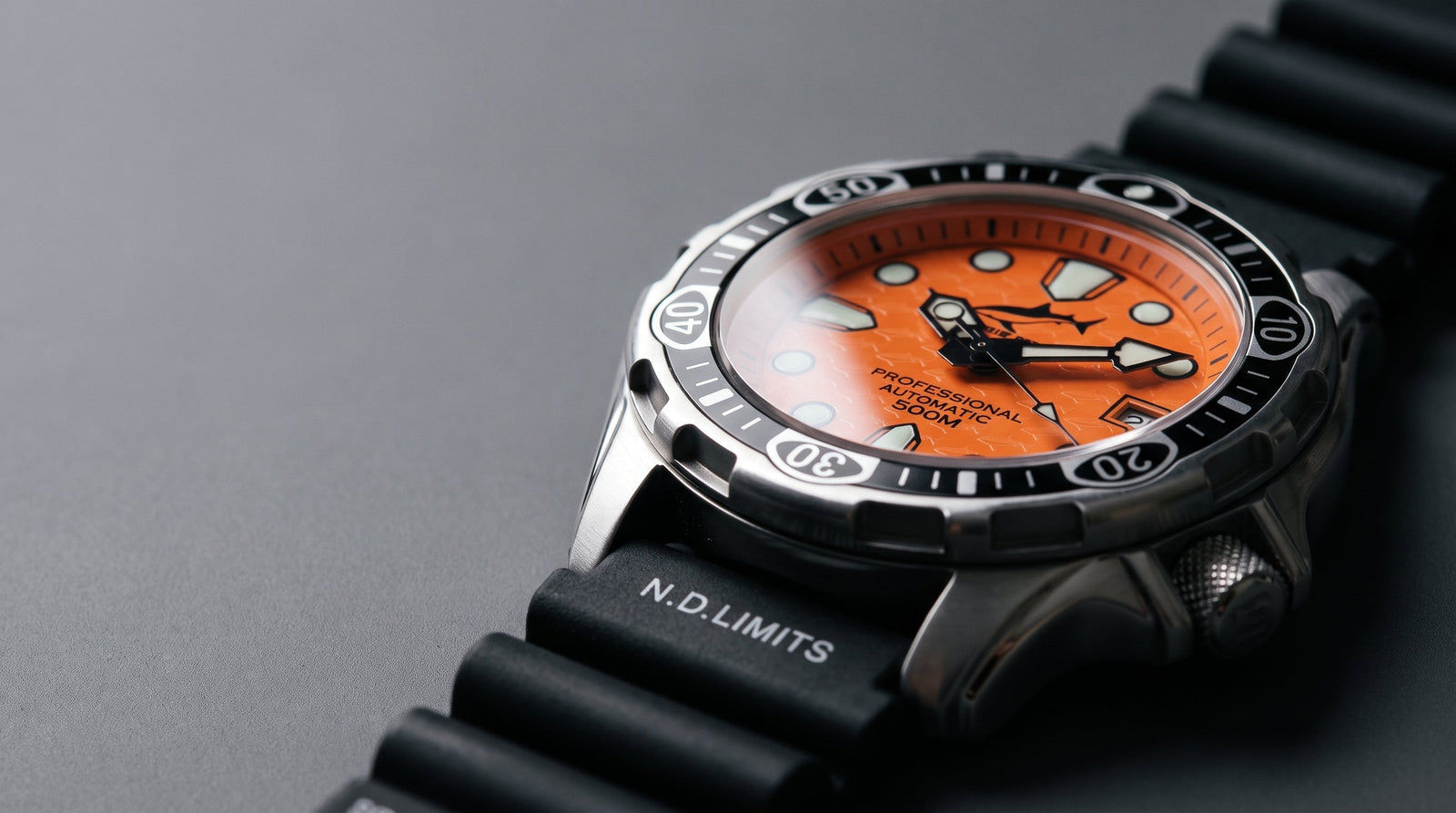

Anyone buying a new wristwatch almost always stumbles across two specifications on the data sheet: the type of glass and the water resistance in bar. Both appear side by side, but are rarely explained together. Yet they are more closely related than they seem at first glance. How scratch-resistant the glass is, how tightly it sits in the case, and what pressure it can withstand are not independent properties.
This article compares the technical data of the three common types of glass and shows how they relate to the water resistance rating. The basis for this is data sheets from our range as well as general material science facts about the materials. Anyone who knows what 5 bar with sapphire crystal means and why 3 bar mineral glass is enough for some buyers can make the decision themselves without any effort.
Three types of glass in comparison: composition, hardness, and scratch behavior
The terms sapphire crystal, mineral glass, and Hardlex describe three fundamentally different materials used in watches as a glass cover over the dial.
Mineral glass
Mineral glass is tempered window glass. It is treated thermally or chemically so that the surface builds up compressive stress, which makes small scratches more difficult. The hardness on the Mohs scale is about 5-6. This is sufficient for everyday office life, but a stone on the ground or a rough metal edge will leave visible marks if handled carelessly. Mineral glass is inexpensive to produce and easy to replace if damaged.
Hardlex
Hardlex is a brand name from Seiko for a specially hardened mineral glass. The process creates a deeper hardness zone than simple mineral glass; the surface is estimated to be at 6-7 on the Mohs scale. Hardlex is therefore more scratch- and shatter-resistant than standard mineral glass, but remains a silicon-based glass product, not sapphire. Hardlex is found in the lower and middle price range, where it is a useful compromise between cost and durability.
Sapphire crystal
Sapphire crystal is synthetic corundum, i.e., artificially grown aluminum oxide. With a Mohs hardness of 9, it is just below diamond. Only very hard minerals or carborundum abrasives leave marks on it. For everyday watch use, this means: practically no everyday scratches. The disadvantage is different. Corundum is more brittle than glass. A point impact on an edge can break the sapphire crystal, where mineral glass would only get a scratch. Sapphire crystal is more expensive to manufacture and replace.
| Property | Mineral glass | Hardlex | Sapphire crystal |
|---|---|---|---|
| Material | Tempered silicate glass | Deep-tempered silicate glass (Seiko) | Synthetic corundum (Al₂O₃) |
| Mohs hardness (approx.) | 5-6 | 6-7 | 9 |
| Scratch resistance | Low | Medium | High |
| Breakage behavior | Shatters, more flexible | Shatters, slightly more flexible | Brittle, breaks under point load |
| Typical price range | Entry-level | Entry-level to mid-range | Mid-range to premium |
| Polishability | Good | Good | Only with diamond polish |

Water resistance in bar: what 3 bar, 5 bar, and 10 bar allow in everyday life
The water resistance rating in bar is a static test value, not a promise of dynamic pressure. Water resistance ratings in bar and meters correspond to laboratory values under static conditions. In everyday life, movement creates a multiple of the static pressure. An outstretched arm when diving into water creates significantly more than the nominal value just below the surface.
| Rating | Means in the lab | Allows in everyday life | Not suitable for |
|---|---|---|---|
| 3 bar / 30 m | Static pressure 3 bar | Splashes, light rain, washing hands | Showering, swimming, sports |
| 5 bar / 50 m | Static pressure 5 bar | Showering, brief submersion in still water | Swimming laps, snorkeling |
| 10 bar / 100 m | Static pressure 10 bar | Swimming, snorkeling, water skiing | Scuba diving |
| 20 bar / 200 m | Static pressure 20 bar | Sports diving to medium depth | Deep diving over 40 m |
| 50 bar / 500 m+ | Static pressure 50 bar | Professional diving | Hardly any restrictions in sports |
An important limitation: Hot water and strong temperature fluctuations put a strain on the seals, regardless of the nominal bar value. Anyone who goes into the sauna with a 10-bar watch or steps under a hot shower risks more than with immersion in cool water with the same rating.
Seals and glass material: how both work together
The water resistance of a watch does not depend solely on the glass. It is the result of the entire system of the case, seals on the crown and pushers, case back, and the glass itself. The glass itself is one of several sealing surfaces.
Here, the type of glass plays an indirect role. Sapphire crystal has a very low surface roughness and can be ground flat, which allows the seal between the glass and the case bed to fit more evenly. Mineral glass is also flat, but in simpler case constructions, smaller tolerances are less precisely maintained. Hardlex lies in between.
More important than the glass material is the form of embedding. A glass that is glued into a milled groove may hold better than a press-fitted sapphire crystal in a poorly milled case. Therefore, the type of glass alone says nothing about the actual water resistance achieved. The manufacturer's specification in bar or ATM is the truly reliable criterion.


Price range and glass choice: what is typically installed at which price level
In the uhren4you.de range, the distribution is easy to read. Under 100 euros, mineral glass dominates. Hardlex appears from the lower double-digit range and is common in many Seiko models up to the mid-price range. Sapphire crystal reliably starts from about 100 euros and is the more frequent choice from 200 euros for models that focus on longevity.
Seiko's new Lukia edition with solar radio-controlled caliber sets sapphire crystal as the standard and shows how a manufacturer uses glass choice as a quality signal: the glass stands on an equal footing with the drive technology in product communication. This is no coincidence. Sapphire crystal costs more to produce, but remains visually untouched for years, which supports the long-term perception of the product's value.
| Price range | Typical glass | Typical water resistance |
|---|---|---|
| Under 100 euros | Mineral glass | 3-5 bar |
| 100-200 euros | Mineral glass or Hardlex, rarely sapphire | 5-10 bar |
| 200-400 euros | Sapphire crystal common, Hardlex as an alternative | 10-20 bar |
| Over 400 euros | Sapphire crystal standard | 10-50 bar and more |


Summer use, swimming pool, sports: concrete scenarios with recommendations
Abstract values help little without everyday context. Here are typical situations with concrete classification:
Outdoor and indoor swimming pools
Chlorinated water attacks rubber seals faster than fresh water. Anyone who swims regularly should choose at least 10 bar and have the seals checked more frequently. The type of glass is secondary here, as no scratches occur in the water. However, sapphire crystal is useful because pool edges and ladders made of metal are rough contact points.
Water sports and surfing
Wave impact creates dynamic pressure that is far above the static nominal value. 20 bar is a sensible minimum value here. Sapphire crystal is typical for surf watches because sand particles in the water can leave significant scratches on mineral glass.
Jogging and fitness sports on land
Sweat is hardly a problem for water resistance, but impacts against equipment or walls are for the glass. Hardlex or sapphire crystal are preferable to simple mineral glass here. 5 bar is enough for sweat and occasional raindrops.
Office and everyday life without sports
For rain resistance and hand washing, 3 bar is technically sufficient. However, anyone bothered by scratches on the glass should opt for sapphire crystal, even if water resistance is not a factor.
Diving
For scuba diving, EN ISO 6425 is the minimum requirement, which demands 20 bar under test conditions. Sapphire crystal is standard here because the standard includes crystal strength under pressure. Which protection class is sufficient for which use, is detailed.


Maintenance: when seals and glass should be checked
The water resistance rating applies to the time of manufacture and the last inspection. Seals made of rubber or silicone age, harden, and lose their elasticity. This also happens without visible damage, accelerated by UV light, heat, and chemicals such as sunscreen, chlorine, or disinfectants.
As a rule of thumb: Anyone who wears the watch regularly in water should have the seals checked by a watchmaker every two years and replaced if necessary. After a glass impact or visible cracks in the glass, immediate service is required, as water can then penetrate unhindered.
The glass itself does not wear out in its sealing function as long as it is intact. But scratches on mineral glass can weaken the crystal at sufficient depth. Sapphire crystal remains permanently sealed if there are no cracks, but is more brittle against point pressure.
More on the properties of all three types of glass in direct comparison can be found in a separate article on mineral, Hardlex, and sapphire.

Checklist: correctly matching glass type and water resistance
- Always check water resistance in bar against actual use, not against the nominal depth rating.
- For regular swimming pool use, have seals checked every two years, even if the watch appears undamaged on the outside.
- Sapphire crystal protects against scratches, not against breakage from point impacts. For climbing or martial arts, mineral glass with higher breakage resistance can be an alternative.
- Hot water and strong temperature changes stress seals regardless of the bar rating.
- After a visible crack in the glass: dry immediately, do not continue to wear in water, take to a watchmaker.
- Wipe off sunscreen and disinfectant before wearing, as they attack rubber seals.


