


Seiko vs. Citizen: Automatic and Solar Watches Under 500 Euros
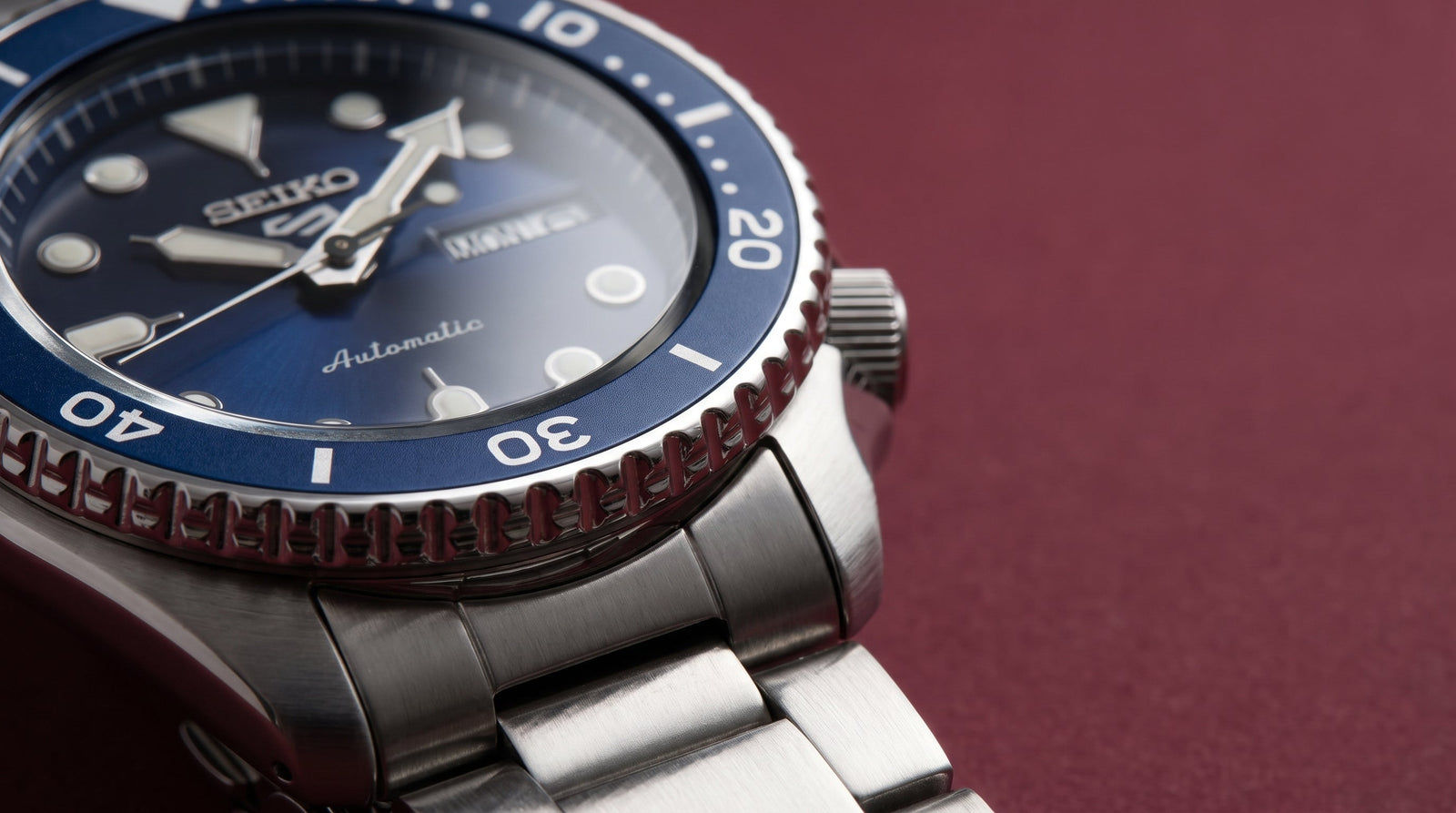

This article compares data sheets, not wearing experiences. The technical specifications are taken from the product fields of the uhren4you catalog as well as from publicly available manufacturer specifications. Anyone who wants to first understand how automatic, quartz, and solar movements work in principle will find a compact introduction in the Watch Movement Lexicon on Quartz, Automatic, Manual Wind, and Solar.
Two Japanese strategies: Seiko's automatic tradition versus Citizen's solar focus
Seiko has built its international market position in the mid-range primarily on mechanical movements. The Seiko 5 Sports line, the Prospex diver's watches, and the Presage collection are almost entirely equipped with automatic movements. Citizen, on the other hand, has developed Eco-Drive technology—where a solar cell behind the dial converts light into electrical energy and charges a rechargeable battery—into its central platform. In Citizen's current portfolio, solar and solar-radio-controlled models make up the largest share.
There are strategic reasons for this: An automatic movement requires manual assembly and a greater case depth. A solar quartz movement can be built thinner and lighter and eliminates the need for battery changes entirely. With the Promaster, Citizen has built a robust outdoor line based on Eco-Drive that competes directly with Seiko's Prospex. The comparison of both brands is therefore not just a brand comparison, but a comparison of two technical philosophies.
Movement data comparison: NH35/NH38 and 4R36 versus Eco-Drive calibers on paper
In the segment up to 500 euros, Seiko relies primarily on three caliber families:
- NH35 and NH38 (also referred to as 4R35/4R36): 21,600 vibrations per hour (3 Hz), power reserve of approximately 41 hours, manual winding, and quick-set for date (4R35) or date and day (4R36).
- 4R65 and related GMT calibers: same as 4R36, but with an additional 24-hour hand for a second time zone.
- 6R35 (in the Presage line): 45-hour power reserve, otherwise similar basic data.
Citizen's Eco-Drive calibers are quartz calibers whose accuracy is typically plus/minus 15 seconds per month. The solar cell powers a rechargeable battery. When fully charged, most calibers can run for several months in the dark. Radio-controlled Eco-Drive calibers additionally receive a time signal and automatically correct the time as soon as reception is available.
| Feature | Seiko 4R35/4R36 | Citizen Eco-Drive (Solar Quartz) |
|---|---|---|
| Drive principle | Automatic (rotor self-winding) | Solar quartz (light-powered battery) |
| Accuracy | ±15 sec. per day (manufacturer specification) | ±15 sec. per month (typical) |
| Energy source | Wrist movement, manual winding | Light of any kind, rechargeable battery |
| Power reserve | approx. 41 hours | several months (dark, charged) |
| Movement maintenance interval | recommended every 3-5 years | Battery replacement after approx. 10 years |
| Manual winding possible | yes | no (light required) |
Comparison of accuracy, maintenance intervals, and everyday suitability
Everyday accuracy
According to manufacturer specifications, Seiko's 4R36 caliber is designed for plus/minus 15 seconds per day. This corresponds to a deviation of about seven to eight minutes per month if the movement is running at the worst point of its tolerance. In practice, many examples perform better, but the corridor is wider than with quartz. Those who value minute-level punctuality without occasional setting will find this more reliably with Citizen's Eco-Drive.
Citizen's solar quartz calibers keep time to plus/minus 15 seconds per month, which is about 30 times more accurate than the Seiko automatic movement in the worst-case scenario. With radio-controlled Eco-Drive models, the question of accuracy is largely eliminated because the time signal corrects the watch to atomic time daily.
Maintenance and running costs
An automatic movement recommends a service every three to five years: cleaning, re-lubricating the bearings and gears, and checking the seals. The costs for such a service on a Seiko caliber range from double to triple digits depending on the workshop. If you wear the watch daily, five years is a good interval.
Citizen Eco-Drive movements do not require regular servicing because the drive does not store spring energy and the moving parts are minimal. The rechargeable battery (not a standard disposable battery, but a capacitor-like storage element) loses capacity after about ten years and is then replaced by a watchmaker. This is a less invasive procedure than a full overhaul of an automatic movement.
Everyday suitability
An automatic movement works as long as it is worn on the wrist. If you travel for a week and leave your Seiko 5 Sports in your suitcase, you will find it has stopped and you will have to reset it. This is not a defect, but a design feature. Citizen's Eco-Drive keeps time even after months in the dark, provided the battery was charged beforehand.

Price range 100 to 300 euros: where the differences become visible
The Seiko 5 Sports series begins in this segment. Models like the SRPD51K1 or the SRPJ81K1 offer an automatic movement (4R35 or 4R36), 10 bar water resistance, and mineral glass (Hardlex). The cases are made of stainless steel, and the bezels on sports models are often rotatable.
Citizen competes in this price range with Eco-Drive models that also offer stainless steel cases and mineral or sapphire glass, plus solar automatic charging without battery changes. The main difference is the drive principle. Citizen's quartz movements in this range display the time more accurately, while Seiko's automatic movements have the mechanical character that many watch enthusiasts are looking for.
An important point for divers and swimmers: Both brands offer models in this price range with 10 bar water resistance, which allows for swimming and snorkeling, but not scuba diving.

| Criterion | Seiko 5 Sports (100-300 euros) | Citizen Eco-Drive (100-300 euros) |
|---|---|---|
| Movement type | Automatic (4R35/4R36) | Solar quartz |
| Accuracy | ±15 sec./day | ±15 sec./month |
| Glass | Hardlex (hardened mineral) | Mineral or sapphire (depending on model) |
| Typical water resistance | 10 bar | 10 bar |
| Mechanical character | high (rotor visible/audible) | none |
| Energy independence | low (41 h power reserve) | high (months without light) |
Price range 300 to 500 euros: sapphire glass, titanium, Promaster versus Seiko 5 Sports and Prospex
Between 300 and 500 euros, the range of both brands opens up significantly. Seiko enters the race here with the Prospex diver's watch, including the SRPE93K1 with 200 bar water resistance (suitable for scuba diving), a unidirectional rotating bezel, and the in-house automatic caliber 4R65. The Seiko 5 Sports HDB002K1 comes in this segment with a GMT caliber and sapphire glass (Hardlex variant with hardened cover glass).
Citizen's Promaster line competes in the same price field: titanium cases in some variants (titanium is lighter than steel and more skin-friendly for those with nickel allergies), sapphire glass, Eco-Drive solar, and automatic time correction for radio-controlled models. Those who regularly switch between time zones will find a function in Citizen's radio-controlled Eco-Drive models that Seiko's mechanical GMT movements do not offer: the watch sets itself.
A relevant difference in the upper price range concerns water resistance. Citizen's Promaster diver's watches are designed for 20 bar in this segment, which allows for scuba diving up to defined depths. Seiko's Prospex SRPE93K1 reaches 200 bar, one of the highest classes in the segment, which goes far beyond sports and recreational diving.

| Criterion | Seiko Prospex / 5 Sports GMT | Citizen Promaster Eco-Drive |
|---|---|---|
| Movement type | Automatic In-House | Solar quartz (Eco-Drive) |
| Glass | Hardlex / Sapphire glass (depending on model) | Sapphire glass |
| Case material | Stainless steel | Stainless steel or titanium |
| Water resistance (typical) | up to 200 bar (Prospex) | up to 20 bar |
| Automatic time correction | no | yes (radio-controlled variants) |
| Second time zone | yes (GMT models) | yes (World-Time variants) |
Anyone looking for a deeper overview of Citizen's Eco-Drive calibers and their classification into price ranges will find it in the Citizen portrait on Eco-Drive, calibers, and price ranges.
Which system suits which user
The decision between Seiko automatic and Citizen solar is not a question of quality, but a question of usage profile.
Seiko automatic suits users who: wear a watch daily and appreciate a mechanical self-winding movement, have an interest in the movement (skeleton dial, exhibition case back), want to operate a watch completely independently without an external power source, and are willing to correct the watch by a few seconds or minutes every two to three months.
Citizen Eco-Drive suits users who: own several watches and do not wear individual pieces for weeks or months, prefer absolute accuracy without having to set the time, appreciate radio-controlled time synchronization, prefer a lighter titanium case, or value a low-maintenance everyday companion.
An often overlooked aspect: In the segment up to 500 euros, Citizen also offers some automatic models under the name "Citizen Eco-Drive Automatic," which combine an in-house automatic rotor with a small solar cell. These calibers combine mechanical character with energy buffering via light, but operate on different principles than the classic Seiko mainspring. Anyone looking for this middle path should check the caliber designation of the respective model.


