


Solar and Radio-Controlled Watches in Detail: Technology, Performance, and Limitations
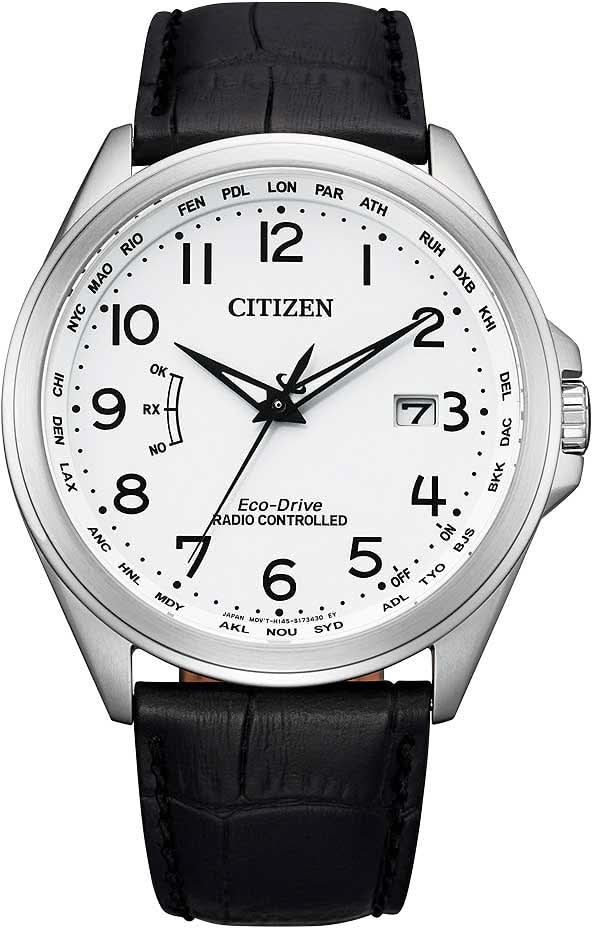

Anyone looking to buy a solar or radio-controlled watch will quickly come across terms like Eco-Drive, DCF77, or power reserve in the data sheet and wonder what they mean and whether the information is really relevant in everyday life. This article explains the technology behind both concepts, shows what the combination of solar and radio-controlled technology can do, and identifies the limitations that no manufacturer likes to emphasize.
The basis for this is technical data from the uhren4you.de range as well as generally accessible information on the processes used. Where data sheets are compared, this is explicitly stated. Citizen will celebrate the 50th anniversary of its Eco-Drive technology in 2026, which makes this technical explanation particularly timely.
How a solar watch converts light into energy: the basic mechanism
A solar watch works on the same principle as any other photovoltaic system: photovoltaic cells convert incident photons into electrical energy. In a wristwatch, these cells are integrated under the dial or directly into the dial so that the design is affected as little as possible. The transparent or semi-transparent dial lets enough light through to power the cells underneath.
The energy generated is stored in a rechargeable accumulator (a secondary cell, not a standard primary battery). Citizen calls its system Eco-Drive; this term stands for the combination of a solar cell, a lithium-ion accumulator, and a particularly energy-efficient quartz movement. Casio uses a similar system in many models under the name Tough Solar. The basic physics is identical for all manufacturers; the difference lies in the efficiency of the movement and the capacity of the accumulator.
Artificial light or sunlight: What really counts?
Both light sources charge the accumulator, but with very different efficiency. Direct sunlight provides enough energy for weeks in just a few hours with a typical solar dial. Office light or LED lighting charges noticeably slower. The decisive factor is the illuminance in lux: direct sun is over 100,000 lux, a well-lit office is 300-500 lux. Most manufacturers state in their data sheets how many hours at which lux level are required for a full charge.

Radio reception and DCF77: What is behind automatic time setting
DCF77 is a long-wave transmitter operated by the Physikalisch-Technische Bundesanstalt (PTB) in Mainhausen near Frankfurt. It broadcasts at 77.5 kHz and encodes the official Central European Time and the date as a time code in the carrier signal. A radio-controlled watch receives this signal with an internal ferrite antenna, decodes the time code, and automatically sets the hours, minutes, date, and summer or winter time correctly.
The signal from DCF77 covers a radius of about 2,000 kilometers and can therefore be reliably received throughout Germany, Austria, Switzerland, and large parts of Western Europe. Other regions use their own time transmitters: MSF in Great Britain (60 kHz), WWVB in North America (60 kHz), and JJY in Japan (40/60 kHz). Watches that only receive DCF77 no longer synchronize automatically outside the transmission range.
Reception quality: What influences it
A radio-controlled watch typically attempts synchronization at night, when the long-wave signal is exposed to less interference. Concrete ceilings, metallic building structures, and electronic devices in the immediate vicinity can impair reception. The watch then displays the stored time but does not update itself. On some models, manual synchronization can be triggered at the push of a button.

Solar plus radio-controlled combined: What this means in practice
A solar radio-controlled watch combines both concepts: it requires neither battery changes nor manual time correction. This sounds simple, but technically it presents both systems with common tasks. The reception process itself consumes power; frequent automatic reception attempts can strain the energy balance of a weakly charged watch. Manufacturers solve this by having the watch reduce or suspend reception attempts when the charge level is low.
| Feature | Pure quartz watch | Solar quartz watch | Solar radio-controlled watch |
|---|---|---|---|
| Battery change | every 2-4 years | none | none |
| Time accuracy | ±15 s/month typical | ±15 s/month typical | Atomic clock precision via DCF77 |
| Works everywhere | yes | yes (with light) | only in transmission range |
| Charging dependency | no | yes | yes |
With its Eco-Drive radio-controlled line, Citizen offers models that combine both technologies in one case. Since the first Eco-Drive model in 1976, Citizen has continuously improved system efficiency: newer calibers require only a fraction of the energy of older generations to operate, which significantly extends the power reserve. More about Citizen and titanium in the official technology overview from Citizen.

Classifying charging times, power reserve, and dark operation in the data sheet
Three pieces of information appear regularly in data sheets for solar watches and are not always intuitive to read.
Charging time to full charge
The information refers to a specified lux level, usually direct sunlight. With weaker light, the time increases proportionally. More important than the full charge time is the question of how long the watch needs under normal wearing conditions to keep the battery at a stable level. No data sheet answers this directly, but a high power reserve signals that the battery is dimensioned large enough to bridge periods with little light.
Power reserve
The power reserve indicates how long the watch will continue to run with a full accumulator without any further charging. Typical values are between 180 days and over 6 months. For radio-controlled solar models, the reserve may appear shorter because the receiver draws additional power. When comparing models, you should check whether the stated reserve was measured with or without active radio reception.
Dark operation
Some manufacturers state that the watch switches to an energy-saving state in dark storage mode: the hands stop, and the time information remains stored internally. As soon as the watch receives light again, it continues to run and adjusts the time. This extends the theoretical reserve significantly, but it means that a watch will briefly show the wrong time after a long period of darkness until it has adjusted itself.
| Information in the data sheet | What it means | What to look for |
|---|---|---|
| Charging time (full charge) | Hours until the accumulator is full | At what lux level was it measured? |
| Power reserve | Days/months of operation without recharging | With or without radio reception? |
| Dark operation / Power-Save | Hand standstill in darkness | Time adjustment after activation |
A detailed comparison of all movement types is offered by the Watch movement lexicon on quartz, automatic, manual wind, and solar. Anyone specifically looking for solar watches for men will find information on models and price ranges in the article Solar watches for men: technology, brands, and buying guide.
Limitations of the technology: When solar and radio fail
Both technologies have definable weaknesses that are rarely prominent in the data sheet.
Weaknesses of solar technology
The accumulator of a solar watch ages. Lithium-ion cells lose charging capacity over many years, so a watch may no longer have the same power reserve after ten or fifteen years as it did when new. Citizen and other manufacturers offer accumulator replacement as a service. Another point: dials with a dark coating or elaborate printing let less light through and thus reduce the charging performance compared to light-colored dials.
Weaknesses of radio reception
DCF77 is a ground-based long-wave transmitter. When traveling outside Europe, synchronization is completely lost if the watch can only receive this one transmitter. Models with multi-band reception, which receive multiple time transmitters worldwide, solve this problem but are generally more expensive. Within the reception range, strong electromagnetic interference (high-voltage lines, certain industrial plants) can prevent reception on individual nights.
What solar radio-controlled does not solve
The time zone usually has to be set manually. DCF77 transmits Central European Time; anyone living or traveling in a different time zone adjusts the hours by hand. The watch then shows the correct time for the set time zone, but the hand only adjusts to the full hour offset, not to unusual half-hour zones. Models with GPS solar, a different technical concept, solve this automatically but are in a higher price range.


