


Proper Care for Solar Watches: Charging, Dark Storage, and Strap Replacement
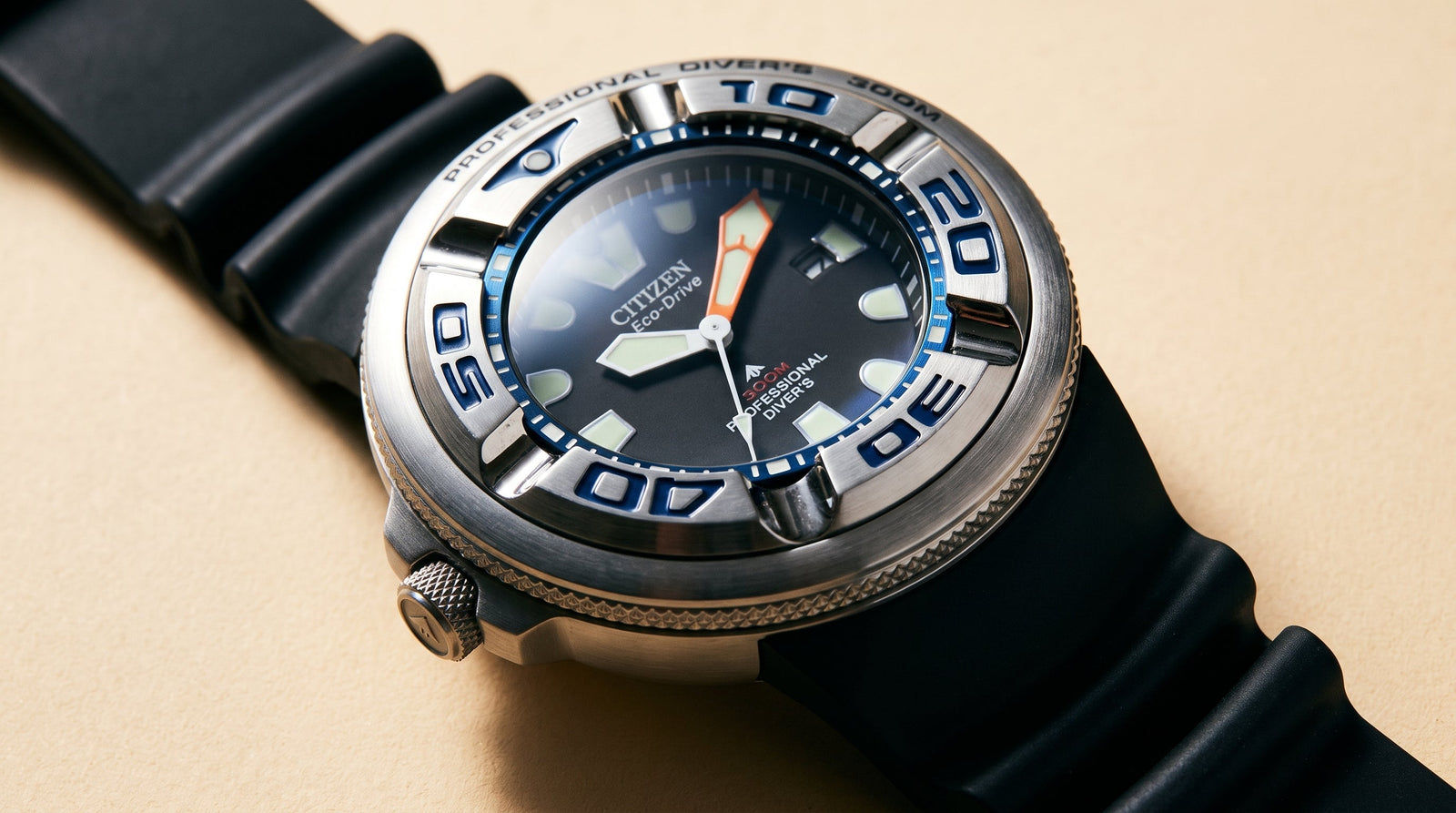

A solar watch feels maintenance-free, and for the most part, it is. However, anyone who stores the watch in a drawer for months, only wears it under artificial light, or notices a declining power reserve after years will realize: solar watches also require targeted care. The good news is that most measures can be taken without tools or specialized knowledge.
This article explains how a solar watch battery ages, what optimal charging conditions mean in practice, how to correctly interpret the low-energy warning, how to gently clean the case and strap, and when a visit to a specialist retailer is advisable. The information is based on technical data from watch movements and manufacturer specifications, not on our own measurements.
How a solar watch battery ages and what that means
Solar watches do not store the energy they collect in a standard disposable battery, but in a rechargeable battery. Most manufacturers rely on a lithium-ion battery or, in older calibers, a nickel-metal hydride battery. Both types have a limited number of charge cycles before their capacity noticeably decreases.
In practice, this means: A battery that holds only 60 to 70 percent of its original capacity after ten to fifteen years of use will charge more slowly in low light and drain faster in the dark. The power reserve—the time the watch continues to run without light—shortens. Depending on the model, Citizen specifies power reserves between 180 days and over a year for Eco-Drive calibers. If a watch that used to run for six months without light stops after just a few weeks, it is a clear sign of battery aging.
Important: An aged battery is not a defect in terms of the manufacturer's warranty, but normal wear and tear. It can be replaced, and a replacement at a specialist retailer is significantly cheaper than a new watch.

Charging correctly: Light conditions and charging times in practice
Solar cells in wristwatches convert both sunlight and artificial light into electrical energy. Efficiency depends significantly on light intensity and wavelength. Direct sunlight charges faster than office light, and fluorescent lamps provide more usable spectrum than some LED sources.
Practical tips for charging
- The watch on your wrist is sufficiently illuminated in everyday life as long as you spend time outdoors regularly.
- In the office, the watch can be placed on a desk near a window, with the dial facing the light source.
- Direct sunlight on the dial for two to three hours is sufficient for most calibers to bring an almost empty reserve back to operating level.
- Never leave the watch in a closed car in the sun for long: heat above 60 degrees Celsius permanently damages the battery. Light yes, heat no.
- UV-protective glass in some windows filters out part of the usable spectrum, so charging behind window panes is slower than in direct outdoor light.
| Light source | Typical charging performance | Note |
|---|---|---|
| Direct sunlight | High | Most efficient source, 2-3 h for full reserve |
| Overcast sky / daylight | Medium | Sufficient for ongoing operation while wearing |
| Fluorescent lamp / office light | Low to medium | Slow charging, good for trickle charging |
| Warm white LED | Low | Spectrum often unfavorable, long period required |
| Candle / incandescent bulb | Very low | Hardly suitable for emergencies |

Understanding the low-energy warning and reactivating the watch
If the battery level falls below a certain threshold, most solar watches switch to an energy-saving mode. The second hand then jumps in two-second intervals instead of the usual one-second step. This is not a defect, but a warning signal: the watch is still running but is conserving its battery. This state is called the low-energy mode or power-save mode, with the low-energy mode referring to the automatic stop when the battery is completely drained.
In the true low-energy state, the watch stops completely to prevent deep discharge of the battery. Deep discharge can permanently damage lithium-ion batteries. To reactivate the watch, hold it in bright light for a few minutes. Most calibers will then resume operation automatically. If the watch does not run correctly afterward—i.e., it shows the wrong time or the second hand continues to jump noticeably—a manual time correction is necessary. For radio-controlled watches like the Citizen Eco-Drive, a radio synchronization, provided there is reception, solves this problem automatically.
Those who want to understand more about the technology behind solar and radio-controlled watches can find a detailed overview in our article Solar and radio-controlled watches in detail: technology, performance, and limits.

Cleaning the strap and case without damaging the solar cell
The solar cell is located directly under the dial and is protected by the watch crystal. Mechanically, it is not at risk during normal cleaning. However, the watch crystal itself, whether mineral or sapphire, is sensitive to incorrect cleaning agents and hard objects.
Correct cleaning of the case
A soft, lint-free cloth, slightly dampened with lukewarm water, removes everyday dirt without scratching the glass. Solvent-based cleaners, high-concentration alcohol, and ultrasonic cleaners are not recommended without consulting a specialist retailer, especially if the watch's water resistance has not been recently tested. Gaskets age and can fail under aggressive cleaning.
Metal and plastic straps
Link bracelets made of stainless steel or titanium collect dirt in the joints. A soft toothbrush with lukewarm water loosens stubborn residue. Then pat dry, do not rub. Plastic straps, as are common with Casio models, can be cleaned in the same way and can withstand a bit more mechanical pressure.
Leather and textile straps
Leather straps absorb moisture and can become brittle or stained with frequent contact with water. They can be wiped with a slightly damp cloth but should then be allowed to dry completely. If you wear the watch regularly while exercising, replace the leather strap with a rubber or textile strap in the medium term.
Changing the strap yourself
For most wristwatches, the strap can be changed without tools or with a simple spring bar tool. Spring bars are the small, spring-loaded pins that hold the strap to the case. An inexpensive spring bar tool from a watch shop is sufficient for this process. Important: When changing, be careful not to slide the tool onto the watch crystal. If you are unsure, leave the change to the retailer.
| Strap material | Cleaning agent | Special notes |
|---|---|---|
| Stainless steel | Water, soft brush | Dry joints carefully |
| Titanium | Water, soft cloth | Avoid scratches from hard brushes |
| Plastic / rubber | Water, soft brush | Robust, can withstand more pressure |
| Leather / vegan leather | Slightly damp cloth | Do not soak, let dry completely |
| Textile / NATO style | Water, mild | Remove and dry separately |

When to visit a specialist retailer: battery replacement and water resistance test
Two scenarios clearly call for a visit to a specialist retailer, and neither should be postponed.
The first is battery replacement. If a solar watch switches to low-energy mode significantly earlier than before despite regular charging, or stops more frequently, the battery capacity has decreased significantly. Replacement by a qualified watchmaker is possible for most solar watches. The procedure requires opening the case and thus replacing the gaskets. Anyone who replaces the battery themselves risks having a permanently leaky watch.
The second scenario is the water resistance test. Rubber or silicone gaskets age, even if the watch never comes into contact with water. Professional associations recommend a water resistance test every two to three years, or at the latest after every time the case is opened. A watch with outdated gaskets can let moisture inside while swimming or washing hands, which damages the movement and solar cell.
Additionally, a workshop visit is worthwhile if the crown is difficult to turn, the glass shows a crack, or the second hand runs irregularly. These symptoms indicate mechanical problems that have nothing to do with the battery but can damage the movement in the long term.
A good overview of the difference between solar and quartz watches in terms of maintenance is provided by our guide Quartz watch care and battery replacement: what you can do yourself.


Care checklist at a glance
- Wear the watch daily or regularly outdoors so that the solar cell receives sufficient light.
- Do not store the watch in dark drawers for weeks without fully charging it first.
- Clean the case and strap monthly with a soft, slightly damp cloth.
- No solvents, no ultrasonic baths without specialist retailer approval.
- In case of two-second jumping: immediately place in bright light and check charge level.
- Battery replacement and water resistance test every two to three years at a watchmaker.
- Have new gaskets inserted after every time the case is opened.
- Do not expose the watch to ambient temperatures above 60 degrees Celsius permanently.


