


Sternglas vs. Zeppelin: A Comparison of Two German Watch Brands
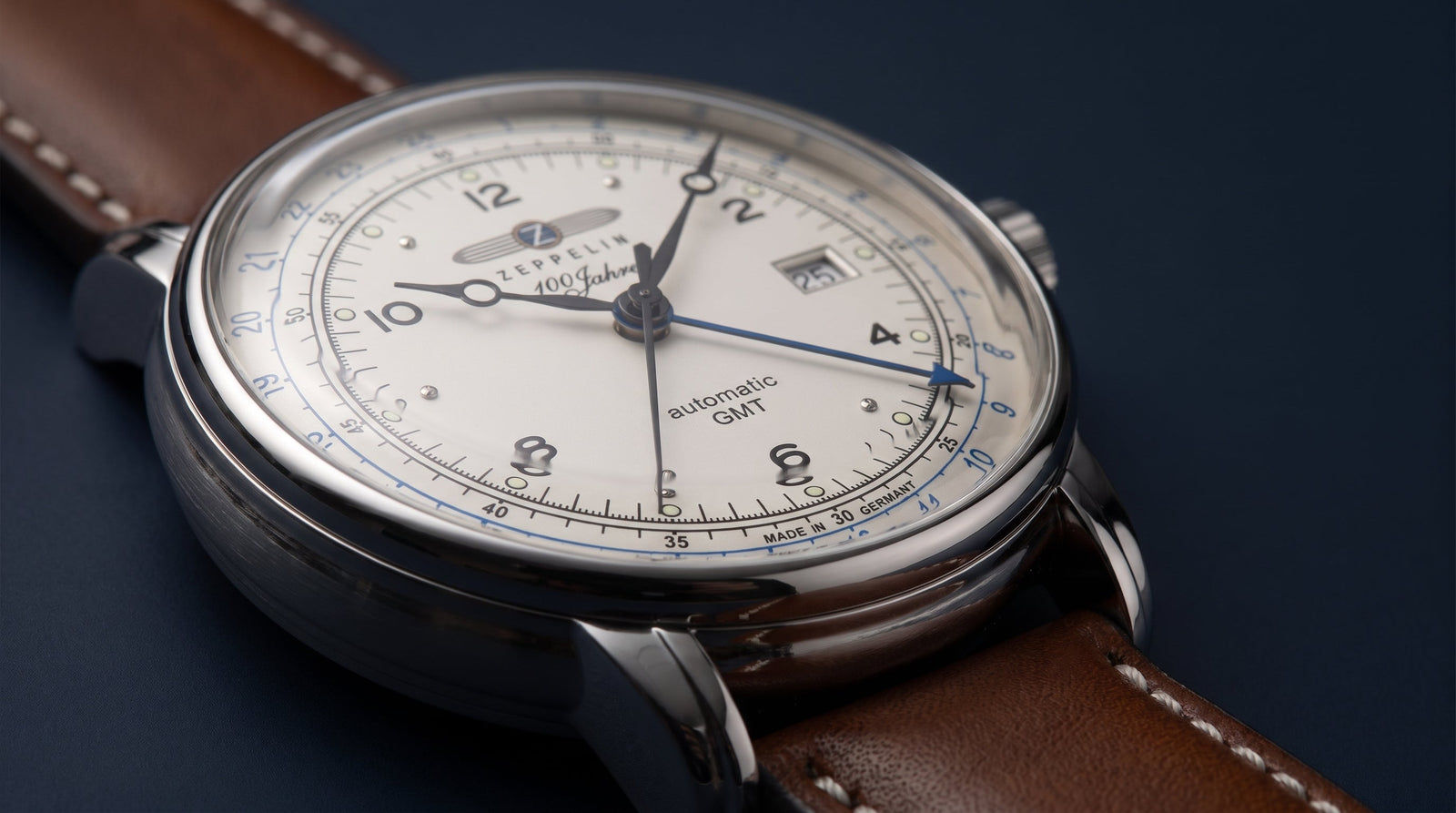

Anyone torn between a Sternglas and a Zeppelin is comparing two brands that, at first glance, belong on the same shelf: both German, both under 500 euros, both with a clear design statement. At second glance, the differences lie in the spec sheets, not in gut feeling. This article compares exclusively technical data and product range data from the catalog. No wearing experiences, no test series.
The Geneva Watch Days 2026 have reignited interest in German watch brands and brought the question of what defines a brand beyond its name into sharper focus. Sternglas hails from Hamburg, draws inspiration from the Bauhaus heritage, and consistently works with slim cases. Zeppelin comes from Pforzheim, references the history of German aviation, and offers a wider range of functions. This comparison highlights where the details diverge.
Two brands, one root: What connects and divides Sternglas and Zeppelin
Both brands cater to a German-speaking audience that values recognizable heritage and is willing to invest a mid-three-figure sum for clean design. Both are positioned in the price range between 150 and 500 Euro, both predominantly sell men's watches, and both use Japanese movements as their base.
The distinction begins with the design reference. Sternglas draws on Bauhaus, the design school active in Germany between 1919 and 1933, which championed reduction to the essentials as its core philosophy. Dials at Sternglas feature minimal decoration, hands are slim, and typography is clean and understated. Zeppelin, on the other hand, takes the aviation history of the 1920s and 1930s as its source of inspiration: domed dials, Arabic numerals, and complications like Dual Time or GMT that evoke onboard instruments.
Im Sortiment von uhren4you sind 199 Sternglas- und 247 Zeppelin-Modelle gelistet. Zeppelin hat damit eine leicht größere Sortimentsbreite, die sich vor allem in mehr Funktionsvarianten niederschlägt.
Movements in Comparison: Quartz and Automatic at Sternglas and Zeppelin
Both brands rely on Japanese movements, but choose different focal points.
Sternglas: Quartz as standard, automatic as an upgrade
The majority of Sternglas models run on a quartz movement, often Miyota calibers from the JS series or comparable Ronda movements. Here, quartz means: excellent accuracy (typically plus/minus 15 seconds per month), no winding, no rotor. The automatic line, recognizable by the abbreviation S02 in the model name, uses Miyota automatic movements with self-winding via an oscillating rotor. The rotor spins with every movement of the wrist and winds the mainspring, which stores the energy. Typical accuracy deviation for these movements: plus/minus 10 to 20 seconds per day, which is mid-range for an automatic movement.
Zeppelin: Quartz with functional depth, automatic with GMT
Zeppelin also offers both movement types. The quartz models range from simple three-hand movements to chronographs and dual-time versions. The flagship of the automatic line is the Miyota 9075, a movement with a true GMT function: it displays a second time zone via an additional 24-hour hand that can be set independently of the hour hand. This is functionally more sophisticated than a simple automatic three-hand watch.
| Feature | Sternglas | Zeppelin |
|---|---|---|
| Main drive | Quartz (Miyota, Ronda) | Quartz (various calibers) |
| Automatic available | Yes (Miyota series) | Yes (including Miyota 9075) |
| GMT function | No | Yes (automatic line) |
| Chronograph | Selected models | Multiple models |
| Quartz accuracy | Very high | Very high |
If you want to dive deeper into the topic of automatic movements, you can find more information in the article Automatic Watches for Beginners: What Self-Winding Means in Everyday Life a detailed explanation of the mechanics and their practical consequences.


Case, crystal, and water resistance: technical specifications in a direct comparison
For both brands, the case is made of stainless steel. Sternglas cases tend to be slimmer and often remain under 40 mm in diameter, which benefits smaller wrists and aligns with the Bauhaus principle of reduction. Zeppelin cases are frequently somewhat more solid, which fits the aviation aesthetic but also requires a larger wrist.
Sapphire crystal as a common feature
Both brands use sapphire crystal across large parts of their ranges, which is significantly more scratch-resistant than mineral glass and will not show any marks from keys or desk edges in everyday use. Sapphire crystal is by no means a given in this price range, but it is a clear sign of quality. At Sternglas, sapphire crystal is standard in almost all models, and it is also common at Zeppelin, though not across the entire range.
Waterproof
Both brands specify 5 bar for most models. In practice, 5 bar means: splash-proof, suitable for rain and hand washing, but not for swimming or diving. Anyone looking for a watch that will regularly be in water must specifically search for models with higher water resistance ratings in both product ranges.
| Feature | Sternglas | Zeppelin |
|---|---|---|
| Case material | Stainless steel | Stainless steel |
| Glass Type (Main Line) | Sapphire crystal | Sapphire crystal (many models) |
| Typical diameter | 38-40 mm | 40-42 mm |
| Waterproof (Standard) | 5 bar | 5 bar |
| Viewing window in the floor | Selected automatic models | Selected automatic models |

Price Ranges and Product Range Width: Where Each Brand is Truly at Home
Sternglas starts in the high double-digit range and ends just under 500 Euro. The focus lies in the range of 180 to 350 Euro, where most quartz and basic automatic models are priced. Models with sapphire glass and an automatic movement cost more, but generally remain under 450 Euro.
Zeppelin covers a similar range but offers more models in the over 300 Euro segment, as complications such as chronograph, dual time, and GMT require additional movement parts and therefore incur higher costs. Those looking to invest less than 200 Euros will also find entry-level models at Zeppelin.
| Price range | Sternglas: Typical models | Zeppelin: Typical models |
|---|---|---|
| Under 200 Euro | Three-hand quartz | Quartz three-hand, simple date |
| 200-350 Euro | Sapphire crystal quartz, entry-level automatic | Chronograph Quartz, Dual Time |
| 350-500 Euro | Automatic with sapphire crystal, Lumatik | GMT Automatic, Made in Germany |

Look and Style: Bauhaus vs. Aviation Reference
Sternglas consistently keeps the dial empty. No decorative elements, no guilloché patterns, no historical fragments. Indices are sleek, hands are thin, and the typography on the dial is kept to the absolute minimum. This is no coincidence, but rather programmatic design: the viewer is meant to read the time, not stare at the dial. Straps are available in leather, mesh (Milanese), or woven NATO bands, mostly in muted colors.
Zeppelin works with more dial depth. Domed dials, Arabic numerals modeled after vintage cockpit clocks, and occasional guilloché patterns or textured surfaces reminiscent of pre-war metal. This creates a different effect: more opulent, more historical, and in some models, almost theatrical. Those who collect watches because they tell a story will find more points of connection with Zeppelin. Those who wear watches because they need to function while remaining unobtrusive are more likely to find what they are looking for at Sternglas.
A detailed description of the Zeppelin design language and its historical sources can be found in the article Zeppelin Watches in Portrait: Aviation Heritage and Everyday Life.


Which brand is suitable for whom
The question cannot be answered with a ranking because both brands meet different requirements. The deciding factors are wrist size, functional needs, and design preference.
Sternglas is a perfect fit if:
- the wrist circumference is under 18 cm and slimmer cases (38-40 mm) fit better
- a minimalist, understated dial is desired that slips easily under a shirt sleeve
- Sapphire crystal and a solid quartz or automatic movement are at the forefront
- there is no need for additional functions
Zeppelin is a good fit if:
- a second time zone or a chronograph is needed
- the dial should show character and historical references are desired
- a slightly larger case (40-42 mm) fits the wrist
- Made in Germany manufacturing is a decisive criterion (applies to selected models of the Friedrichshafen line)
Both brands offer a good balance of material quality and design care in the 200 to 450 euro range. Those who find both styles appealing must choose: reduction or depth.
For comparison with a similarly structured brand duel, it is also worth taking a look at the article Bering vs. Danish Design: Nordic Watch Design in a Data Comparison, showing how Scandinavian brands solve the same reduction question.
If you would like to learn more about the German watch market and other manufacturers, you can find information at DerJuwelier.at an overview of Zeppelin and Bauhaus as Made-in-Germany brands.


