


Table Clocks for Living Room and Shelf: Size, Style, and Movement

Anyone looking for a table clock for the living room or a shelf is faced with a confusing selection: different sizes, movement types, and styles fill the market, but few guides explain which combination actually makes sense for which situation. This article answers exactly that, based on technical data from our range of around 243 table clocks.
The article compares product data and datasheet specifications. It tells you what matters when it comes to size, movement, and style, and where you have to make compromises if you prioritize certain features.
Table clock or wall clock: when which form is the better choice
Table clocks and wall clocks solve similar tasks, but under different conditions. The choice depends not only on taste, but also on the room geometry and the available space.
A wall clock needs free wall space and a fixed mounting point. It is easy to read from a distance and visually dominates an entire wall. A table clock stands on a surface, for example on a sideboard, a bookshelf, or a desk. It works well when the view from the front is at eye level or slightly below. On a high shelf above eye level, however, a table clock is harder to read than a wall clock at the same height.
For narrow shelf niches, mantelpieces, or desks where a wall clock is structurally impossible, the table clock is the only sensible choice. In rooms that generally have little wall space, for example due to many windows or shelves, the table clock takes over the time display without having to be built into the decor. You can find a direct comparison of both forms by price range in the article Wall clocks and table clocks by price: What every price range offers.
Size to surface area: how much clock fits on the shelf
The surface area is the most important selection criterion before style or movement even play a role. Anyone who does not measure the available area beforehand will buy a clock that either looks lost or displaces neighboring objects.
Reference values for common locations
| Location | Recommended width | Recommended height | Note |
|---|---|---|---|
| Shelf compartment (deep) | up to 20 cm | up to 25 cm | Note the depth of the compartment; pendulum clocks protrude forward |
| Dresser | 20-35 cm | up to 35 cm | Enough space for a pendulum movement with a visible pendulum |
| Mantelpiece | 25-40 cm | up to 40 cm | Taller shapes look more impressive here |
| Desk | up to 15 cm | up to 20 cm | Small quartz or radio-controlled clocks, no striking mechanism |
An example from our range: The Hermle acrylic table clock measures 23 x 7 x 8 cm and is therefore suitable for narrow shelves or desks. The AMS T2195/1, with its dimensions in the range of a classic mantel clock, requires significantly more surface area.


In general: A table clock should not take up more than a third of the visible surface area so that it is not perceived as an obstacle. Striking and pendulum clocks also need clearance in front because the pendulum swings beyond the base of the case in some designs.
Movement types for table clocks: Quartz, pendulum, and radio-controlled
The movement determines how accurately the clock runs, how much maintenance it needs, and whether it makes noise. This is particularly relevant for table clocks because they are often in living rooms where ticking and striking mechanisms are noticeable.
Quartz movement
A quartz movement uses a piezoelectric oscillating quartz as a clock generator and runs on a battery. It is the most accurate and low-maintenance movement for table clocks in everyday life. Deviations are typically less than one minute per year. The movement ticks audibly if the case has no sound-absorbing elements. For bedrooms or offices, there are silent quartz movements that jump one second at a time without mechanical noise.
Pendulum quartz movement
Many table clocks referred to as "pendulum clocks" do not have a mechanical pendulum movement, but a quartz movement that drives a pendulum. The pendulum fulfills an optical function here; the drive continues to come from the quartz movement and a battery. This is not a disadvantage as long as you know what you are buying: The accuracy corresponds to that of a normal quartz movement, and the pendulum swings evenly because an electric motor drives it, not gravity alone.
The AMS T1138 is an example of this principle: curved aluminum case with an Arabic dial and a pendulum quartz movement.

Mechanical pendulum movement
A true mechanical pendulum movement stores energy in a mainspring and releases it via a gear train that is timed by the swinging pendulum. The movement must be wound regularly, either daily, weekly, or less frequently for 8-day movements. The accuracy is lower than that of a quartz movement, but sufficient for decorative purposes. A mechanical skeleton movement, where the gear train remains visible, also has aesthetic value.

Radio-controlled movement
A radio-controlled movement (DCF77 receiver in Central Europe) receives a time signal and automatically sets itself to the exact time. It is more accurate than any quartz movement and requires no manual time correction, even after daylight saving time changes. A prerequisite is reception: solid walls, metal cabinets, or basements can dampen the signal. The AMS F5149 combines wood in a walnut look with an aluminum element and a radio-controlled movement.

| Movement | Accuracy | Maintenance | Noise | Fits |
|---|---|---|---|---|
| Quartz | very good (under 1 min/year) | change battery | quiet ticking | all locations |
| Pendulum quartz | very good | change battery | pendulum visible, quiet ticking | dressers, mantelpieces |
| Mechanical | sufficient | wind regularly | distinct ticking, possibly striking mechanism | representative places |
| Radio-controlled | highest (time signal) | change battery | quiet ticking | living rooms with good reception |
Styles in the range: classic, modern, and Bauhaus
The design of a table clock determines whether it fits into an interior or clashes with it. Three styles dominate the range.
Classic
Classic table clocks work with brass, polished metal, wood cases, and Roman or Arabic numerals. Striking mechanisms with a Westminster melody, i.e., a four-stage bell sequence every quarter hour, belong to the classic repertoire. The Haller table clock made of brass and glass with a Westminster melody stands for this type, as does the Hermle in wood with a vintage design. Such clocks are at home on dressers or mantelpieces, less so on minimalist shelves.


Modern and Bauhaus
Modern table clocks reduce the form to the essentials: clean lines, few decorative elements, often monochrome coloring. The acrylic case of the Hermle with quartz movement or the Atlanta made of metal and glass follow this approach. Bauhaus-inspired design emphasizes function over decoration: legible numerals, no superfluous hands, proportioned cases.
Flip numbers and retro
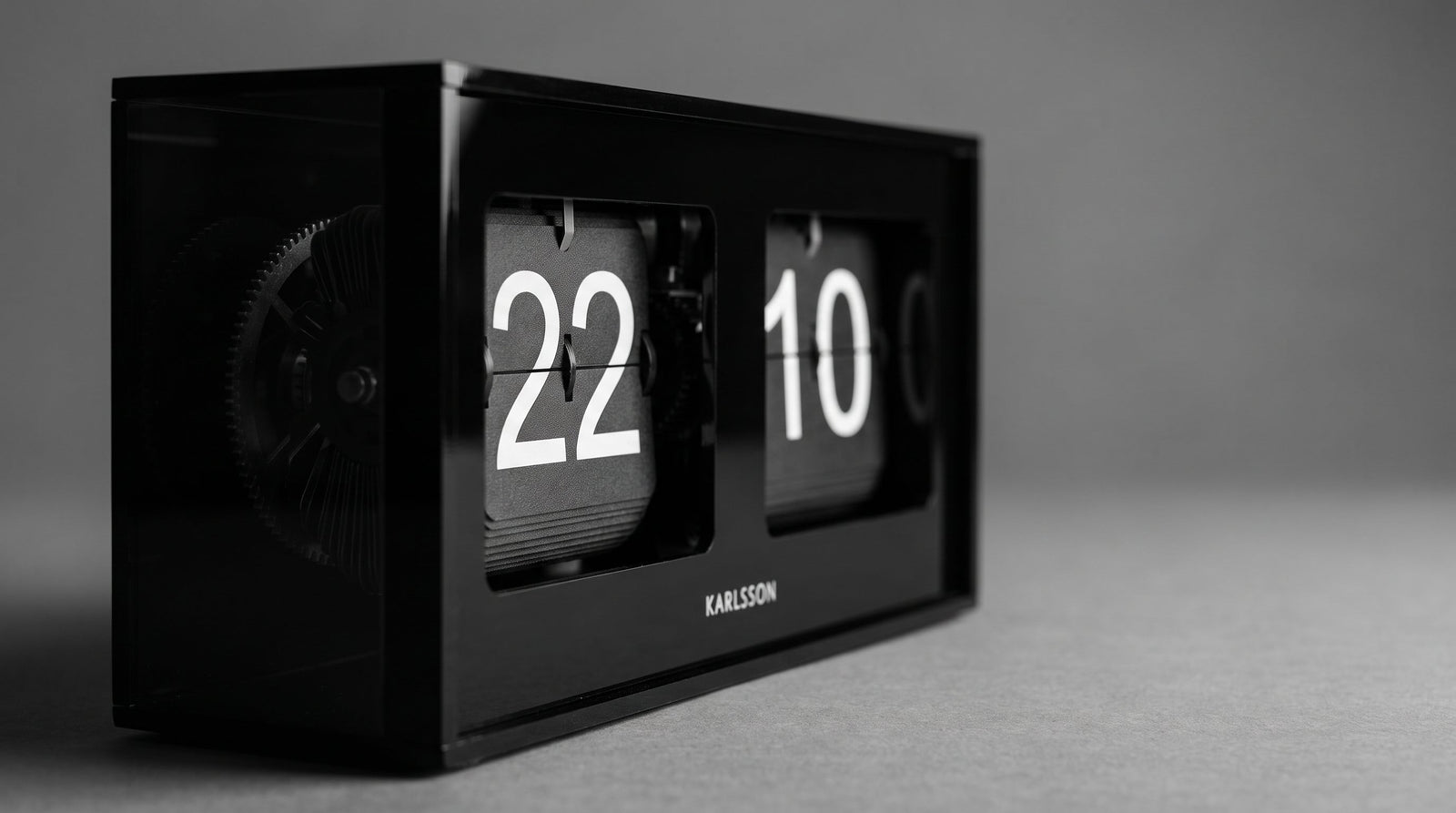
Flip-number clocks, also called flip clocks, show the time via mechanically changing dials. The sound when flipping is an essential feature: it can be pleasant or annoying, depending on the environment. The Karlsson Boxed Flip KA5976BK is an example from the range: acrylic case in black with a classic flip-number mechanism.

Overview of brands and price ranges for table clocks
In the uhren4you range, several brands cover the table clock segment, with different focuses.
| Brand | Focus | Typical price range | Movement types |
|---|---|---|---|
| AMS | Classic to modern, pendulum and radio-controlled | under 200 Euro | Quartz, pendulum quartz, radio-controlled |
| Hermle | Classic and modern, also mechanical | 100 to 500 Euro | Quartz, mechanical (8-day) |
| Karlsson | Design and retro | under 200 Euro | Quartz, flip numbers |
| Haller | Classic, brass | 200 to 300 Euro | Pendulum quartz movement |
| Atlanta | Modern, metal/glass | under 100 Euro | Quartz |
| Seiko | Timeless, compact | under 100 Euro | Quartz |
AMS produces in Furtwangen in the Black Forest and is one of the few German manufacturers with active production in the large clock segment. Hermle is also a German company with a long tradition of movements, offering both quartz and mechanical calibers. In the lower price range under 100 Euro, Seiko and Atlanta provide reliable quartz movements in simpler cases. You can find a detailed classification by price band in the article Large clocks 100 to 300 Euro: What the middle price band offers.


Checklist before buying
- Measure the surface area: note the width, height, and depth of the available space.
- Striking mechanism desired or not: Westminster melody and hourly strike are not desired in every room. Check if a night shut-off is available.
- Clarify movement type: quartz for ease of maintenance, radio-controlled for automatic time setting, mechanical for aesthetics and ritual.
- Consider the pendulum: pendulum clocks need free space in front of and below the case. Shelf compartments can be too narrow.
- Font size of the numerals: Arabic numerals are more legible at short distances than Roman ones on small cases.
- Reception conditions for radio-controlled: basements, metal cabinets, and thick walls can impair DCF77 reception.


