


Wall clocks and alarm clocks under 50 euros: What this price range offers
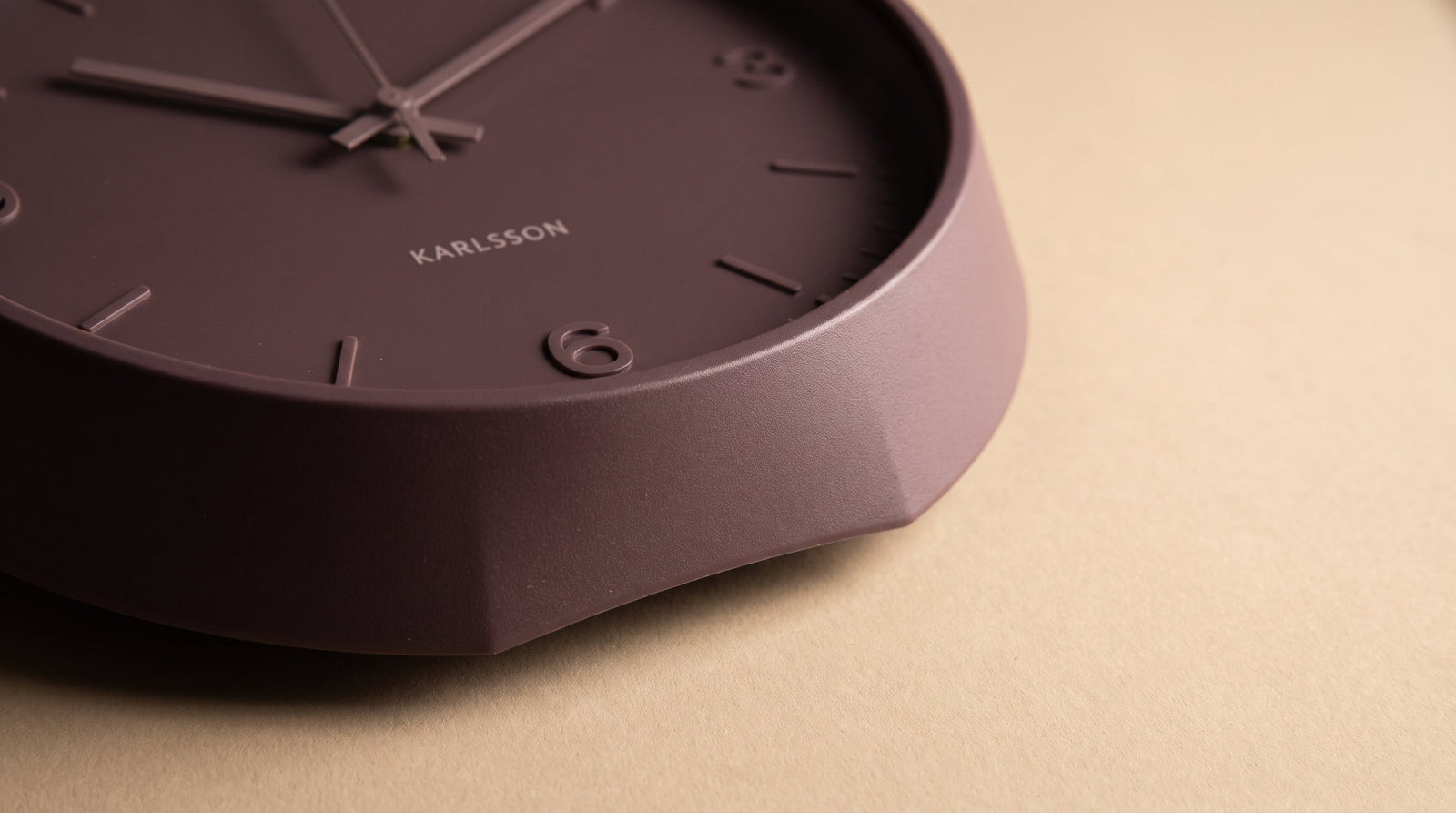

Anyone looking for a wall clock or alarm clock for the kitchen, hallway, or children's room with a budget limited to 50 euros will find surprisingly good options today, while also encountering clear limitations. This article describes what the lower price bracket actually delivers in technical terms: which movements, housing materials, and functions can realistically be expected, and where the compromises lie.
The following assessments are based on product data from the uhren4you.de catalog. Data sheets are compared, not worn or measured items.
What the lower price bracket means for large clocks: Assortment and brands
The widest range of wall clocks and alarm clocks can be found in the under 50 euro range. The three major clock brands most strongly represented in the catalog cover this range together: AMS with 743 items, Karlsson with 708, and Atlanta with 418 items. In addition, the Czech manufacturer JVD appears in the alarm clock segment.
AMS and Atlanta specialize in functional wall clocks and alarm clocks. Atlanta provides classic analog shapes, from bathroom models to mechanical alarm clocks. AMS focuses more on decorative variants with various frame materials. Karlsson positions itself in the lower to mid-range segment with design clocks that stand out due to unusual shapes.
Important to understand: 50 euros is not a rigid limit, but a range in which part of the assortment lies and in which purchasing decisions are actually made. Those who want or need to spend more will find an overview of the next price segment in the article Large clocks under 100 euros: What wall clocks and alarm clocks offer an overview of the next price segment.
Quartz vs. radio-controlled under 50 euros: What is technically possible
Most wall clocks and alarm clocks under 50 euros run on a quartz movement. Quartz movements are inexpensive to produce, reliable, and generally require an AA or AAA battery. Their accuracy is typically plus/minus 15-30 seconds per month, which is more than sufficient for use as a wall clock.
Radio-controlled clocks receive the DCF77 time signal (a time signal transmitted by the Physikalisch-Technische Bundesanstalt time standard laboratory in Germany) and automatically set themselves to the exact time. Radio-controlled wall clocks are also available in the under 50 euro price bracket, as are radio-controlled alarm clocks like the JVD RB1603.2. However, radio control has a disadvantage: in rooms with heavy shielding, in basements, or with unfavorable orientation to the transmitter antenna in Mainflingen, reception may fail. The device then displays the last synchronized time until a signal is received again.
| Movement type | Accuracy | Time synchronization | Reception required | Typical price |
|---|---|---|---|---|
| Quartz (standard) | approx. ±15-30 sec./month | manual | no | from approx. 10 euros |
| Quartz (sweep) | approx. ±15-30 sec./month | manual | no | from approx. 20 euros |
| Radio-controlled (DCF77) | Atomic time, practically exact | automatic, daily | yes (DCF77 signal) | from approx. 25 euros |
| Mechanical (alarm clock) | ±60-120 sec./day | manual, daily | no | from approx. 30 euros |

Classifying housing materials and glass quality in this price range
Plastic dominates the under 50 euro segment. This is not a weakness, but a consequence of manufacturing: plastic housings can be produced cheaply in many shapes, are lightweight, and are moisture-resistant in many models. Atlanta explicitly focuses on steam and water protection for its bathroom wall clock, which is technically easier to implement with a plastic housing than with metal.
Metal housings appear in the alarm clock segment, such as the Atlanta 1065/0 with a metal housing. Here, the weight is higher, the feel is firmer, and the model is suitable for surfaces where durability is required.
Mineral glass predominates for glazing. Mineral glass is more scratch-resistant than simple acrylic glass (Plexiglas), but less scratch-resistant than sapphire glass, which does not appear in the under 50 euro price bracket for wall clocks and alarm clocks. For use on the wall or on the bedside table, mineral glass is sufficient as long as the glass is not exposed to direct mechanical stress.
| Material | Typical for | Advantage | Disadvantage |
|---|---|---|---|
| Plastic | Wall clocks, bathrooms | lightweight, flexible shape, moisture resistance possible | less robust if dropped |
| Metal | Alarm clocks, table stands | stable, durable | heavier, colder to the touch |
| Mineral glass | Alarm clocks with glass cover | clear view, more scratch-resistant than acrylic | breaks upon heavy impact |
| Acrylic glass | cheapest wall clocks | lightweight, more shatterproof | scratches more easily |

Silent or ticking: Which movements are available in this segment
The ticking sound of a wall clock occurs when the second hand jumps in individual steps. Each step creates the familiar ticking. Whether this is annoying in the bedroom or a quiet study is a personal matter, but many buyers underestimate how loud a jumping quartz movement actually is in a quiet room.
The alternative is a sweep movement (also called a silent quartz movement), where the second hand runs continuously and smoothly instead of jumping. Sweep movements are slightly more expensive to manufacture and therefore do not appear in every model in the under 50 euro segment, but they are available. The Karlsson Slope KA6047PU, for example, is explicitly equipped with a silent sweep movement.
For alarm clocks, the sweep movement plays a smaller role because alarm clocks are designed for volume anyway. With the Atlanta 2173/30, for example, both acoustic and visual alarm signals are included. The Atlanta 1065/0 is a mechanical alarm clock whose movement is naturally audible.
For bedrooms, a sweep movement or a radio-controlled alarm clock, which also comes in sweep versions, is recommended. For the kitchen, hallway, or workshop, the ticking sound is usually not an issue.

Wall clocks and alarm clocks under 50 euros: Suitable for which rooms and requirements
The under 50 euro segment covers a wide range of applications if the requirements are formulated realistically.
Kitchen and bathroom
Humid environments place special demands on the housing and movement. The Atlanta 454/4 is explicitly developed for bathrooms and kitchens and offers steam and water protection. Anyone wanting to mount a wall clock in the bathroom should specifically look for this feature and not assume that every plastic clock is moisture-resistant.
Bedroom
In the bedroom, the noise is what counts most. An alarm clock with a glow-in-the-dark effect like the Atlanta 2173/30 allows for reading without light, which is more practical in the dark than an illuminated display. Those who do not want an alarm tone can use a silent alarm clock with a vibration function, although this is rare in this price range. Sweep movements at least reduce the running noise.
Living room and hallway
Design plays a greater role here. In the lower price segment, Karlsson offers models with unusual shapes that go beyond a simple round dial. For the hallway, where the clock is seen daily but rarely looked at for long, a simple quartz movement is completely sufficient.
Office and workshop
In work environments, a radio-controlled clock is useful if accurate time is important. DCF77 synchronization prevents the clock from slowly losing time and providing incorrect information for appointments. However, in workshops with electromagnetic interference, reception may be impaired.

Anyone wanting to learn more about correctly hanging a wall clock will find specific tips on height, distance, and wall mounting in the article Hanging a wall clock correctly: Height, distance, and wall in view.
Checklist before buying
- Check room humidity: Is the clock being mounted in the kitchen or bathroom? If so, explicitly look for steam and water protection, not just a "plastic housing".
- Assess noise sensitivity: Bedrooms and reading rooms require a sweep movement or a radio-controlled alarm clock with a sweep movement.
- Radio-controlled or quartz: In rooms with good DCF77 reception, radio-controlled is more comfortable in the long run. In basements or concrete rooms, a quartz movement is more reliable.
- Match housing material to the location: Metal housings are heavier and may require more effort for wall mounting.
- Match dial size to room format: A 17 cm clock looks lost in a large living room. However, it is suitable for a kitchen or small bathroom.
- Clarify alarm signal type for alarm clocks: Acoustic, visual, or both? Is a glow-in-the-dark effect useful for reading in the dark?
- Note battery type: AA, AAA, and special flat batteries are not equally available everywhere.


