


Wall clocks and table clocks under 50 euros: What the entry-level price range offers
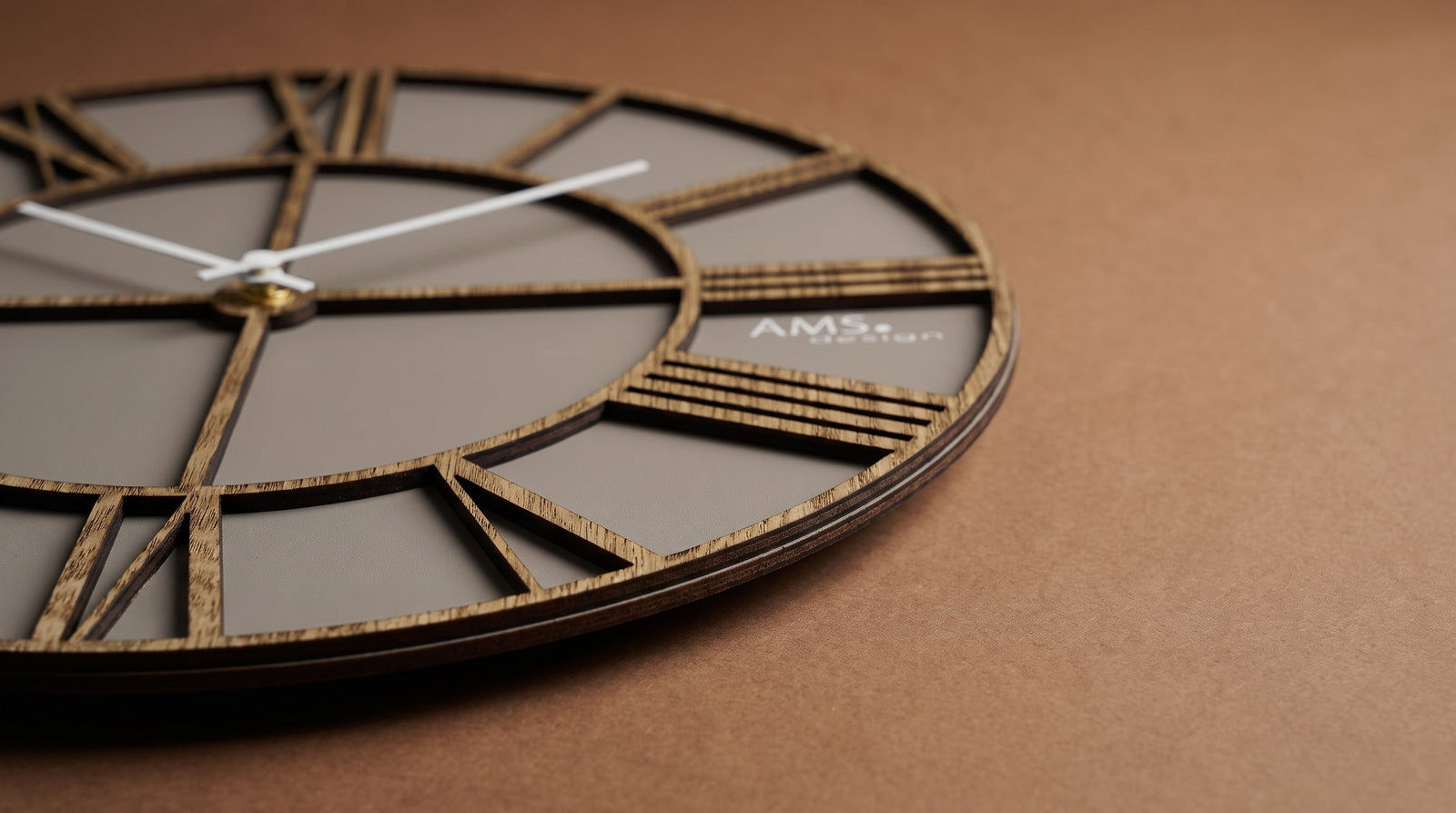

Anyone looking for a wall clock or table clock under 50 euros is quickly faced with the question of what this price range actually delivers and where it ends. The offerings range from simple plastic housings with loud stepper motors to wooden clocks with silent sweep movements and design aspirations. This article compares technical data from the assortment and classifies which expectations are realistic and which are not.
The basis is product data from the uhren4you.de catalog, including models from AMS, Karlsson, and Atlanta. Anyone looking for a more comprehensive overview of different price ranges can find it in the article Wall clocks and table clocks by price: What every price range offers.
What the entry-level price range for large clocks realistically delivers
Wall clocks with diameters between 22 and 40 cm are available for under 50 euros. In this range, the housing typically consists of plastic, polypropylene, polystyrene, or lacquered plywood. Metal frames are rare, and when present, they are usually thin sheet metal or plastic with an aluminum look.
What the price range reliably delivers: a battery-operated quartz movement, a readable time display, and a housing suitable for normal interior rooms. What it does not deliver: scratch-resistant mineral glass as standard (many models come without glass or with a simple plastic cover), radio reception for automatic time setting, or movements with proven origin and caliber designation. Anyone who needs these features should move to the next price range.

Wall clocks under 50 euros: Quartz movement, housing materials, and dial quality
The quartz movement is the standard drive mechanism in this price range. It keeps time accurate to within a few seconds per month, which is more than sufficient for a wall clock. The design of the motor is the decisive factor here.
Stepper motor and sweep movement
Most affordable wall clocks work with a stepper motor that advances the second in a single jump. This creates the typical ticking that is distracting in quiet rooms like bedrooms or studies. Sweep movements (also called silent movements) move the second hand continuously without an audible click. They cost slightly more to produce, but can already be found in models under 50 euros, as several Karlsson wall clocks in the assortment show.
Housing materials
Polypropylene and polystyrene are the most common materials. Both are lightweight, shatterproof, and easy to color, but are not suitable for damp rooms like bathrooms. Lacquered plywood, as in the AMS W9635, gives the housing more weight and a warmer look, but requires a bit more distance from sources of moisture. Metal looks in plastic are purely decorative and have no influence on stability.
Dial quality
Open dials without protective glass or those with a thin plastic disc dominate this price range. Embossed or raised dial designs, as with some Karlsson models, improve readability at no extra cost. One should not count on metal indices or applied numerals in this segment; they are exceptions, not the rule.

| Feature | Typically under 30 euros | Typically 30-50 euros |
|---|---|---|
| Housing material | Simple plastic | Polypropylene, polystyrene, wood |
| Movement | Stepper motor (ticking) | Often sweep (silent) |
| Dial | Flat print, no glass | Embossed numerals, plastic glass possible |
| Diameter | 22-28 cm | 28-40 cm |
| Design range | Classic, round | Diverse shapes, colors |
Table clocks under 50 euros: Size, stand, and movement in comparison
Table clocks make up a significantly smaller part of the uhren4you.de assortment with 243 items than wall clocks. Under 50 euros, you will mainly find compact models with a display area between 10 and 20 cm wide. A stable stand is important, because a narrow housing tips over easily on slanted surfaces.
Quartz drive is also standard for table clocks. Models with a flip display, i.e., mechanically advanced flip numbers like the Karlsson Funky Flip, represent a visual alternative that is also technically quartz-controlled. The flip numbers create a quiet sound when turning, which is perceived as pleasant in some rooms and distracting in others.

| Property | Wall clock under 50 euros | Table clock under 50 euros |
|---|---|---|
| Typical size | 28-40 cm diameter | 10-20 cm housing width |
| Mounting | Wall hook, 1 drill hole | Stand, sometimes also wall-mountable |
| Movement | Quartz, sweep more common | Quartz, stepper motor more common |
| Battery | AA or AAA | AA, AAA, or button cell depending on model |
Brands in the price range: AMS, Karlsson, Atlanta, and what distinguishes them
The three most important large clock brands in the assortment are AMS, Karlsson, and Atlanta. All three have models under 50 euros, but with different focuses.
AMS
AMS is a German clock factory from Furtwangen in the Black Forest. The brand traditionally stands for solid workmanship and well-maintained product data. Under 50 euros, AMS offers wall clocks made of wood or with mirror glass elements that stand out visually from pure plastic clocks. The AMS W9635 with laser-cut wood design and 40 cm diameter is an example of this. Anyone who wants to learn more about the brand can find a detailed classification in the article AMS Wall Clocks: German Large Clock Tradition at a Glance.
Karlsson
Karlsson is a Dutch design brand that works with color and unusual shapes. The assortment under 50 euros includes round models in trendy colors like rose, tea green, or moss green, but also asymmetrical shapes like the Slope series. Karlsson uses sweep movements in many models, which makes the brand particularly interesting for quiet rooms. The housings are predominantly made of plastic, and the workmanship is decent for this price range.
Atlanta
Atlanta offers solid everyday clocks in the entry-level price range with a clear focus on readability and unobtrusive design. The wall clock with a 32 cm diameter and silent quartz movement with a sweeping second hand is a typical example: no design experiment, but a reliable companion for the kitchen, office, or hallway.

Silent or ticking: Stepper motor vs. sweep
The choice of movement type is in many cases the most important decision when buying a wall clock under 50 euros. Not because one type is objectively better, but because the difference is noticeable in everyday life.
A stepper motor advances the second in a single impulse. Depending on the housing construction, the sound ranges from a quiet click to a clearly audible tick. In the kitchen or hallway, this is hardly noticeable. In the bedroom or study, it can become annoying after a few hours.
A sweep movement (silent) moves the second hand with a significantly higher step frequency, so that the movement appears continuous and the noise is reduced to a minimum. Whether a clock has a sweep movement is stated in the product data. Karlsson explicitly mentions this in many model descriptions, as does AMS in the W9324.
The difference hardly matters for battery life. Both movement types run on standard AA or AAA batteries and generally last one to two years per battery.


When the entry-level price range is enough and when it is not
The price range under 50 euros is the right choice if a reliable time display is required indoors, the design should match the room, and no additional technical effort is needed. This segment is well-suited for the kitchen, office, children's room, or as a secondary piece in the hallway.
It is not enough if radio synchronization is desired, i.e., automatic time setting via the DCF77 signal from Mainflingen. Radio-controlled clocks only appear reliably in the assortment from a higher price point. Anyone looking for robustness for damp rooms, scratch-resistant glass, or a particularly solid housing will also only find limited options in this price range.
Anyone weighing between a wall clock and an alarm clock will find a supplementary classification in the article Wall clocks and alarm clocks under 50 euros: What the price range achieves.
Checklist: What to clarify before buying
- Should the movement be silent? Then explicitly look for "sweep" or "sweeping second" in the product text.
- Which room? Do not choose a wooden or paper housing for damp rooms.
- Which diameter fits the wall area? Under 28 cm often looks too small in large rooms.
- Is a second hand desired? Not all wall clocks have one; it is often omitted, especially in the design segment.
- Table or wall mounting? Some models like the Karlsson Funky Flip work as both.


