


Watch Movement Encyclopedia: Quartz, Automatic, Manual Wind, and Solar
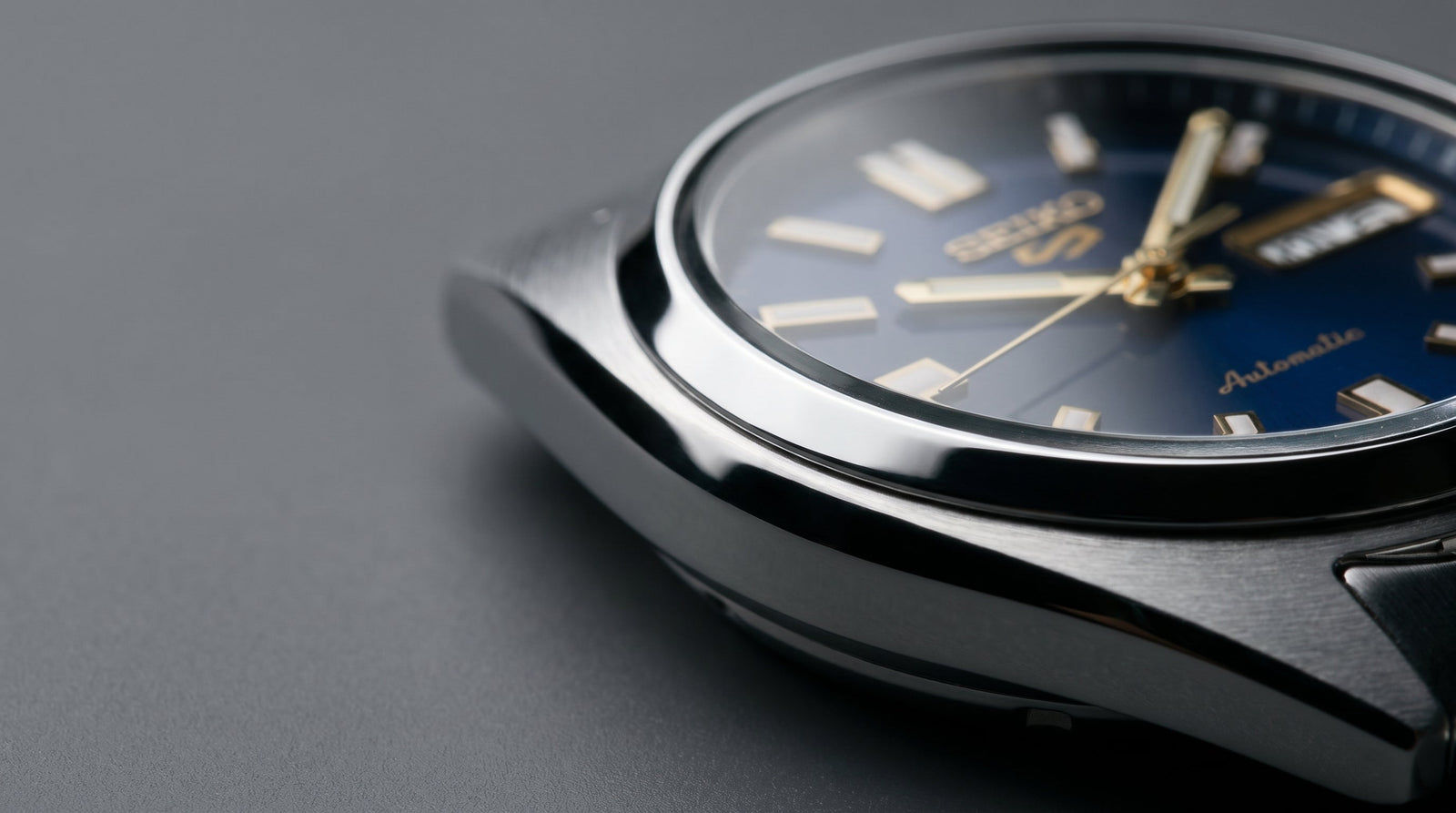

Anyone looking to buy a wristwatch will sooner or later encounter terms like automatic, quartz, Eco-Drive, or manual wind. They appear side-by-side in the assortment, but describe fundamentally different concepts that shape everyday life with the watch in different ways. Which movement fits which usage profile depends on concrete factors: How often do you wear the watch? How important is accuracy? How much maintenance is acceptable?
This article explains the four most important movement types for wristwatches, names typical calibers from the assortment, and shows in a comparison table where each movement type is strong and where its limits lie. In addition, radio reception is classified as a supplementary technology that is often misunderstood. All technical specifications refer to the catalog data of the assortment.
Why the movement type is more than just a purchase feature
The movement type determines not only how a watch is powered. It also determines what care is necessary, how accurate the watch is in everyday life, when a service is due, and what happens if you don't wear the watch for a week. Anyone who buys an automatic watch and only wears it occasionally on weekends will have to regularly reset the time because the movement stops without movement. Anyone who buys a quartz watch and never thinks about changing the battery will eventually be surprised by an abruptly stopped hand. These consequences are not defects, but characteristics that one should be aware of.
Movement and caliber are not the same thing. The movement refers to the drive concept (for example, automatic), the caliber is the exact series of the watch movement (for example, Seiko 4R36). A manufacturer can offer several calibers of one movement type, which differ significantly in function and quality.
Quartz movement: Precision, energy consumption, and typical calibers
The quartz movement is the most common movement type in wristwatches. It uses a quartz crystal as a clock generator: An electrical pulse from the battery causes the quartz to vibrate, a circuit counts these vibrations and uses them to control the stepper motor that moves the hands. Standard quartz crystals vibrate at 32,768 Hz and thus provide an accuracy of about plus/minus 15 seconds per month, which is more than sufficient for most everyday purposes.
In the assortment, quartz watches often work with calibers from Miyota, Ronda, Seiko, or ISA. These caliber designations are facts, not marketing statements: Miyota supplies, among others, calibers for Festina and numerous mid-range brands; Ronda is a Swiss specialist for quartz movements in various quality levels. Depending on the caliber and dial features, batteries last between two and five years, and even longer for some high-energy designs.
The practical advantage of the quartz movement lies in its low maintenance: An occasional battery change is sufficient. Mechanical services are rarely necessary. The accuracy remains stable over the years and does not deteriorate due to the aging of the mainspring. Anyone who wants to learn more about battery changes and care will find detailed instructions in the magazine: Quartz watch care and battery change.
Automatic movement: Rotor, power reserve, and what self-winding requires in everyday life
An automatic movement is a mechanical watch movement that winds itself through the movement of the wearer. This is ensured by a rotor, a semicircular weight that rotates with every hand movement and tensions the mainspring via a clutch gear. The mainspring stores this energy and releases it in a controlled manner via the gear train to the escapement area, which regulates the movement of the hands in a rhythmic manner.
Power reserve and wearing habit
The power reserve describes how long a fully wound automatic watch continues to run without further movement. Typical values are 38 to 48 hours, some calibers reach 70 hours or more. Anyone who wears the watch daily usually keeps the movement sufficiently tensioned. Anyone who takes it off for several days must manually wind it afterwards or reset the time.
Accuracy of automatic movements
Automatic movements are mechanical and therefore more sensitive to temperature, position, and wear than quartz movements. A well-adjusted automatic watch achieves minus 4 to plus 6 seconds per day under COSC conditions (chronometer certification). Without this certification, plus/minus 10 to 30 seconds per day are realistic for simpler calibers. This is significantly less accurate than a quartz movement, but tolerable for most everyday requirements. Services are recommended about every 5 to 10 years.

The Seiko caliber 4R36 is a well-documented automatic caliber in the mid-price range with manual winding capability and hacking seconds (the second hand stops when the crown is pulled out). The assortment also includes Miyota automatic movements of the 8000 and 9000 series as well as movements from ETA, which are common in Swiss-made watches. What self-winding means in everyday life explains the practical consequences in more detail.

Manual wind: Mechanics without a rotor, winding rhythm, and advantage
The manual wind movement is the oldest form of mechanical watch movement. It works on the same principle as the automatic, but dispenses with the rotor. The mainspring is tensioned exclusively by manually turning the crown, usually daily or every two days, depending on the power reserve of the caliber.
The omission of the rotor has two practical consequences: The movement can be built flatter because the rotor extends over the entire dial and forces the case to be higher. And the winding itself becomes a conscious ritual that many watch wearers appreciate. In the assortment, manual wind watches are the smallest group of mechanical movements with 91 items, but they are available and serve a specific demand.
For watches with a very thin case, manual winding is often the only sensible mechanical option. Anyone who wears the same watch every morning and gets used to a short winding rhythm has no disadvantages with a manual wind movement compared to an automatic, except that they have to do the winding work themselves.
Solar movement: Eco-Drive, Citizen calibers, and light requirements in practice
Solar watches use a photovoltaic layer under the dial or in the dial itself to convert light energy into electrical energy and thus charge a rechargeable battery. The battery powers a quartz movement. Sunlight charges faster than artificial light, but both sources work. Typical charging times for a full charge are, depending on the caliber and light intensity, from a few hours of direct daylight to several weeks in weak artificial light.
Citizen Eco-Drive as a reference system
Citizen is the best-known manufacturer of solar watches and markets its system under the name Eco-Drive. In the assortment, Citizen is one of the strongest brands with 450 items, and a significant portion of them run on Eco-Drive calibers. The caliber E111, for example, is a simple Eco-Drive caliber with date and reliable light yield. Higher-quality Citizen calibers combine solar with radio reception (H820, H950) or GMT function.

Light requirements in everyday life
A solar watch that receives regular daylight, for example when worn on the wrist under normal conditions, keeps its battery permanently charged. It becomes problematic with watches that lie in a drawer for weeks. Many Citizen calibers then activate an energy-saving mode in which the hands stop, but the battery can continue to be charged. After sufficient exposure to light, they resume operation. Anyone who buys a solar watch and only wears it occasionally should be aware of this property. A detailed look at solar watches for men can be found in the magazine: Solar watches for men: Technology, brands, and buying guide.
Radio reception as a supplement: not a separate movement, but its own logic
Radio-controlled watches do not have their own drive concept. They are usually quartz or solar watches that additionally contain a receiver module. This module receives time signals from long-wave transmitters: DCF77 (Germany, 77.5 kHz), MSF (Great Britain), WWVB (USA), or JJY (Japan) and regularly synchronizes the internal quartz watch time, usually at night, automatically.
The result is an accuracy that practically corresponds to that of the atomic clock transmitter, i.e., better than any quartz watch alone. The disadvantage: In buildings with thick concrete walls, in regions far from the transmitter stations, or on long-distance trips outside the reception zones, the synchronization does not work. The watch then continues to run like a normal quartz movement until there is reception again. There are 333 radio-controlled items listed in the assortment, many of them from brands like Casio, Atlanta, and AMS, which offer radio-controlled watches for the German market.
Radio is therefore a supplement that improves accuracy, but does not provide an independent drive and does not work under every condition. Anyone traveling abroad should check whether the respective caliber supports multiple reception zones.
Comparison table: Accuracy, maintenance interval, everyday suitability
| Movement type | Typical accuracy | Energy source | Maintenance interval | Special requirement in everyday life |
|---|---|---|---|---|
| Quartz | +/- 15 sec./month | Battery (2-5 years) | Battery change every 2-5 years | None, very low maintenance |
| Automatic | +/- 10-30 sec./day (standard) to +/- 4-6 sec./day (COSC) | Body movement, manually rechargeable | Service every 5-10 years | Regular wearing or manual winding |
| Manual wind | Like automatic, depending on caliber | Manual crown | Service every 5-10 years | Daily or every two days winding |
| Solar | Like quartz (+/- 15 sec./month) | Light (sun/artificial light), rechargeable battery | Rarely, battery lasts many years | Regular exposure to light, no drawer storage |
| Radio (as supplement) | Second/year (in reception area) | Quartz or solar | Like base movement | Reception area required for synchronization |
| Movement type | Fits well with | Less suitable for |
|---|---|---|
| Quartz | Everyday life, work, occasional wearing, tight budget | Collectors who appreciate mechanical technology |
| Automatic | Daily wearers, technology enthusiasts, gift watches with character | Occasional wearers without winding discipline |
| Manual wind | Flat watches, conscious wearers with an affinity for rituals | Forgetful users, active athletes |
| Solar | Outdoor, travel, maintenance-averse wearers with plenty of daylight | Office workers with heavily darkened rooms, drawer watches |
| Radio | Germany, Austria, Switzerland, UK with need for reception | Frequent long-distance travel to countries without a reception station |


