


Women's watches under 300 Euros: What the upper mid-range has to offer
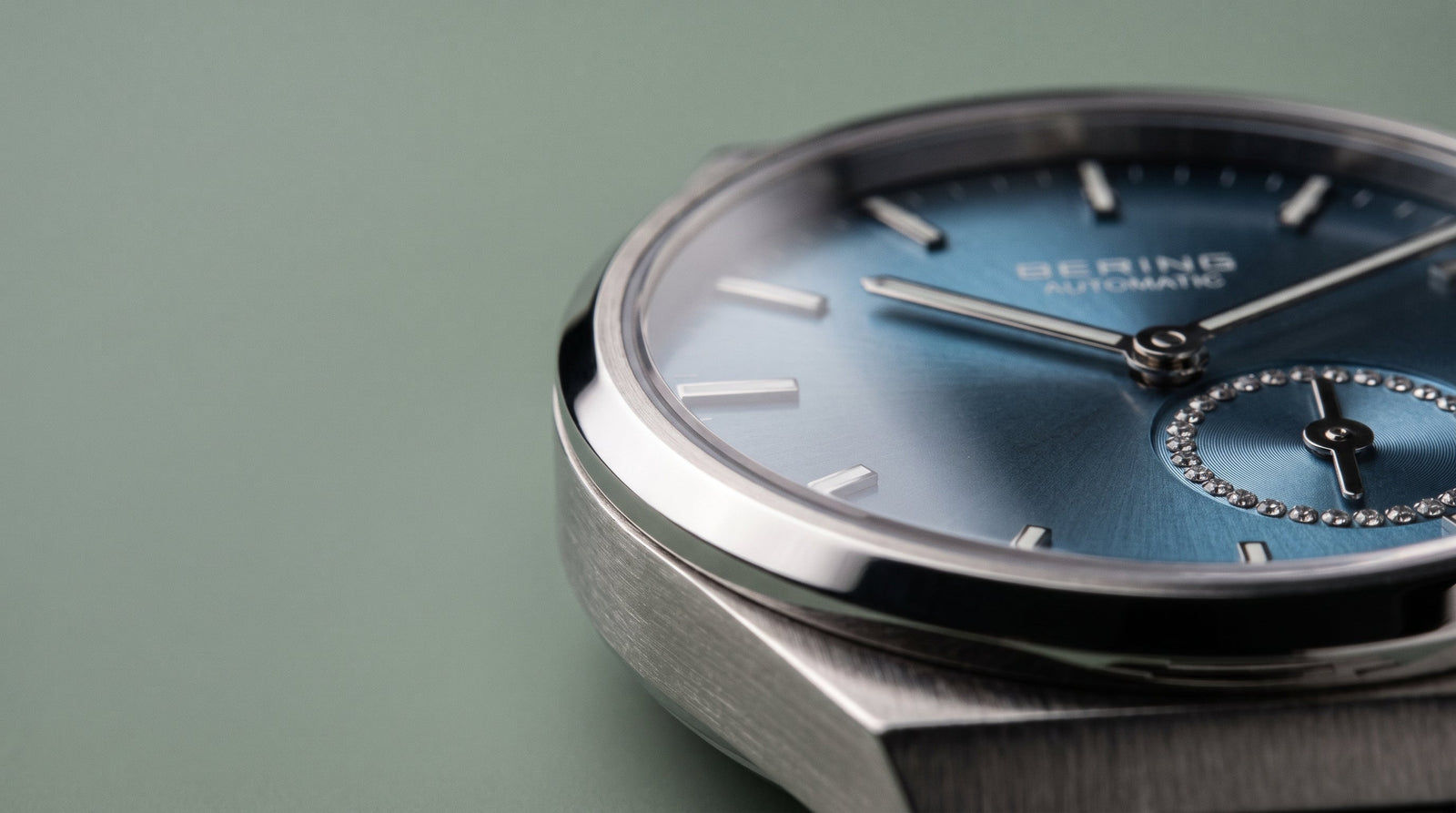

Anyone looking for a women's watch between 200 and 300 euros has a specific question: What do I get in this price range that I don't get for less money? The answer rarely lies in the dial design, but rather in the technical specifications behind the case. This article compares the data sheets of the models in our range and explains what the differences mean in everyday life.
The 200 to 300 euro segment is particularly densely populated for women's watches. Brands like Bering, Boccia, Danish Design, and Festina place models here that clearly stand out from the entry-level segment under 100 euros in terms of material, movement, and workmanship. Whether this gap justifies the higher budget depends on which features actually count.
What 200 to 300 euros specifically changes for women's watches compared to the entry-level
Under 100 euros, mineral glass dominates as the dial cover. Mineral glass is hardened flat glass and scratches noticeably during everyday use. From about 150 euros, sapphire crystal is introduced, a synthetically grown corundum glass with a hardness of 9 on the Mohs scale. In the segment up to 300 euros, sapphire crystal is the standard for most relevant brands, not the exception.
The same applies to case material. Simple women's watches under 100 euros often use alloyed zinc die-cast cases with a coating. In the range from 200 euros, polished or brushed 316L stainless steel is the norm, and titanium appears as a lighter and hypoallergenic alternative. Water resistance in this segment increases to 5 bar (corresponds to splash protection, not diving), with individual models reaching 10 bar. In short: the upper mid-range sells more everyday suitability, not just more aesthetics.

Case material and glass: Stainless steel, titanium, sapphire in data comparison
The three most important material decisions in this price range concern the case, strap, and glass. The following table shows what the catalog data for selected models reveals:
| Model | Case | Glass | Strap | Water resistance |
|---|---|---|---|---|
| Bering Classic 13326-362 | Stainless steel | Sapphire crystal | Milanese | n/a |
| Bering Titanium 18634-334 | Titanium | Sapphire crystal | Titanium Milanese | n/a |
| Bering Ceramic 30434-754 | Ceramic | Sapphire crystal | Ceramic | n/a |
| Bering Classic 15630-701 | Titanium (bicolor) | Sapphire crystal | Milanese | n/a |
Titanium: lighter, but not indestructible
Titanium has about 40 percent less weight than stainless steel with comparable strength. Those who are sensitive to nickel also benefit: titanium is naturally almost nickel-free and therefore uncritical for most contact allergies. One disadvantage remains: titanium is harder to polish to a high gloss than steel, and deeper scratches cannot be hidden by repolishing.
Ceramic: special properties, special limitations
High-tech ceramic, as used by Bering in the Ceramic line, is extremely scratch-resistant and retains its shine permanently. However, ceramic is more brittle than metal: a hard fall onto a hard surface can break the material, whereas stainless steel would at most dent. For office and city use, this is not a practical risk; those who wear the watch during manual work should be aware of it.
Sapphire crystal: the decisive upgrade
More information on comparing glass types can be found in the article Sapphire crystal, mineral glass, Hardlex: Thinking about watch glass and water resistance together. The essence in one sentence: Sapphire crystal shows hardly any signs of wear after years of wearing, whereas mineral glass can show a fine film of scratches after just a few months.

Movements in this price range: Quartz, solar, and first automatic models
The type of movement determines how the watch is powered and what requirements arise in everyday life.
| Movement type | Accuracy | Maintenance | Special feature |
|---|---|---|---|
| Quartz | ±15 sec./month | Battery every 2-3 years | Reliable, low-maintenance |
| Solar | ±15 sec./month | No battery needed | Charges via any light source |
| Automatic | ±10-30 sec./day | Service interval approx. 5-8 years | Winding by arm movement, no battery change |
Quartz remains the reliable basis
Most women's watches in this price range run on a quartz movement. The movement is powered by a battery and oscillates with a quartz crystal at 32,768 Hz. The accuracy is better than mechanical movements if the quality is good; changing the battery is the only regular effort.
Solar: Comfort without changing batteries
With solar movements, the dial or a collector behind it is used as a solar cell. Bering offers models with sapphire crystal in this price range in its Solar line. A fully charged battery lasts for several months without light exposure, depending on the model. Those who rarely wear the watch and leave it in a drawer must occasionally recharge it by simply placing the watch in the light.
Automatic: mechanical with self-winding
Automatic movements tension their mainspring via a freely oscillating rotor that turns through arm movement. Unlike a quartz movement, they have no battery and run purely mechanically. The price for this is lower accuracy: a deviation of up to 30 seconds per day is normal for entry-level automatic movements and not a malfunction. In the price segment under 300 euros, the first automatic models appear, such as the Bering Charity line.

Brands at a glance: Bering, Boccia, Danish Design, Festina, and others
The range includes over 44 brands in the price segment from 200 to 299 euros. The following are particularly relevant for women's watches:
| Brand | Design line | Typical material | Movement selection |
|---|---|---|---|
| Bering | Scandinavian minimalism | Stainless steel, titanium, ceramic | Quartz, solar, automatic |
| Boccia | Flat, puristic | Titanium | Quartz |
| Danish Design | Classic, structured | Stainless steel | Quartz |
| Festina | Broadly diversified, sport to dress | Stainless steel | Quartz, solar |
Bering is the strongest brand in the range with over 800 items and consistently occupies the segment between minimalist everyday companion and light evening watch design. A deeper look at the technology behind the models is provided in the article Bering women's watch: Nordic design and its technology.
Boccia has specialized in titanium and thus offers the lightest models in this price range. Danish Design works with more classic proportions and rather conservative dial layouts. Festina covers the widest design spectrum, from sporty chronographs to slim dress models.

Size and feel: Case diameter 28 to 36 mm in comparison
Case diameters decide more about the feel than the material. For women's watches, the range of 28 to 36 mm is the relevant framework in this price range.
28-30 mm: classic, understated
Models in this range look balanced on a slim wrist (under 15 cm circumference). The Bering model 15630-701 has a 30 mm case made of bicolor titanium and, according to catalog data, lies very flat on the wrist. Smaller diameters also mean that dial elements such as indices or date windows are correspondingly more compact or omitted entirely.
32-34 mm: the most common range
Most women's watches in this price range are offered with a 32 or 34 mm diameter. This range is wearable on almost all wrist sizes and works well in both wedding and office contexts. If you have no specific preferences, you are rarely wrong here.
35-36 mm: more modern, present
Models from 35 mm have more surface area for dial details and look better proportioned on wider wrists. They are rarer in this price range than smaller diameters, but they do exist, especially with Festina and Danish Design.


When more money is worth it and when the lower band is sufficient
The honest answer to this question depends on three variables: intensity of use, material preference, and a sense for technical details.
The entry-level segment is sufficient if...
- the watch is worn rarely or only for special occasions.
- scratches in the glass are not a high priority or a new model is purchased regularly.
- there is no need for titanium or hypoallergenic materials.
The upper mid-range is worth it if...
- the watch is worn daily and sapphire crystal is intended to maintain a scratch-free appearance in the long term.
- weight and wearing comfort play a role (titanium is the decisive factor here).
- a solar movement is intended to increase comfort by eliminating the need for a battery change.
- there is an interest in a mechanical automatic movement that does not require a battery.
What the upper mid-range does not offer: chronometer certification (a precision test according to COSC standards, which only becomes relevant in the high-price segment), water resistance for diving, or manufacture movements. Anyone looking for these features will end up beyond the 500-euro limit.


