


Buy Alarm Clocks: Analog, Digital, and Radio-Controlled Compared

A new alarm clock is quickly ordered, but the wrong choice makes itself felt every morning: too bright, too loud, too inaccurate, or simply too cumbersome to operate. Anyone who wants to leave the bedroom well-rested should understand the technology behind the three common types and what each one really delivers before making a purchase.
This article compares analog, digital, and radio-controlled alarm clocks based on product data from our range. It explains which display suits which requirements, what DCF-77 reception achieves during the switch to winter time, and what the pre-purchase checklist should cover.
Which alarm clock suits which type of sleeper
The question of the right alarm clock does not start with the design, but with your own sleep behavior. Three types can be roughly distinguished:
- The deep sleeper needs a loud or rising alarm signal, perhaps even a vibration element or light. A quiet 'silent sweep' analog alarm clock is usually not enough here.
- The light sleeper is disturbed at night by a display that is too bright. For them, dimmability, automatic brightness control, and the quietest possible clockwork are what count.
- The traveler or shift worker needs reliability: no manual time adjustment, multiple alarm times, and a robust battery power supply.
In addition, there is the location. An alarm clock in a darkened bedroom has different requirements for the display than one on the bedside table in a bright children's room. If you keep this in mind, you can use the following sections as a filter.
Analog alarm clock: mechanical or quartz, pros and cons
An analog alarm clock shows the time via hands. The clockwork behind it can be mechanical (manual winding, rare) or quartz-operated. In today's everyday assortment, the quartz movement dominates: it is maintenance-free, requires a battery, and keeps time accurate to within a few seconds per month. The classic mechanical wind-up movement, on the other hand, loses or gains up to a minute per day and must be wound regularly.
Silent sweep: a concrete feature, not marketing
Many analog alarm clocks advertise with the term "silent sweep" (Leisegang). This refers to a clockwork in which the second hand glides continuously instead of ticking. The noise is largely eliminated, which is relevant for sensitive sleepers. Analog quartz alarm clocks without this feature tick audibly, which is distracting in a quiet bedroom.

Disadvantages of the analog alarm clock: Reading in the dark requires luminous hands or lighting. Date and temperature cannot be displayed. Anyone who needs multiple alarm times must opt for digital or special analog models.
| Feature | Analog Quartz | Analog Manual Wind |
|---|---|---|
| Accuracy | ±15 sec./month | ±30-60 sec./day |
| Power supply | Battery | Mainspring, wind daily |
| Silent sweep possible | Yes | No |
| Time adjustment | Manual | Manual |
| Additional displays | None | None |

Digital alarm clock: display, projection, and additional functions
Digital alarm clocks show the time as a numerical display, usually via LCD or LED. This has advantages: the display is readable from a greater distance, date, temperature, and humidity can be shown on the same surface, and multiple alarm times are standard.
Projection alarm clock: time on the ceiling
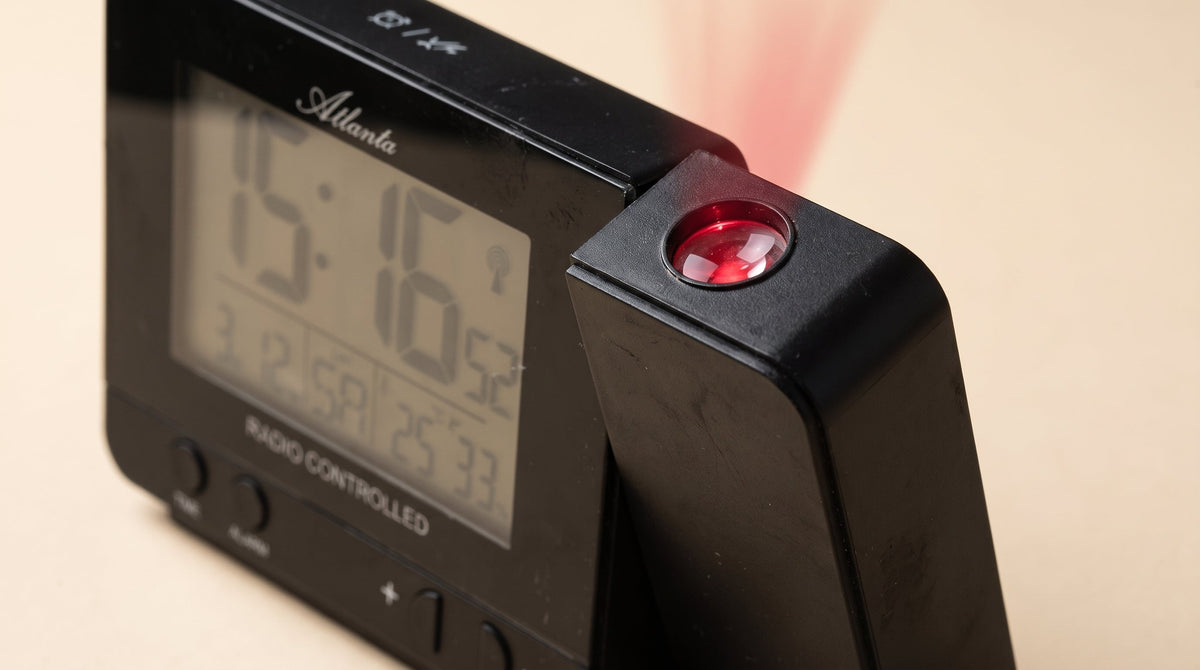
A special design is the projection alarm clock: it casts the current time onto the ceiling or wall via a built-in lens. This is practical for anyone who does not want to turn the clock or has poor eyesight. The focus sharpness of the projection depends on the room height and can be adjusted on good models.

Additional functions at a glance
Many digital alarm clocks measure temperature and humidity at the same time. This is not a luxury if the bedroom needs to be monitored for values below 60 percent humidity to prevent mold. Atlanta offers such combination alarm clocks in the price range under 50 euros.

Radio-controlled alarm clock: automatic time adjustment and accuracy
A radio-controlled alarm clock receives the DCF-77 time signal, which is transmitted by the Physikalisch-Technische Bundesanstalt in Mainflingen near Frankfurt. The signal encodes the exact time including the date and the indication of the upcoming time change. A radio-controlled alarm clock adjusts itself fully automatically as soon as it receives the signal, usually once a night.
The upcoming switch to winter time on the last Sunday in October makes this advantage particularly tangible: anyone using a quartz alarm clock without radio reception has to adjust it manually. The radio-controlled alarm clock does this itself as long as it has reception. In basements or buildings with strong shielding, the signal may be absent; in that case, a manual synchronization start or a temporary location by the window helps.
| Criterion | Quartz alarm clock without radio | Radio-controlled alarm clock (DCF-77) |
|---|---|---|
| Accuracy | ±15 sec./month | Atomic time accuracy (signal reception required) |
| Time adjustment | Manual | Automatic |
| Reception range | N/A | Up to approx. 1,500 km, limited in basements |
| Energy consumption | Battery | Battery |
| Typical use | Travel, simple application | Bedroom, office, continuous operation |
More on how radio clocks and pendulum clocks process the time change is explained in our article Time change 2026: Automatically switching radio and pendulum clocks.

Volume and light: displays, night light, and vibration
Alarm volume is one of the most frequently underestimated features. The following points help with the assessment:
- Crescendo alarm: The signal starts quietly and gets louder. Gentler than an immediate full tone, but less reliable for deep sleepers.
- Single tone vs. bell signal: Analog alarm clocks with a real bell (like the Atlanta 1829/9) produce a mechanical sound that can be very loud.
- Vibration: Rare in classic stand-alone alarm clocks, more common in smartwatch combinations. Relevant for the hearing impaired or very quiet environments.
Display brightness and night light
A display that is too bright disturbs sleep. Good digital alarm clocks offer automatic brightness control via a light sensor or at least manually adjustable levels. Some models switch the display to a low value at night and increase the brightness briefly when the snooze button is pressed. Anyone who prefers a completely dark bedroom should specifically look for a display that can be switched off.

Brands at a glance: Atlanta, Casio, and others in price comparison
In the alarm clock assortment at uhren4you, Atlanta dominates with over 400 models. The brand covers analog and digital radio-controlled alarm clocks, projection alarm clocks, and classic travel alarm clocks, mainly in the entry-level and lower mid-range. The price-performance ratio is particularly dense in the segment under 60 euros.
Casio also offers alarm clocks with around 410 items in the total assortment, often with a well-known LCD design and clear readability. Casio alarm clocks are often designed in a somewhat more sober way, but are very robust in their workmanship.
Seiko provides an example with the QHR204K radio-controlled alarm clock, a model that places a little more value on a clear dial design, with white Arabic numerals on a black background and a snooze function.

JVD complements the assortment with models in a wood look, which appear visually warmer and fit into natural-looking interiors.

| Brand | Strength | Typical price range | Special feature |
|---|---|---|---|
| Atlanta | Assortment breadth, radio, projection | Under 60 euros | Largest provider in the assortment |
| Casio | Robustness, readability | Under 50 euros | Clear LCD design |
| Seiko | Design, dial quality | Under 60 euros | Well-known brand competence from the watch sector |
| JVD | Look, home design | Under 40 euros | Wood-look variants |
A more detailed classification by room and function is offered by our guide Radio-controlled alarm clock for the bedroom: What matters when buying.

Checklist: What your new alarm clock should be able to do
- Radio reception (DCF-77) if automatic time adjustment is important
- Silent sweep clockwork if ticking in the bedroom is disturbing
- Dimmable or switchable display for dark bedroom environments
- Crescendo or rising alarm for gentle waking
- At least one snooze function with a known interval time
- Multiple alarm times if different wake-up times are necessary on different days
- Temperature and humidity display if the room climate is to be monitored
- Lighting or luminous hands for readability in the dark
- Projection function if the clock should not stand directly on the bedside table


