


Buy a Casio G-Shock: Which model for which use
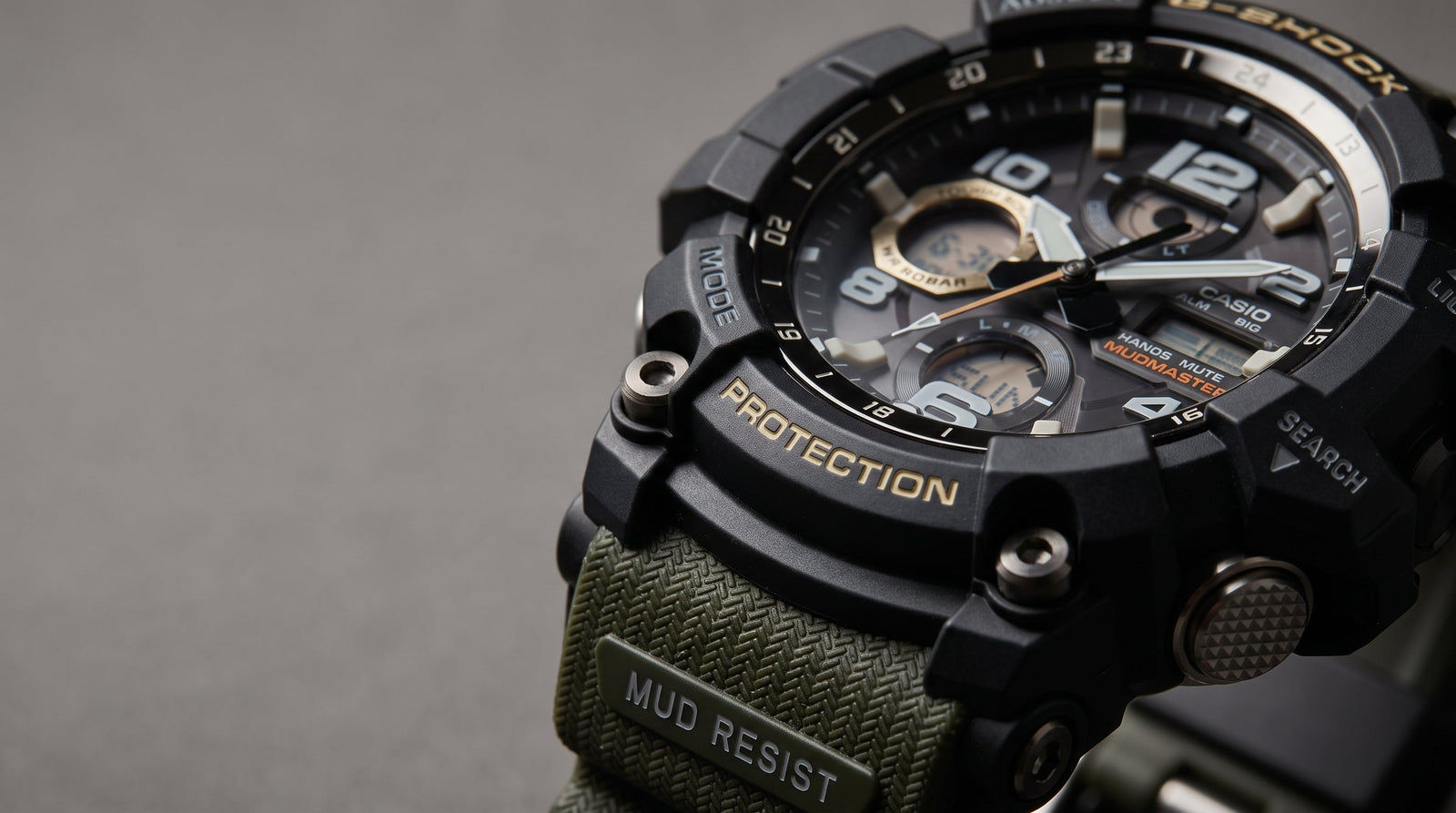

Anyone looking to buy a G-Shock faces an unusual challenge: the range extends from simple digital resin watches for under 100 euros to titanium models handcrafted in Japan for several thousand euros. Both bear the same name, both meet the shock-resistance standard, but they are aimed at completely different groups of wearers. Those who choose the wrong model either pay for features they never need or buy a watch that is not designed for their intended use.
This article compares the technical data from the product sheets and categorizes the G-Shock line by movement type, case size, model group, glass type, and water resistance. The result is not a ranking, but a basis for decision-making: What features do I need, and which model group provides them?
G-Shock basic principle: why shock resistance is not just a marketing promise
The first G-Shock, the DW-5000C, was released in 1983 after a development phase in which the engineering team suspended the movement in a rubber housing, thus decoupling it from the case frame. This principle still applies today: the actual watch movement does not sit rigidly in the shell, but in a shock-absorbing inner structure made of resin or polyurethane. If the watch falls onto concrete, the outer structure absorbs the impact, and the movement remains largely unaffected.
Casio defines shock resistance via an internal standard: a free fall from ten meters onto a concrete surface must not impair the function. This test is reproducible and applies to all models in the line, not just the more expensive series. The difference between an entry-level and a professional model therefore lies not in the principle of shock resistance, but in the choice of materials, the movement equipment, and the additional features.
Movement types in the G-Shock line: an overview of quartz, solar, and radio-controlled
The G-Shock line uses exclusively quartz movements. Within this framework, Casio distinguishes between three power supply concepts:
Battery operation
The base models run on a button cell. Run times of two to ten years are common, depending on how many additional features are activated. The disadvantage: the battery must be changed at some point, and with a screw-down case back, this usually means a professional service. Those who want to avoid the effort should consider solar from the start.
Tough Solar
Casio's term for solar-powered models. A solar cell under the dial converts light, including artificial light, into electrical energy and charges a battery. With sufficient light exposure, the battery is permanently supplied; the capacitor keeps the watch running in the dark for several months, depending on the model. For everyday wearers who have the watch on their wrist during the day, this is a maintenance-free solution. For someone who rarely wears the watch or stores it in the dark, the passive charging method may not be sufficient.
Multiband 6 (Radio-controlled)
Multiband 6 is Casio's term for the reception of six long-wave time signal transmitters worldwide, including DCF77 in Germany. The watch receives the signal automatically, usually at night, and sets itself to the atomic clock time. The accuracy therefore no longer depends on the quartz oscillator, but on the received signal. Important: Radio-controlled needs reception. In deep basements, in certain regions of Asia, or behind thick concrete walls, reception may fail; the watch then continues to run, but without automatic synchronization. In Europe, DCF77 reception is reliable for most everyday situations.
Many models combine solar and radio-controlled, i.e., "Tough Solar + Multiband 6". This is the lowest-maintenance combination that Casio offers.

Case size and weight: from compact to oversized
The range within the G-Shock line is considerable. The classic square base model (derived from the DW-5600) measures about 42 x 48 mm at around 50-55 g. Round mid-range models like the GA-100 family have a case diameter of 55 mm and can reach 70 g. The professional models of the Master of G series, including Mudmaster and Rangeman, have significantly more volume and weight due to their protective frames. The full-metal GMW-B5000 model made of stainless steel weighs a good 160 g.
| Model group | Typical case width | Weight range | Wrist suitability |
|---|---|---|---|
| DW-5600 base (square) | approx. 43 mm | 50-60 g | small to medium wrists |
| GA-100/GA-110 family | approx. 55 mm | 60-80 g | medium to large wrists |
| Master of G (Mudmaster, Rangeman) | 56-60 mm | 80-110 g | large wrists, outdoor wearers |
| GMW-B5000 full metal | approx. 49 mm | approx. 160 g | accustomed metal watch wearers |
| MR-G (titanium) | approx. 48-49 mm | approx. 90-100 g | wearers with a preference for metal, lighter |
Anyone who has previously worn a sports watch under 50 g should plan for an adjustment period when switching to an 80 g model. The G-Steel line (GST-B1000) takes a different approach: it combines a metal case with a slim profile and thus appeals to wearers who want a G-Shock as an everyday watch but do not like a plastic case. The line shows that Casio is consciously expanding its target group.
Model groups and their area of application: sport, outdoor, business-casual
Casio internally divides the G-Shock line into several series. Four groups are particularly relevant for the purchasing decision:
Classic / Base
Models such as the DW-5600 and GA-100 series. Shock resistance and 20 bar water resistance are standard, the movement is quartz with battery or solar. Suitable for everyday sports, occasional swimming, manual work. Price is usually under 150 euros.
Master of G
Models such as Mudmaster and Rangeman. Additional protection against mud, dust, and extreme temperatures. The Rangeman carries three built-in sensors: compass, barometer/thermometer, and altimeter. Suitable for outdoor activities where environmental data is relevant. Prices in the mid-three-digit range.

G-Steel and GMW-B5000
Metal case, slimmer profile, more everyday-suitable look. The GMW-B5000 is a direct reissue of the original G-Shock design in full stainless steel. Suitable for wearers who want G-Shock robustness but do not want to stand out in an office environment or with urban casual wear. The weight of the GMW-B5000 is noticeable, the wearing comfort is different from resin.
MR-G
The top model of the line. Titanium case with DLC coating (a hard coating made of diamond-like carbon), sapphire crystal, hand-finished with Japanese watchmaking tradition. For wearers who want to combine G-Shock robustness with the material properties of a high-quality watch. Prices well over 1,000 euros.

If you would like to know more about which watch suits which occasion and activity, read our article Sports watches for men: which technology for which activity.
Sapphire or mineral glass: what G-Shock uses and when
The vast majority of G-Shock models use mineral glass. This is a hardened flat glass that is suitable for everyday use, but can be dented or shattered by a heavy blow. Scratches are caused by mineral particles (sand, concrete) that are harder than the glass.
Sapphire crystal, a synthetically grown corundum material with a hardness of 9 on the Mohs scale, is significantly more scratch-resistant. It can break upon sharp-edged impact, but resists everyday abrasion significantly better than mineral. Casio currently only uses sapphire crystal in the MR-G series, i.e., in the premium segment.
| Glass type | Scratch resistance | Breakage behavior | G-Shock use |
|---|---|---|---|
| Mineral glass | medium | shatters upon heavy impact | Base to Master of G |
| Sapphire crystal (with AR coating) | high | breaks upon sharp impact | MR-G series |
Those who want to delve deeper into the difference between glass types in the context of other watches will find a detailed classification in the article Sapphire crystal, mineral glass, Hardlex: thinking about watch glass and water resistance together.
Water resistance classes within the line
Almost all G-Shock models specify 20 bar water resistance. 20 bar corresponds to a static test pressure of 200 meters. This does not mean that the watch can be operated at a depth of 200 meters. It means that it withstands this pressure in a static test. For wearing while swimming, snorkeling, and occasional diving down to sports depths, 20 bar is sufficient. Scuba diving with compressed air requires diver's watches explicitly tested according to the ISO 6425 standard; this only applies to the G-Shock line for models specifically designated for this purpose, which are not listed in the standard assortment of this shop.
The few models with 10 bar, including some G-Steel variants, are suitable for intensive swimming, not for diving. Check the data sheet of the respective model before purchasing if water resistance is a deciding factor for you. A systematic classification of all water resistance classes can be found in our article Water-resistant wristwatch: which protection class is enough for what?.
Purchasing decision: which factors really count
Before buying, it is worth answering five questions:
- Which area of application? Everyday life and leisure require something different than mountain tours or manual work with exposure to dirt. A base model is sufficient for the city runner. Those who navigate in the wilderness benefit from the triple sensor of the Rangeman.
- Battery or solar? Solar is lower-maintenance, but requires daily light exposure. Those who frequently hide the watch under sleeves or store it for long periods should check the battery life in the dark in the data sheet.
- Radio-controlled necessary? Multiband 6 is very reliable in Europe. Those who frequently travel in regions without DCF77 coverage need radio-controlled less; manual GPS synchronization is not possible with simpler models.
- Case size and weight? A 55 mm diameter on a slim wrist looks bulky and chafes under sleeves. The specification in millimeters is more valid than a photo.
- Metal or resin? Resin is lighter, more comfortable with temperature changes (no cold metal), and cheaper. Metal looks more formal, is more stable against point pressure, but weighs significantly more.
| Requirement | Recommended model group | Example series |
|---|---|---|
| Everyday, gym, leisure | Classic / Base | GA-100, DW-5600, AWG-M100 |
| Outdoor, hiking, climbing | Master of G | Rangeman GW-9400, Mudmaster |
| Business-casual, city | G-Steel, GMW-B5000 | GST-B1000, GMW-B5000D |
| Premium claim, titanium, sapphire | MR-G | MRG-B2000 |
Currently, Casio is specifically expanding the G-Steel line with the GST-B1000 to include models that are lighter and slimmer than the classic professional models. This reflects the trend that robustness and everyday suitability do not have to be opposites. G-Central regularly documents new G-Shock announcements and provides a good overview of current model developments.


