


Citizen in Profile: Eco-Drive, Calibers, and Price Ranges
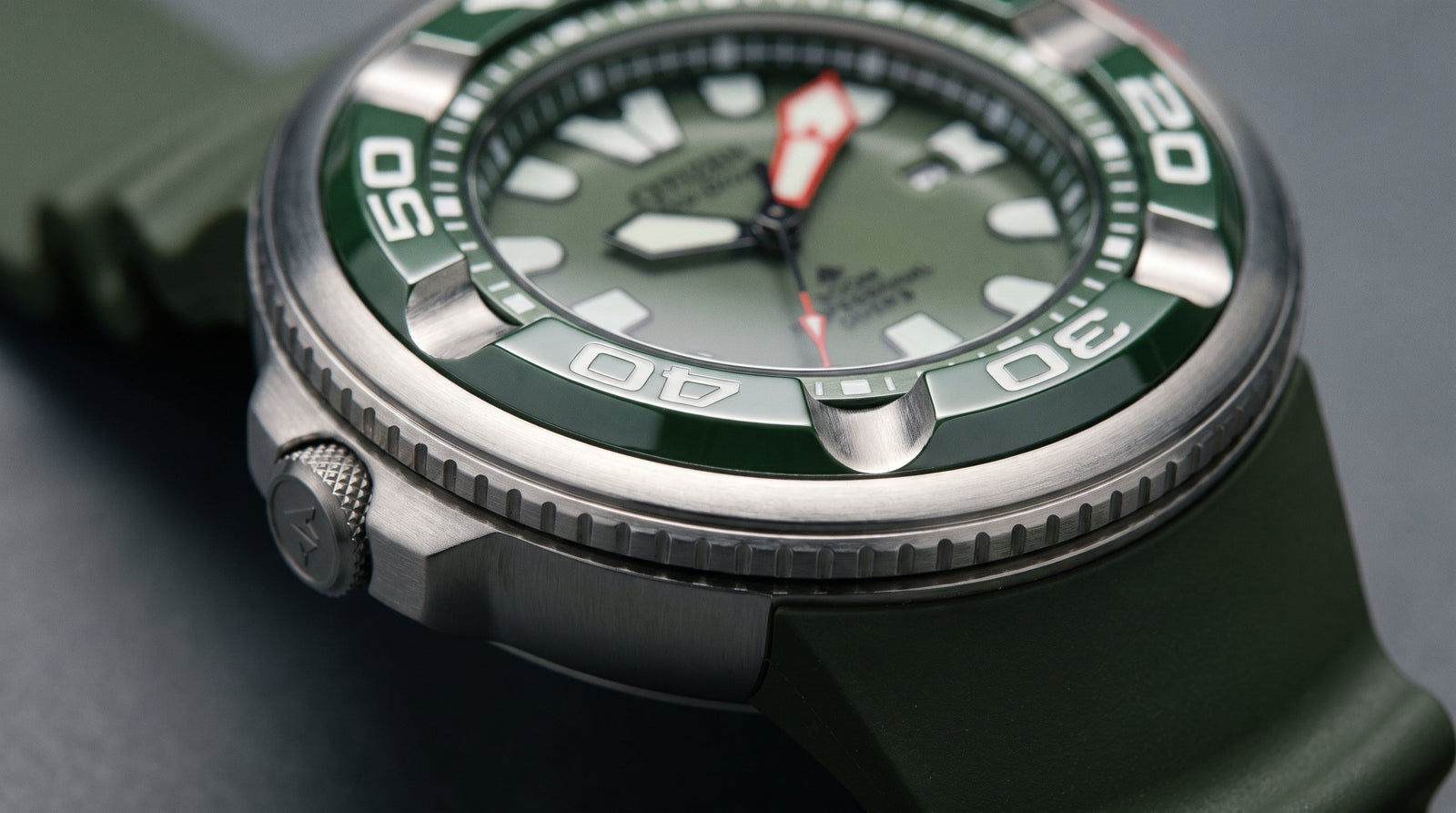

Anyone looking for a Japanese watch in the mid-range price segment will sooner or later end up with Citizen. Alongside Seiko, the brand is the second major Japanese watch group and, with Eco-Drive, has developed a drive technology that is now almost synonymous with solar-powered wristwatches. At the same time, the range is so broad that it is difficult to find one's way around: Promaster, Attesa, Super Titanium, Automatic, Radio-Controlled, GPS. This article classifies the technology behind the models, explains what distinguishes the most important calibers, and who each series is suitable for. The basis is the technical data from the range, not a practical test.
Strong annual figures from Japanese manufacturers for 2025/26 show that the mid-range price segment is growing worldwide. For buyers, this means: there is plenty of choice, but comparing data sheets is more worthwhile than ever.
Citizen as a global Japanese brand: manufacturing, philosophy, and range breadth
Citizen was founded in Tokyo in 1918 and today produces at several locations in Japan. The corporate philosophy can be reduced to one sentence: A watch should be designed in such a way that it powers itself. This led to Eco-Drive, and almost all product lines are built on this.
The range extends from simple quartz watches under 100 euros to the Attesa line with GPS time synchronization in the four-digit range. In between, there are mechanical automatic movements, radio-controlled combinations, and diver's watches with 300 meters of water resistance. Citizen manufactures its calibers predominantly in-house, but also sources raw movements from suppliers for individual entry-level models. This vertical integration is a significant difference from many competitors in the same price range.
Eco-Drive explained: how the light cell permanently powers the watch movement
Eco-Drive is Citizen's term for solar-powered watches. The principle: Under the dial sits a thin solar cell that converts both sunlight and artificial light into electricity. This electricity charges a rechargeable lithium-ion capacitor, which serves as an energy storage unit. When fully charged, the watch runs for between six months and several years without further light, depending on the caliber.
The dial itself is designed to be translucent without the solar cell underneath being visible. The cell is therefore installed behind the normal dial. The main practical advantage is that there is no need to change batteries: no visits to the workshop, no battery waste, no sudden discharge while on vacation. Eco-Drive models usually display a warning when the charge level is low, with the second hand moving in two-second jumps instead of single steps.
In 2026, Eco-Drive celebrates its 50th anniversary. Citizen has launched the "Light in BLACK" special series for this occasion and received the Red Dot Design Award for the Promaster in the same year. More current models can be found on the Citizen Global News page.

A more detailed technical overview of solar-powered men's watches from various brands is provided in the article Solar watches for men: technology, brands, and buying guide.
Important calibers at a glance: from E031 to A660 and what distinguishes them
Citizen identifies its movements with caliber designations consisting of one letter and three to four digits. The letter roughly indicates the type: E-calibers are Eco-Drive quartz movements, B-calibers are usually simpler quartz movements, N-calibers are automatic movements, J-calibers are Eco-Drive with radio technology or GPS add-on, A-calibers are calibers of the Attesa and high-end line.
| Caliber group | Drive | Typical additional functions | Price range |
|---|---|---|---|
| E031 / E168 | Eco-Drive Solar | Date, simple additional hands | under 200 euros |
| H500 / H820 | Eco-Drive Solar | Chronograph, tachymeter | 150-300 euros |
| B612 / B650 | Eco-Drive Solar + Radio | Time signal reception, world time | 200-500 euros |
| N3950 / N3960 | Automatic (self-winding) | GMT, exhibition case back, open rotor | 200-600 euros |
| A660 (Satellite Wave) | Eco-Drive Solar + GPS | GPS time synchronization worldwide | from 800 euros |
An important difference: Radio-controlled calibers (letter B or J with radio identifier) receive the DCF77 time signal, which is reliably available in Central Europe but is not available on other continents. GPS calibers like the A660 synchronize worldwide via satellites. The automatic rotor of the N-calibers is an oscillating mass that winds the mainspring when the wrist is moved; no battery, no solar.

Model series: Promaster, Attesa, Super Titanium, and the women's line
Promaster
The Promaster line is Citizen's sports line for specific areas of use. There are three orientations: Marine (diving), Land (outdoor, military), and Sky (aviation). Promaster Marine models are designed for 200 to 300 meters of water resistance, have a rotating bezel, and meet the ISO 6425 standard for diver's watches. Promaster Sky models combine Eco-Drive with radio or GPS reception and are geared towards pilot requirements: world time, alarm, countdown. The B612 caliber in the Promaster Sky JY8100 combines Eco-Drive with radio reception, a Super Titanium case, and sapphire crystal.


Attesa
Attesa is Citizen's business line in the premium segment. The name denotes models with a titanium case, sapphire crystal, and, in the higher levels, GPS time synchronization via the Satellite Wave system. The A660 caliber in the Attesa CC4055-14H receives GPS signals in seconds and automatically sets the time and time zone without the wearer having to do anything.

Super Titanium
Super Titanium is Citizen's own term for titanium that has been given a scratch resistance exceeding that of stainless steel through a surface hardening process (Duratect). The material is significantly lighter than steel. Super Titanium models are recognizable by the abbreviation "Super Titanium" in the model name and are used in the Promaster, Attesa, and women's lines.

Women's line
Citizen offers a wide women's line that combines Eco-Drive and Super Titanium in slim, smaller cases. The EW2601-81M is a typical example: 26 mm Super Titanium case, Eco-Drive drive, and sapphire crystal in an elegant bracelet. The weight advantage of titanium is a measurable argument, especially when worn all day.

Price ranges from 70 to over 500 euros: what more money specifically brings
| Price range | Typical features | What is still missing |
|---|---|---|
| under 150 euros | Eco-Drive, stainless steel, mineral glass, date, 5 bar water resistance | Sapphire crystal, Super Titanium, radio |
| 150-300 euros | Eco-Drive, chronograph or calendar, 10 bar, mineral glass or sapphire crystal | Super Titanium, radio, GPS |
| 300-500 euros | Super Titanium or radio, sapphire crystal, Promaster level, 20 bar | GPS, Attesa finish |
| over 500 euros | GPS (Satellite Wave), Attesa, Super Titanium, sapphire crystal, full equipment | - |
What more money specifically brings can be determined by three features. First, the glass: mineral glass scratches with normal use, sapphire crystal does not significantly. Second, the case material: Super Titanium is lighter and more scratch-resistant than stainless steel. Third, time synchronization: radio is automatically precise in Central Europe, GPS worldwide. A chronograph in the mid-three-digit range usually already has sapphire crystal, but still stainless steel instead of titanium.

Citizen vs. Seiko: where the brands overlap and where they separate
Citizen and Seiko serve similar price ranges and both have a strong degree of in-house production. Both brands produce solar, quartz, and automatic movements in Japan. The most important differences lie in the technology strategy.
| Feature | Citizen | Seiko |
|---|---|---|
| Solar drive | Eco-Drive, broad model base | Solar, narrower model base |
| GPS time sync | Satellite Wave (Attesa) | Astron (own line) |
| Titanium technology | Super Titanium (Duratect) | Titanium in Prospex and Presage |
| Automatic prestige | Promaster Mechanical, NB series | Prospex, Presage, 5 Sports |
| Solar entry price | from approx. 100 euros | from approx. 90 euros |
| Automatic entry | from approx. 150 euros | from approx. 100 euros |
Seiko has more model depth in the lower price range in the automatic segment, while Citizen has a wider selection for solar and GPS. Anyone who wants to buy a watch that charges itself and does not require a battery change will find more models in the shortlist at Citizen. Anyone looking for a mechanical watch with a rotor and a visible movement will also find cheaper entry-level options at Seiko. More on this in the article Classifying Seiko watches: model series, movements, and price ranges.

Who Citizen is suitable for and which series belongs to which requirement
Citizen is a good fit if at least one of the following criteria applies: no interest in battery changes, desire for a lightweight case, need for professional water resistance, or automatic time synchronization. Anyone looking for a classic quartz watch without solar will find more choice with other brands.
- Everyday life and office without effort: Eco-Drive Classic or Eco-Drive Elegant under 200 euros, mineral glass or sapphire crystal depending on budget.
- Sport and outdoor: Promaster Land or Marine, from 200 euros, sapphire crystal and 20 bar or more water resistance as a minimum requirement for active use in water.
- Professional diving: Promaster Marine with 300 meters water resistance and ISO 6425 certification. Not every watch with a high water resistance value carries this certificate.
- Travel and time zone changes: Promaster Sky with radio or Attesa with GPS. Radio works reliably in Central Europe, Japan, and North America. GPS everywhere.
- Lightweight all-day wear: Super Titanium in every series, women's or men's size.
- Mechanical watch with rotor: Promaster NB series or Automatic line. Automatic movements are less accurate than quartz movements due to manufacturing tolerances; this is the case with all manufacturers.


