


Large clocks under 100 euros: What wall clocks and alarm clocks can do

Anyone looking for a new wall clock or alarm clock and wanting to spend no more than 100 euros faces a confusing selection: hardware store items with no indication of origin meet brand-name products with genuine radio control, and in between lie dozens of compromises regarding material, clockwork, and workmanship. This article compares the technical data from the range and classifies what is realistic in the entry-level segment and what really matters when buying.
The information refers to product data from the current catalog. Those who would like to learn more about individual price levels afterwards will find a more comprehensive classification across all price ranges in the article Wall clocks and table clocks by price: What every price range offers a more comprehensive classification across all price ranges.
What is realistic under 100 euros: Technology and material in the entry-level segment
The budget of up to 100 euros covers almost all basic functions in the large clock sector: quartz movement, radio control, silent second hand, and in individual cases even retro designs with a flip-card display. What structurally limits this price range is the choice of materials. Housings made of plastic or thin sheet steel are the rule; solid wood or metal are the exception and are reflected in the upper third of the price range.
As for the clockwork, the entry-level segment relies almost exclusively on quartz movements operated by a battery. Motorized silent movements, where the second hand runs smoothly without a ticking sound (sweeping second hand), are common in this class. Radio-controlled movements that automatically receive the time signal and set themselves can be found from about 50 euros upwards. Mechanical movements, pendulums, or weight-driven drives remain the absolute exception under 100 euros and can hardly be expected to be sensible in this price range.
Wall clocks up to 50 euros: Quartz movement, housing material, and typical diameters
In the range up to 50 euros, wall clocks with plastic housings and simple quartz movements dominate. Typical diameters are between 25 and 35 cm, which is well suited for the kitchen, hallway, or a smaller office. In cheaper models, the second hand often jumps, which creates an audible ticking. Anyone wanting to avoid this should specifically look for the note "sweeping second hand" or "silent" when buying, as this difference is almost always stated in the product data sheet.
The dial in models of this price range is often made of printed paper or plastic. Hands are usually made of coated plastic or aluminum. The drive runs on an AA battery, which lasts 12 to 24 months depending on the model.

| Feature | Typical up to 50 euros |
|---|---|
| Housing material | Plastic |
| Diameter | 25-35 cm |
| Movement | Quartz, battery (AA) |
| Second hand movement | jumping or sweeping (check model) |
| Radio control | no |
| Typical use | Kitchen, hallway, children's room |
Wall clocks from 50 to 100 euros: Radio control, silent movement, and design variety
Between 50 and 100 euros, the range opens up significantly. Radio-controlled wall clocks receive the DCF77 time signal, which is transmitted by the time standard in Mainflingen, and automatically adjust to the exact time as well as to daylight saving and standard time. This is practical, but has one limitation: in basements, vehicles, or with strong shielding by reinforced concrete, reception may fail. In that case, the clock continues to show the last synchronized time until the signal arrives again.
In this price range, wooden housings are also available. Solid wood is higher quality than laminated MDF material, which can be recognized by the edge structure and weight. Also more common are silent movements with a sweeping second hand, which are suitable for bedrooms or conference rooms.

| Feature | 50-100 euros |
|---|---|
| Housing material | Wood or high-quality plastic |
| Diameter | 25-45 cm |
| Movement | Quartz or radio (DCF77) |
| Second hand movement | often sweeping/silent |
| Radio control | in many models |
| Typical use | Living room, office, bedroom |
Alarm clocks under 100 euros: Analog, digital, and radio-controlled in comparison
The alarm clock market under 100 euros can be roughly divided into three types: analog quartz alarm clocks, digital alarm clocks, and radio-controlled alarm clocks.
Analog quartz alarm clocks
The classic analog alarm clock with a dial and hands remains the best-selling format. The accuracy of a quartz movement is usually within a few seconds per month, which is hardly noticeable in everyday life. Simple models cost well under 20 euros but often offer no background lighting. Anyone wanting to read the time at night should look for button lighting or luminous hands, which is indicated in the product data as a corresponding function.

Digital alarm clocks
Digital alarm clocks show the time via an LCD or LED display. Advantages: display accurate to the second, often multiple alarm times, date and temperature display. Disadvantage: the appearance is more sober, and inexpensive LCD displays can be difficult to read in the dark if there is no background lighting.
Radio-controlled alarm clocks
Radio-controlled alarm clocks receive the DCF77 signal and set themselves automatically. This is particularly practical when changing the time. However, a radio-controlled alarm clock needs reception: anyone sleeping in a building with thick outer walls or living near electronic sources of interference should consider this when buying. A more detailed comparison of the most important purchase criteria for radio-controlled alarm clocks can be found in the article Radio-controlled alarm clocks for the bedroom: What matters when buying.

| Type | Strengths | Limitations | Fits |
|---|---|---|---|
| Analog quartz alarm clock | Classic appearance, robust | No automatic setting | Minimalists, travelers |
| Digital alarm clock | Multiple alarms, date function | Sober design, LCD sometimes hard to read | Function-oriented users |
| Radio-controlled alarm clock | Automatic time setting, accurate to the second | Reception not guaranteed everywhere | Sleepers with an aversion to time changes |
Table clocks in the entry-level class: Bedroom, kitchen, and office
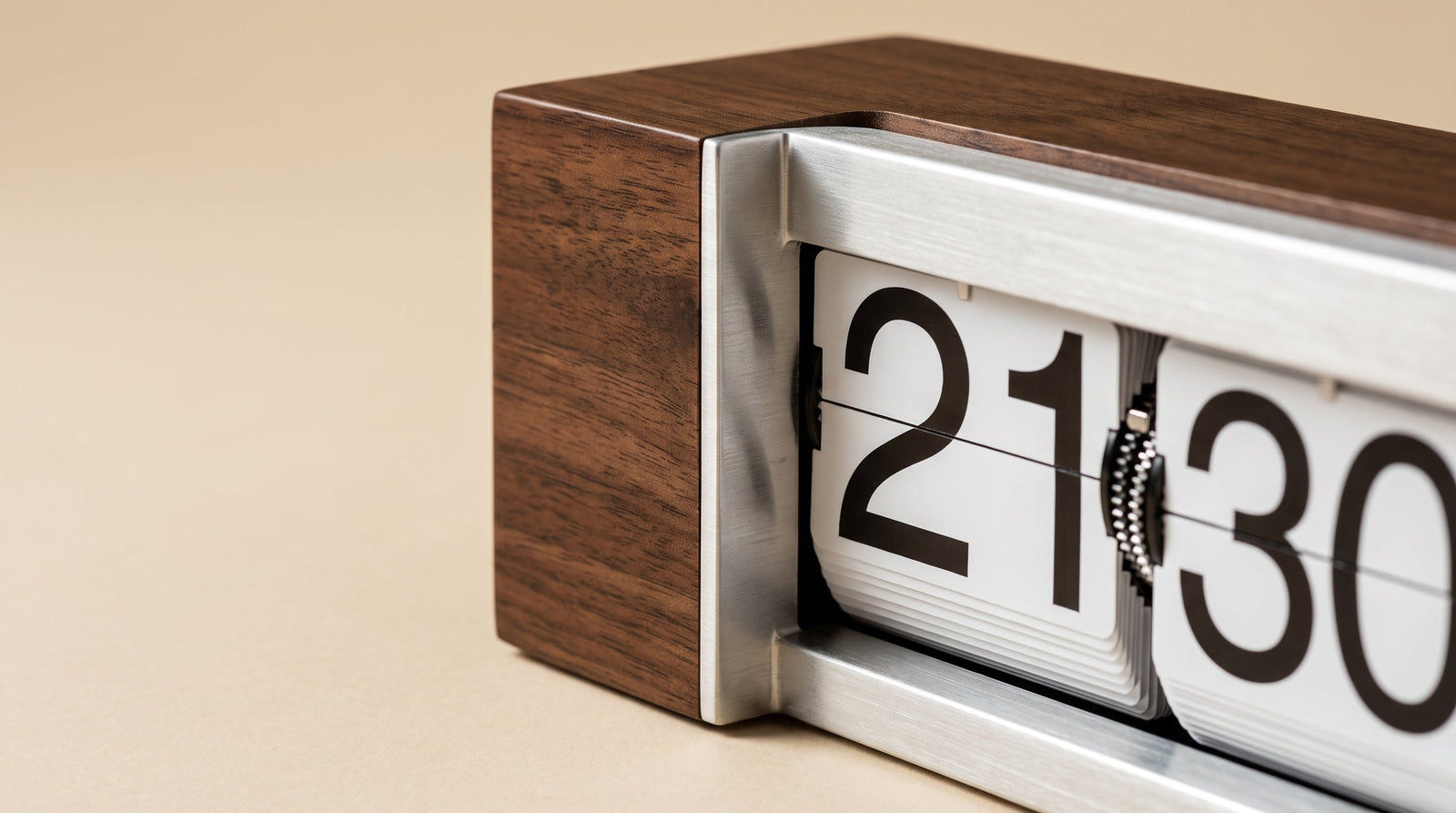
Table clocks under 100 euros are smaller than wall clocks and are often designed to also function as alarm clocks. In the bedroom, what counts most is: no disturbing light in the dark, a quiet or silent movement, and easy-to-read digits without having to get up. In the office, design aspects play a greater role. Table clocks with a retro character, for example with a flip-card display (flap digits), are rare in this price range, but they do exist.
A flip-card clock, which originally dates from the 1960s and 1970s, shows the time via mechanically changing plastic cards. The clockwork turns a mechanism that flips cards with printed digits forward sequentially. Modern versions of this design use a quartz movement as a drive and are significantly more reliable than earlier versions.

Brands in the entry-level segment: AMS, Atlanta, and Karlsson in data comparison
In the uhren4you range, three brands cover the majority of the entry-level large clock segment: AMS with 743 items, Karlsson with 708 items, and Atlanta with 418 items. All three are specialized large clock manufacturers, which means that their entire program is geared towards wall, table, and grandfather clocks.
AMS focuses on classic and modern wall clocks as well as table clocks, with a wide range from simple plastic models to more elaborately designed wood and metal housings. The range also includes pendulum and melody clocks that are over 100 euros.
Atlanta is strongly represented in the radio-controlled segment and offers radio-controlled wall clocks at comparatively low entry-level prices. The models combine manageable diameters with wood or plastic housings and are aimed at price-conscious buyers who do not want to do without automatic time setting.
Karlsson pursues a stronger design focus. Many models work with unusual dial layouts, reduced digits, or graphically emphasized hands. The housing is often made of metal or coated MDF. Anyone looking for a wall clock as a design element will find more choice at Karlsson than at purely functional brands.
| Brand | Assortment size | Strength | Typical material |
|---|---|---|---|
| AMS | 743 items | Wide selection, classic to modern | Plastic, wood, metal |
| Atlanta | 418 items | Radio-controlled clocks, price-performance | Wood, plastic |
| Karlsson | 708 items | Design, graphic dials | Metal, coated MDF |
Checklist: What to really look for when buying under 100 euros
- Check the second hand movement: A jumping second hand creates an audible tick. For bedrooms or conference rooms, look for "sweeping second hand" or "silent".
- Consider reception quality for radio-controlled clocks: Basements, buildings with reinforced concrete walls, or strong electrical appliances nearby can interfere with the DCF77 signal.
- Classify housing material: Solid wood and metal are more durable than plastic but heavier. When wall-mounting, pay attention to the weight and the mounting option.
- Diameter versus room size: A 25-cm clock looks lost in a large living room. As a rule of thumb: for rooms over 20 square meters, choose at least 35 cm in diameter.
- Note battery compartment and type: AA batteries are available everywhere, AAA and button cells less so. A model with an unusual battery format causes unnecessary effort later.
- Mounting for wall clocks: Some models have only one hanging eyelet, others two points for stable support. For heavy models (over 500 g), dowel mounting is worthwhile.
- Lighting for alarm clocks: Without background lighting or luminous hands, an analog alarm clock is hardly readable at night. This function is in the technical data and should be specifically looked for.


