


Men's Watches Under 100 Euros: What the Entry-Level Segment Really Offers
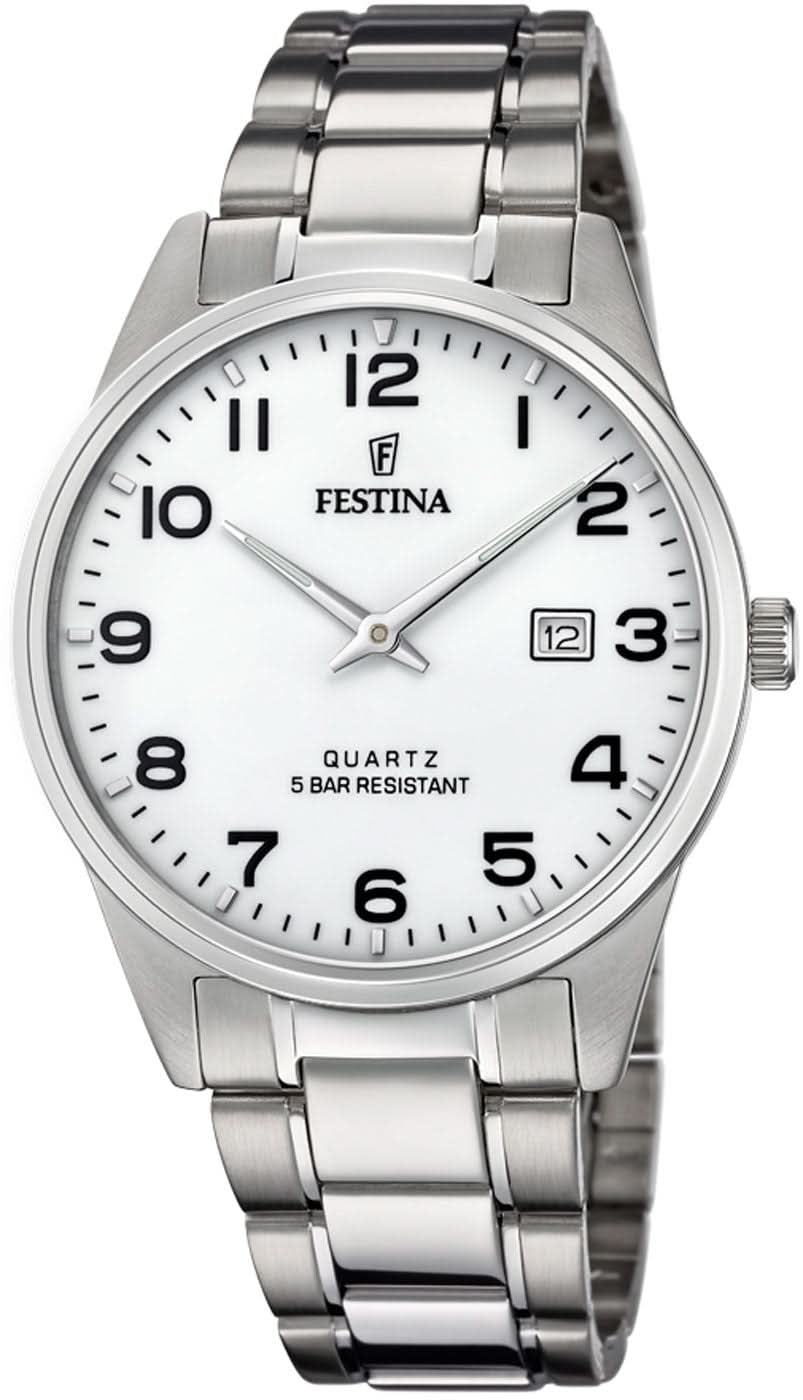

Anyone looking for a men's watch under 100 euros faces a question hidden behind the price: What am I really getting, and what do I have to do without? The price limits the choice of materials, but it does not rule out a functional watch. This article compares technical data from the range and explains what the entry-level segment can constructively achieve and where its limits lie.
The basis for this article is the product data from the uhren4you catalog. Over 4,600 wristwatches are priced under 100 euros, spread across more than 50 brands. Those who read the data sheets will find real differences between the models that can be used for the purchasing decision.
What is feasible under 100 euros: Technology, material, and realistic expectations
The entry-level segment is dominated by quartz movements. A quartz movement gets its timing from a quartz crystal that is made to vibrate by an electric current. The accuracy is typically plus/minus 15 to 30 seconds per month, which is perfectly sufficient for everyday life. Mechanical movements, i.e., automatic or manual wind, are rare in this price range and, if present, are often less precise than an inexpensive quartz.
Radio-controlled watches, which receive their time signal from long-wave transmitters such as the German DCF77, are also represented in the entry-level segment. They synchronize the time automatically and do not require manual correction as long as the reception is good. Under 100 euros, this is technically one of the most reliable options if accuracy is a priority.
What limits the budget: Sapphire crystal, titanium as a case material, and screw-down crowns are the first items to be cut below certain price thresholds. This does not mean that a watch under 100 euros is poorly made, but it does mean that compromises in scratch resistance and water resistance should be realistically planned for.

Case material and glass type in the entry-level segment: Understanding compromises
In the entry-level segment, you mainly encounter three materials for the case: stainless steel, coated brass, and plastic (often ABS or polycarbonate). Stainless steel is common even under 100 euros and offers a good combination of corrosion resistance and stability. Cases made of coated brass are cheaper to produce, but the coating can peel off with prolonged contact with sweat or water.
Glass types in comparison
Mineral glass is the standard in the entry-level segment. It is harder than plastic glass but softer than sapphire crystal and therefore more susceptible to scratches. A deep scratch cannot be polished out of mineral glass. Plastic glass, also called acrylic, is even softer but can be polished if there are light scratches. Sapphire crystal, which is common in the mid and upper price segments, rarely appears under 100 euros, and if it does, it is usually in watches at the upper end of this price range.
| Glass type | Scratch resistance | Repairable? | Typical price range |
|---|---|---|---|
| Plastic glass (acrylic) | Low | Yes, polishable | Under 50 euros |
| Mineral glass | Medium | No | Under 100 euros |
| Sapphire crystal | High | No | From approx. 150 euros upwards |
Stainless steel link bracelets and leather straps dominate the bracelet category. Both are durable enough for everyday use in the entry-level segment, but the clasps and folding clasps of simpler models often have fewer pressure points than more expensive versions.
Water resistance under 100 euros: Which protection classes are realistic
Water resistance is stated in bar and is not a promise of a diving depth, but a test value under laboratory conditions. A rating of 3 bar protects against occasional splashes, not against showering. 5 bar allows brief water contact when washing hands, but not swimming. Only from 10 bar is a watch suitable for water sports.
In the entry-level segment, 3 bar and 5 bar are the most common specifications. Models with 10 bar or more exist under 100 euros, but are rarer and often limited to more robust sports watches. Anyone buying a watch under 100 euros and wanting to wear it for sports or swimming should actively check the water resistance rating and not rely on the "sports watch" category.
Another point: The seal decreases with the age of the sealing rings. Without regular maintenance, even higher-rated watches lose their protection. This applies to all price ranges, but is particularly relevant in the entry-level segment because maintenance costs can quickly exceed the purchase price. The article explains more about the protection classes and their practical significance Water-resistant wristwatch: Which protection class is enough for what?.
Brands under 100 euros: Festina, Casio, Lorus, and Atlanta in data comparison
Four brands from the uhren4you range cover the entry-level segment particularly broadly. The following table compares their profiles based on product data:
| Brand | Strengths in the segment | Typical movements | Focus |
|---|---|---|---|
| Festina | Wide variety of models, stainless steel cases common | Quartz (various calibers) | Everyday, business-casual |
| Casio | Robustness, G-Shock line for sports | Quartz, partly solar | Sports, outdoor |
| Lorus | Good price-data ratio, Seiko Group | Quartz (Seiko caliber) | Everyday, entry-level |
| Atlanta | Radio-controlled and solar models in the lower price range | Radio, solar | Everyday, seniors |
Lorus belongs to the Seiko Group and uses Seiko calibers, which allows for a reliable classification of movement quality: these calibers are proven, and spare parts are available. With over 1,000 items in the range, Festina offers the largest selection, which means that almost every occasion and wrist circumference is covered. Casio scores primarily with the G-Shock line, whose models are built to military shock-resistance standards even under 100 euros. Atlanta focuses on ease of use and automatic synchronization via radio reception.

Typical use cases: Everyday, sports, first gift
Everyday watch
For daily use in the office and leisure time, a watch does not need any special additional functions. Here, readability, comfort, and a case diameter that fits the wrist count. Most men's wrists are well served in the 38-44 mm diameter range. A quartz movement keeps time without effort, and a stainless steel case with mineral glass is durable enough for this purpose.
Sports watch
Anyone wearing the watch for sports needs at least 10 bar water resistance if sweat and occasional water occur. Casio G-Shock models under 100 euros are a concrete option here because they combine shock resistance and higher water resistance. A rubber strap sits better during sports than leather or steel.
First gift
As a first gift, for example for confirmation or graduation, a watch under 100 euros makes sense because it encourages the habit of wearing watches without representing a high financial risk. Here, an appropriate appearance counts for more than technical equipment. In this price range, Festina and Lorus offer models that look like more expensive watches without copying their equipment. The article shows which watch fits which occasion Men's watch by occasion: Business, casual, sports, and dress in more detail.

What to really look for when buying: a step-by-step selection
The following process helps to narrow down the range in a targeted manner instead of choosing a watch for visual reasons that does not technically fit the intended use.
- Measure case diameter: Measure the wrist with a tape measure. Under 17 cm circumference, a watch over 42 mm in diameter often looks too large. From 19 cm circumference, a watch under 38 mm can look small.
- Determine drive type: Quartz for uncomplicated everyday life, radio-controlled for automatic time correction without changing the battery at the transmitter (the battery still needs changing), solar for fewer battery changes overall.
- Check water resistance rating: Do not read the "sports watch" category, but the bar value in the data sheet. Under 5 bar: no water. 5 bar: splash water. 10 bar and more: swimming possible.
- Note glass type: Mineral glass is the standard. Anyone who cannot accept a scratch-prone glass type must adjust the budget or the price class.
- Compare case material: Stainless steel is more durable in the entry-level segment than coated brass. Titanium, as is common with Boccia, is lighter and more skin-friendly, but rarer in the entry-level segment.
- Match bracelet to everyday life: Leather for business and occasions without water contact, steel or rubber for sports and outdoor.
- Check brand profile: Lorus and Citizen stand for solid movement origin. Festina for model variety. Casio for robustness. Atlanta for simple radio operation.


