


Police Watches Profile: Design, Movements, and Price Ranges

Anyone looking to buy Police watches will quickly come across a wide range of models that differ significantly at first glance: skeleton watches alongside chronographs, quartz alongside automatic, three-figure prices alongside four-figure ones. Which collection stands for what, which movement is found in which price range, and does Police even suit your personal style? This article answers these questions based on the technical specifications of the product range.
The comparison is based on datasheet specifications: movements, crystal types, case materials, and water resistance ratings from the catalog. Personal wearing experiences or test results are not included, as they are not available here. What this article provides is an objective classification of the brand and its models.
Police as a Brand: Origin, Positioning, and Brand Profile
Police was founded in Italy in 1983 and sees itself as a lifestyle brand that unites fashion, accessories, and watches under one roof. The name is not derived from the law enforcement agency, but rather stands as an independent brand name for a rebellious, urban style. Police belongs to the Safilo Group, one of the largest eyewear manufacturers in the world, which explains why sunglasses and wristwatches share the same brand image.
The positioning is clearly in the lifestyle segment: Police does not sell sports watches with highly engineered specification profiles, nor formal dress watches with a long watchmaking tradition. Instead, the brand stands for eye-catching designs that complement casual wear and convey a lifestyle. The price point is in the mid-range, roughly between 100 and 400 euros for the majority of the range, with individual models below and above this.
Collections at a glance: from sport to dress
Police organizes its product range into named collections, each with its own distinct design language. The most important ones in the current lineup:
Dayton
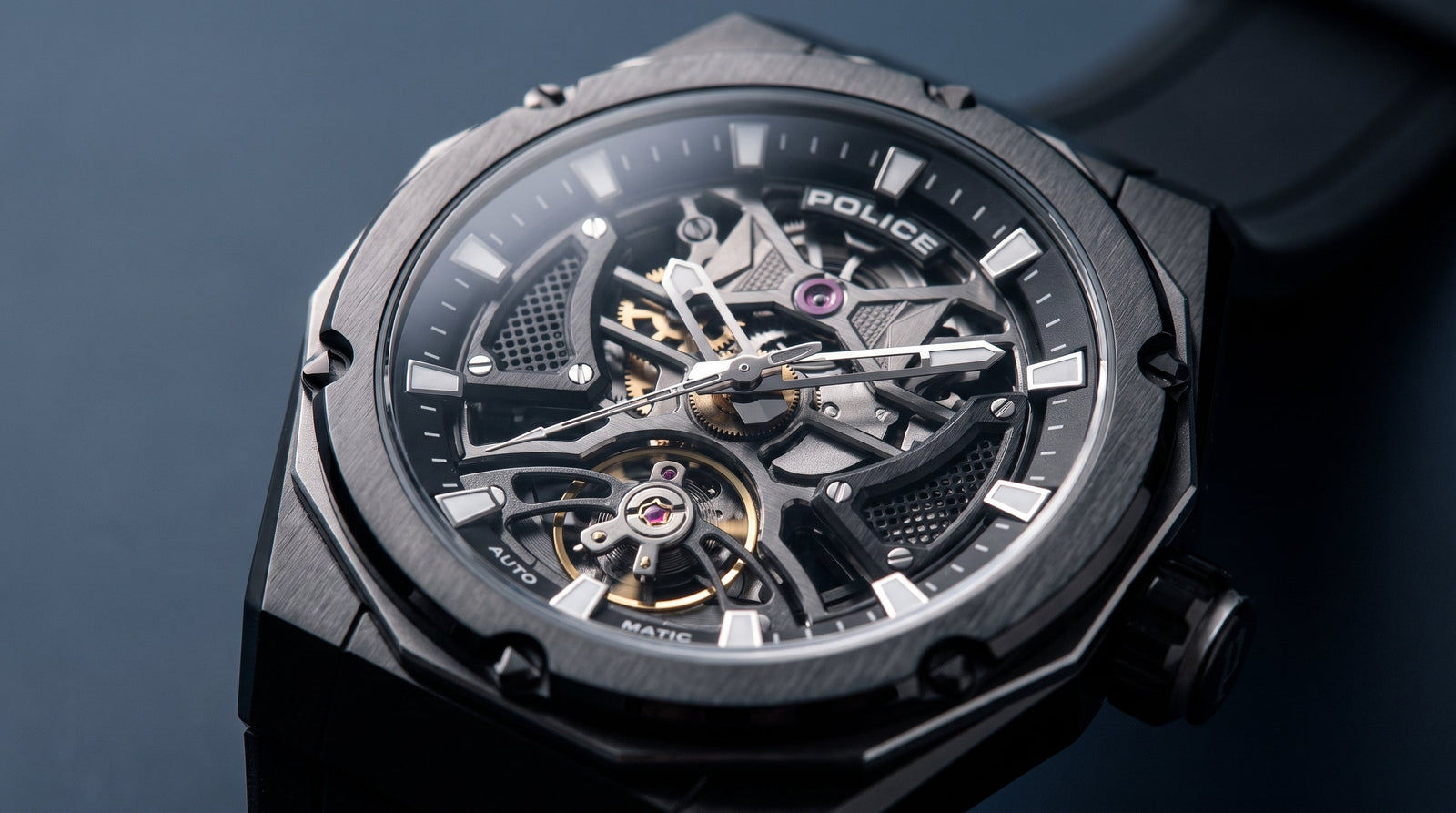
The Dayton collection is the most technically sophisticated line and partly features automatic movements. Skeletonized or semi-transparent dials make the movement visible. The case combines aluminum and stainless steel, giving the model an industrial, heavy look. The target group is wearers looking for a technical eye-catcher, not a classic dress look.

Moonstrike
Moonstrike stands for sporty quartz chronographs with large dials and bold color accents. The eye-catching design is aimed at wearers who view their watch as a visible accessory. Mineral glass comes as standard here.

Offset and Rotocrom
The Ofset line features a sporty, skeleton-style dial with luminous hands. The Rotocrom collection goes a step further, combining an analog dial with a digital display element on a second dial area. This approach, known as mechatronics, means a quartz movement powers both displays—one showing hands, the other a digital screen.

Movements and calibers: what Police uses in which price range
A movement is the entire drive unit of a watch. A caliber is the designation of the specific movement type. Police does not always publicly highlight caliber designations, but conclusions can be drawn from the data sheets.
Quartz-based
The majority of the Police range runs on quartz movements. Quartz means: a quartz crystal keeps the time, and a battery provides the energy. Accuracy is typically around plus/minus 15 to 30 seconds per month, depending on the caliber. Police sources quartz movements from Asian and European suppliers, but rarely names the manufacturers explicitly. In the price range under 200 euros, standardized quartz calibers are common, which run reliably but do not offer any special features.
Mechatronics
The Rotocrom collection utilizes a mechatronic movement: this is a quartz drive unit that controls both hands and a digital display. The term describes the combination of mechanics (hands) and electronics (display) within a quartz system. This solution is structurally more complex than a pure quartz three-hand movement, but remains a quartz movement in terms of precision.
Automatic in the Dayton line
The Dayton models with automatic movements represent the highest technical category in the Police range. An automatic movement stores energy via a mainspring, which is wound by the wearer's movement. It runs without a battery but is slightly less accurate than quartz: deviations of a few seconds per day are normal. Police does not highlight a specific caliber designation for the Dayton automatic. The aluminum and stainless steel case with skeletonized dials makes the movement visible, visually justifying the added value compared to a quartz model.
| Type of work | Sample Collection | Accuracy | Special feature |
|---|---|---|---|
| Quartz (Standard) | Moonstrike, Ofset | ±15-30 s/month | Battery-operated, low-maintenance |
| Mechatronics (Quartz) | Rotocrom | ±15-30 s/month | Analog hands + digital display |
| Automatic | Dayton | ±5-15 s/day | Self-winding, no battery replacement |
If you would like to learn more about the differences between quartz and automatic movements, you can find a detailed explanation in the Watch Movement Glossary.
Case sizes, glass types, and water resistance in the product range
Case sizes
Police men's watches are consistently on the larger side. The Ofset model in the range has a case diameter of 45 mm, which is considered a very large size. Values between 43 and 48 mm are typical for Police, while smaller sizes are rare. Anyone with a wrist circumference of less than 17 cm should check the case size before buying: watches from 45 mm upwards can look oversized.
Glass types
Mineral glass is the standard solution in the Police range. Mineral glass is hardened glass that is more scratch-resistant than ordinary glass, but it can break in the event of drops or heavy impacts. Sapphire crystal, which is significantly more scratch-resistant and only breaks under very high pressure, is not represented in the analyzed Police range. This is in line with the price segment: sapphire crystal typically appears in wristwatches from around 300 to 400 euros, and even then, not across the board.
Waterproof
Water resistance is specified in bar. One bar corresponds approximately to the pressure at a water depth of ten meters, but is not a guarantee for actual diving: the test is static, not dynamic. The following guidelines are standard for Police models: 3 bar means splash protection for rain or brief rinsing. 5 bar allows for brief immersion, such as washing hands, but no swimming. 10 bar is suitable for swimming and snorkeling, but not scuba diving.
| Waterproof | suitability for everyday use | Not suitable for |
|---|---|---|
| 3 bar | Rain, splashes | Swimming, showering |
| 5 bar | Hand wash, brief immersion | Swimming pool, water sports |
| 10 bar | Swimming, snorkeling | Scuba diving |
Price ranges and what accounts for the differences within the brand
The Police range at uhren4you.de spans from around 100 euros to just over 400 euros. What justifies the price difference within the same brand?
In the lower price range, i.e. under 150 euros, you will find simple three-hand quartz watches without any special complications. The case is made of stainless steel, the crystal is mineral, and the design follows current trend colors. This is perfectly sufficient for a solid everyday companion.
In the mid-range between 150 and 250 euros, chronograph functions are introduced, meaning stopwatch sub-dials with pushers on the side of the case. The mechatronic models with dual dials also fall into this price bracket. More functionality and more intricate dial designs justify the higher price.
From 250 euros and up, automatic movements make an appearance. The Dayton line with automatic movement sits at the upper end of the Police spectrum. Here, you pay for the movement itself as well as the case material: aluminum in combination with stainless steel is more complex to process than pure stainless steel. The skeletonized dial requires additional manufacturing steps.

If you want to compare Police models with other brands in the same price range, you can find them in the article Men's watches under 200 euros an overview of the mid-range price segment.
Who Police is right for and who it isn't for
Police is perfect for wearers who view their watch as a visible accessory and value eye-catching design. Large cases, striking dials, and bold colors are the hallmarks of the collection. Anyone looking for a watch that remains understated in formal situations or complements a classic suit will generally not find it with Police. The designs are tailored for leisure, urban everyday wear, and occasions where style is meant to be showcased, not held back.
Police is not a good fit for wearers looking for a watch with a long watchmaking tradition, expecting technical certifications such as chronometer ratings or COSC certificates, or insisting on sapphire crystal for scratch resistance. The brand delivers lifestyle, not classic watchmaking craftsmanship.
Police is also not the first choice for active outdoor sports with high demands on shock resistance or water resistance. Anyone looking for a robust sports watch for extreme conditions will find these requirements better met by brands that are specifically designed for such usage profiles. A comparison of this can be found in the article on Men's watches by occasion.
| Profile | Suitable for police? | Reason |
|---|---|---|
| Lifestyle, Urban, Leisure | Ja | Core brand positioning |
| Business, formal suit | Conditional | Few subtle models, mostly large cases |
| Outdoor, extreme sports | No | Not designed for extreme demands |
| Classic watchmaking tradition | No | Lifestyle brand without watchmaking heritage |
| Automatic entry with viewing mechanism | Ja | Dayton line in the mid four-figure price range |


