


Seiko Calibers in Detail: NH35, NH36, 4R, and 6R Data Comparison

Anyone buying an automatic watch with a Seiko movement will sooner or later encounter a series of caliber designations that sound similar at first glance: NH35, NH36, 4R35, 4R36, 6R15, 6R35. However, the difference between these movements is not cosmetic, but functional. Whether you need manual winding, expect higher accuracy, or simply want to understand why the same basic Seiko concept appears in so many price segments, this comparison is based on manufacturer data.
This article compares the most common Seiko automatic calibers based on their technical data: oscillation frequency, power reserve, hacking function (second hand stops when the crown is pulled out for precise setting), and manual winding. It also classifies which watches in the range actually feature these movements.
Why Seiko calibers are used so often: Origin and reputation
Seiko manufactures its automatic calibers in-house. The supplier is called Seiko Instruments Inc. (SII) and supplies not only its own Seiko models but also numerous other watch brands worldwide. The NH35, for example, is one of the most widely used automatic calibers of all, far beyond the brand itself.
The reason for this lies in the combination of reliable technology, cost-effective production, and broad availability of spare parts. SII produces these movements in very high quantities. Repairs and overhauls are therefore possible in almost every watchmaker's workshop. This is a practical advantage that is not in any data sheet, but plays a role in a watch you want to wear for years.
Since Seiko showed with the Astron caliber 5X83 in 2026 that the brand is actively developing its movement expertise (read more on the Seiko brand website), interest in the entire caliber family has grown. The calibers described below form the broader base.
NH35 and NH35A: the most used base movement with data
The NH35 is the standard caliber of the Seiko NH line. It operates at 21,600 vibrations per hour (3 Hz) and provides a power reserve of around 41 hours. The second hand can be stopped by pulling out the crown, which makes it easier to set the time to the minute. Manual winding via the crown is not provided for the NH35.
The NH35A is the revision of the NH35 with slightly revised tolerances for individual components, but it is functionally identical. The differences are imperceptible to the wearer. In practice, NH35 and NH35A are often used synonymously, even in product descriptions.
Technical data NH35 / NH35A
| Feature | Value |
|---|---|
| Frequency | 21,600 vph (3 Hz) |
| Power reserve | approx. 41 hours |
| Hacking | Yes |
| Manual winding | No |
| Date display | Yes (no day display) |
| Jewel count | 24 |

NH36 and NH36A: Date display and differences to the NH35
The NH36 is based on the same base movement as the NH35, but adds an additional display: the day of the week. Instead of just the date window, the NH36 shows the date and day of the week, usually in two separate windows on the dial. Frequency, power reserve, and hacking function are identical to the NH35. There is also no manual winding with the NH36.
The NH36A is again the revised version with the same small production adjustments as the NH35A. For daily use, there is no difference. The choice between NH35 and NH36 depends solely on whether you want the day-of-the-week display or not.


4R35 and 4R36: Manual winding as a difference to the NH
The 4R calibers are the next step in the Seiko hierarchy below the 6R line. On a technical level, the most important difference to the NH movements is manual winding: The 4R35 and 4R36 can be wound manually via the crown, which is not possible with the NH calibers.
The 4R35 shows the date and day of the week, as does the 4R36. Both have a power reserve of around 41 hours and operate at 21,600 vph, identical to the NH calibers. Hacking is available. The practical advantage of manual winding: If you want to put the watch back on after a break, you can wind it completely without having to wear it for minutes first.
Technical data 4R35 / 4R36
| Feature | Value |
|---|---|
| Frequency | 21,600 vph (3 Hz) |
| Power reserve | approx. 41 hours |
| Hacking | Yes |
| Manual winding | Yes |
| Date display | Yes (+ day of the week) |
| Jewel count | 24 |


6R15 and 6R35: higher accuracy in the mid-range
The 6R calibers are the movements with the highest level of development within the general Seiko line (below Grand Seiko). The 6R15 operates at 21,600 vph, but has a significantly longer power reserve of around 50 hours. Hacking and manual winding are both available.
The 6R35 is a newer variant with an extended power reserve of around 70 hours. It also has 21,600 vph, hacking, and manual winding. The manufacturer's specification for accuracy is -15 to +15 seconds per day, which is a good benchmark for an automatic movement in the mid-price segment. For comparison: with NH and 4R calibers, the official tolerances are wider.
Anyone buying an automatic watch and valuing a longer power reserve and tighter manufacturing tolerances is better served with a 6R caliber than with an NH35 or 4R36. This is usually reflected in the price of the watch.
Technical data 6R15 / 6R35
| Feature | 6R15 | 6R35 |
|---|---|---|
| Frequency | 21,600 vph | 21,600 vph |
| Power reserve | approx. 50 hours | approx. 70 hours |
| Hacking | Yes | Yes |
| Manual winding | Yes | Yes |
| Accuracy (manufacturer specification) | -15 to +15 s/day | -15 to +15 s/day |
| Date display | Yes (+ day of the week) | Yes |
Caliber comparison table: power reserve, frequency, hacking, and manual winding
The following table summarizes all mentioned calibers at a glance. It makes clear where the actual differences lie and which caliber makes more sense for which application.
| Caliber | Frequency | Power reserve | Hacking | Manual winding | Date display | Day of the week |
|---|---|---|---|---|---|---|
| NH35 / NH35A | 21,600 vph | approx. 41 h | Yes | No | Yes | No |
| NH36 / NH36A | 21,600 vph | approx. 41 h | Yes | No | Yes | Yes |
| 4R35 | 21,600 vph | approx. 41 h | Yes | Yes | Yes | Yes |
| 4R36 | 21,600 vph | approx. 41 h | Yes | Yes | Yes | Yes |
| 6R15 | 21,600 vph | approx. 50 h | Yes | Yes | Yes | Yes |
| 6R35 | 21,600 vph | approx. 70 h | Yes | Yes | Yes | Yes (per model) |
A note on classification: All mentioned calibers have the same oscillation frequency of 21,600 vph. This means the second hand moves in steps of one-sixth of a second. Higher-frequency movements such as 28,800 vph (8 vibrations per second) move the hand more smoothly, but do not occur in this caliber family. If this is a criterion for you, you have to choose other movements, such as the Seiko caliber 6R31 or models from other manufacturers.
If you want to know more about the comparison with other brand movements, you will find a broader overview in the article Automatic calibers at a glance: Miyota, Seiko NH and Sellita.
Which watches in the range contain these movements
In the uhren4you range, Seiko automatic watches with 4R36 are particularly well represented, especially in the Seiko 5 Sports line. These models are in the mid-three-digit range and cover various designs: field-watch look, diver watch homages, and more compact everyday models.
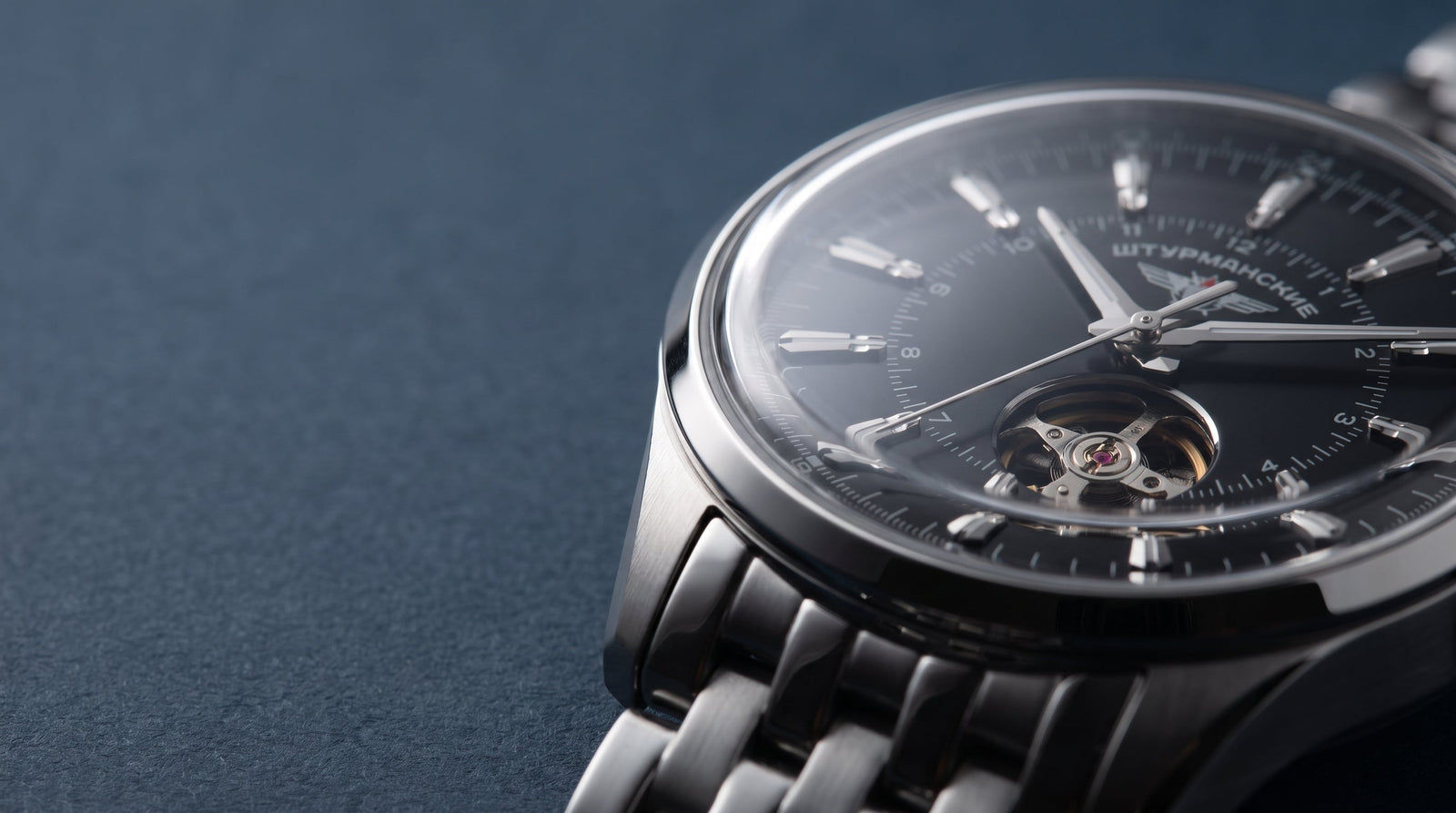
The NH35 and NH36 are found not only in Seiko's own models but also in other brands in the range that install SII movements. A concrete example: The Sturmanskie Open Space models work with the NH36A and combine the Seiko movement with Russian design heritage. The Vostok Europe Rocket N1 relies on the NH35.


The 6R15 and 6R35 appear in more expensive Seiko lines, such as the Presage series. In the range, these calibers are found less frequently than the 4R36, but in models with a more sophisticated dial design and often a better glass type (sapphire crystal instead of mineral glass). A good overview of the entire model hierarchy is provided by the article Classifying Seiko watches: model series, movements, and price ranges.


