


Table clock for the bedroom: light, volume, and size
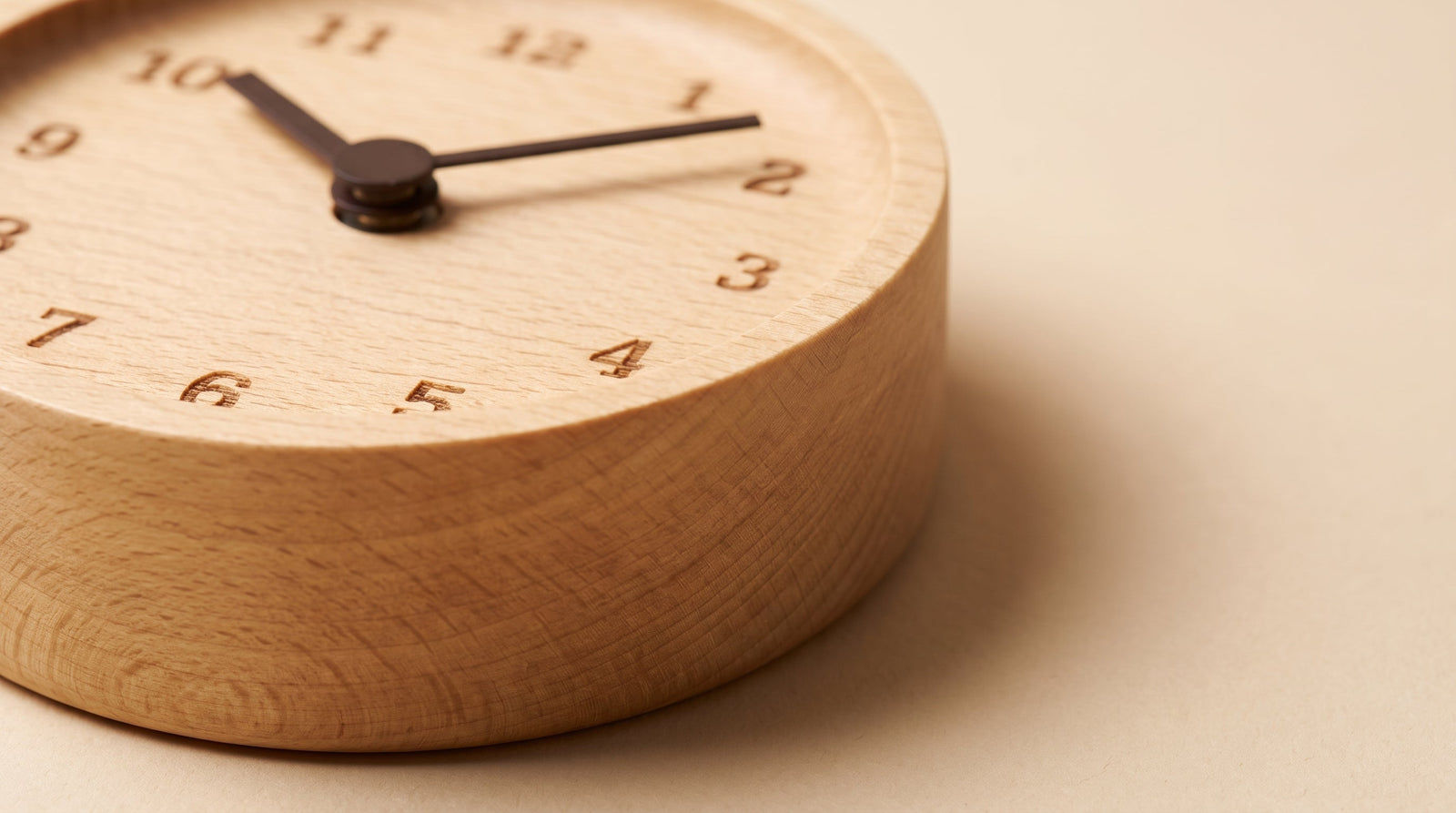

A table clock in the bedroom sounds like a simple thing, until you hear the ticking at three in the morning, cannot read the dial in the dark, or find that the clock takes up too much space on the nightstand. The requirements a bedroom places on a clock differ significantly from those in a living room or office: it is about quietness, quick readability in low-light conditions, and a format that works on a small footprint.
This article compares the technical characteristics of available table clocks based on their product data and assesses which combination of movement, lighting, and case size makes sense for the bedroom. The end result is a clear decision-making aid, not a ranking.
What a table clock for the bedroom must provide: light, noise, readability
Three criteria are decisive in the bedroom, and they are sometimes in conflict with one another:
- Noise-free operation: Any mechanical noise that goes unnoticed in the living room is perceptible in the silence of the bedroom. A classic movement with an audible tick-tock rhythm can disturb sleep, especially for light sleepers.
- Readability: The time must be recognizable without getting up and without turning on the light. This means either sufficiently large digits or a dedicated light source.
- Footprint: Nightstands are usually narrow. A clock with a base width of over 15 cm competes with a glass, book, and phone.
These three requirements determine which type of movement, display form, and case size are suitable.
Silent quartz movement vs. pendulum movement: what is truly quiet
The term "silent" is used differently for clocks, so it is worth taking a closer look at the types of movements.
Classic quartz movement with stepper motor
The most common quartz movement moves the second hand in individual steps: one pulse per second. This creates the typical ticking sound. This noise is quiet, but clearly audible in silence and at close range. For light sleepers in the bedroom, it can be annoying.
Sweep quartz movement (sweeping second hand)
With a so-called sweep movement, the second hand moves continuously, without individual steps. The movement rotates smoothly through several pulses per second. The result is not a tick, but a barely perceptible glide. Most table clocks advertised as "silent" or "noise-free" use this principle. There is no standardized limit at which a clock is considered "silent"; in practice, sweep movements are significantly more pleasant in the bedroom than stepper movements.
Pendulum movement
Table clocks with a pendulum movement are not suitable for the bedroom. The pendulum strikes audibly, often accompanied by a chime or hourly strike. This feature is desirable in the living room or office, but counterproductive in the bedroom.
Radio-controlled quartz movement
Radio-controlled movements receive a time signal (the DCF77 signal in Central Europe) and set themselves to the exact time. The movement itself is a quartz movement and can also be built as a sweep variant. The decisive advantage for the bedroom lies not in the noise, but in the precision: the clock always shows the correct time and corrects itself automatically after the time change.
| Movement type | Noise | Accuracy | Bedroom suitability |
|---|---|---|---|
| Quartz with stepper motor | Audible tick-tock | Good (±15 s/month) | Conditional |
| Quartz with sweep | Barely perceptible | Good (±15 s/month) | Good |
| Radio-controlled quartz | Depends on design | Very high (time signal) | Good, if sweep |
| Pendulum movement | Audible, often strikes | Variable | Not suitable |


Lighting and display: when light helps and when it disturbs
In the bedroom, two needs diverge: at night, the clock should be readable, but without constantly producing light that affects sleep. This is where analog and digital table clocks differ fundamentally.
Analog table clocks without built-in lighting
An analog table clock without lighting is not readable in the dark unless the hands or digits are coated with luminous paint. Luminous paint absorbs light during the day and emits it weakly for a few hours. The readability quality decreases over the course of the night. Those who need reliable readability in the second half of the night are less well served by this solution.
Digital table clocks with display
Digital clocks show the time on an illuminated display, often with brightness control or an automatic dimming function. A permanently illuminated display in a dark room can be disturbing, especially if the brightness cannot be dimmed sufficiently. Clocks with a sensor dimmer that react to ambient brightness are therefore better suited for the bedroom than those with fixed display brightness.
Lighting button on demand
Some alarm clocks and table clocks have a lighting button: the display or the dial only lights up when you press it. This is a good compromise because no constant light is produced during normal operation. The disadvantage: you have to feel for the clock and press it before you can read the time.


| Display type | Readability in the dark | Light pollution | Recommendation |
|---|---|---|---|
| Analog without lighting | Poor | None | Only with luminous hands |
| Analog with luminous hands | Moderate (fading) | None | Acceptable |
| Digital with constant display | Very good | High if brightness is strong | Only with dimmer |
| Digital with push button | Good (on demand) | None during operation | Good compromise |
Case size and footprint on the nightstand
Nightstands vary greatly in depth, but are often between 30 and 45 cm. The clock shares the space with other objects. For the nightstand, table clocks with a base width of up to about 15 cm and a height that allows reading while lying down—i.e., not under 8 cm and not over 20 cm—are recommended.
Compact table clocks with a diameter of under 12 cm can be easily placed on narrow surfaces. The footprint is also important: a round or spherical clock takes up less depth than a rectangular case of the same front width.


Anyone who has little space on the nightstand but values a radio-controlled clock should also pay attention to the depth of the base. The Buying guide for radio-controlled alarm clocks for the bedroom explains which functions are particularly useful for radio-controlled clocks and where DCF77 reception reaches its limits.
Difference between table clock and alarm clock: dual function or separation makes sense
Table clocks and alarm clocks are related but not identical product categories. For the bedroom, the question arises whether a clock with an alarm function should serve both purposes or if a pure table clock is the better choice.
Table clock without alarm function
A pure table clock shows the time and nothing else. In the bedroom, this makes sense if the alarm is already set via a smartphone or a separate device. The advantage: the case can be smaller and simpler because no controls for alarm and snooze are necessary. The risk is that there is no alarm clock available in the event of a power failure or a dead phone battery.
Table clock with alarm function (table alarm clock)
A table alarm clock combines time display and alarm function in one case. For the bedroom, it is crucial whether the alarm tone works as a gentle increase or an abrupt loud signal. Another criterion is the snooze function: many table alarm clocks allow for a short extra sleep with automatic repetition. When buying, it is worth checking the volume of the alarm tone if information is available in the data sheet.
When separation makes sense
If you value a decorative or purely analog table clock, the alarm function often does not match the design. In this case, separation is pragmatic: a simple table clock on the nightstand, a separate alarm clock or the smartphone for the alarm.
| Variant | Advantages | Disadvantages |
|---|---|---|
| Pure table clock | Simple design, more compact | No alarm |
| Table alarm clock | Everything in one device | More controls, larger |
| Table clock + smartphone | Best design freedom | Two devices on the nightstand |


A broader overview of table clocks and their various areas of application is provided by the article Practical table clocks as underestimated everyday helpers, which also categorizes models for the living room and office.
Checklist: Choosing a table clock for the bedroom
- Movement with sweep mechanism or designated as "silent", no stepper motor.
- Case width and base depth fit on the existing nightstand.
- Digits or hands are readable from 1-2 meters away while lying down.
- Lighting either on demand or with adjustable brightness, no constant light with high intensity.
- Battery operation preferred, as no power outlet is needed on the nightstand.
- If alarm function is desired: check snooze function and alarm tone type.
- Radio-controlled movement for automatic time correction after summer and winter time.


